## Diagram: Synergized Model Architecture
### Overview
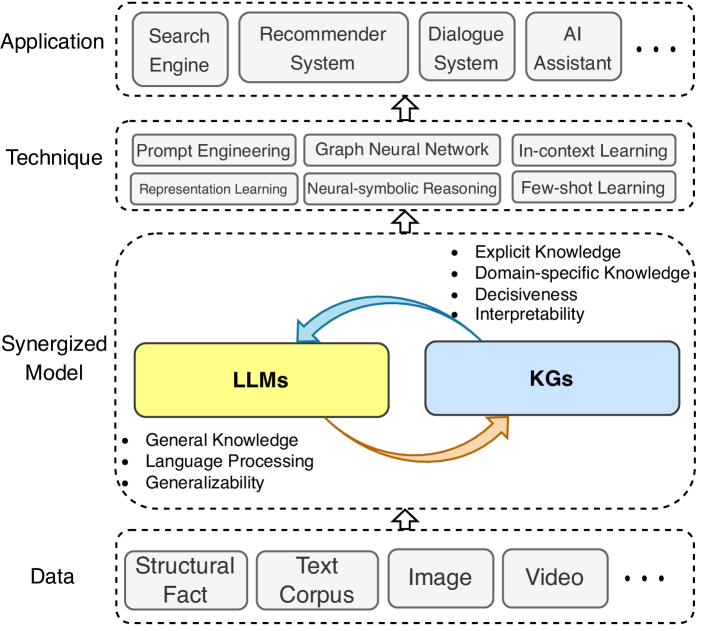
The image presents a layered diagram illustrating a synergized model architecture, showcasing the interplay between different components such as data, techniques, and applications. The core of the diagram focuses on the interaction between Large Language Models (LLMs) and Knowledge Graphs (KGs).
### Components/Axes
* **Layers (from bottom to top):**
* Data
* Synergized Model
* Technique
* Application
* **Data Layer:** Contains data types used as input.
* Structural Fact
* Text Corpus
* Image
* Video
* "..." indicating more data types
* **Synergized Model Layer:** Depicts the interaction between LLMs and KGs.
* LLMs (yellow rectangle): Associated with General Knowledge, Language Processing, and Generalizability.
* KGs (light blue rectangle): Associated with Explicit Knowledge, Domain-specific Knowledge, Decisiveness, and Interpretability.
* A blue arrow points from LLMs to KGs.
* An orange arrow points from KGs to LLMs.
* **Technique Layer:** Lists techniques used in the model.
* Prompt Engineering
* Graph Neural Network
* In-context Learning
* Representation Learning
* Neural-symbolic Reasoning
* Few-shot Learning
* **Application Layer:** Lists applications of the model.
* Search Engine
* Recommender System
* Dialogue System
* AI Assistant
* "..." indicating more applications
### Detailed Analysis
* **Data Layer:** The data layer forms the foundation, providing various data types to the model.
* **Synergized Model Layer:** LLMs and KGs are central, with arrows indicating a bidirectional flow of information. LLMs provide general knowledge and language processing capabilities, while KGs offer explicit and domain-specific knowledge.
* **Technique Layer:** The techniques listed are used to train and optimize the model.
* **Application Layer:** The applications demonstrate the potential use cases of the synergized model.
### Key Observations
* The diagram emphasizes the synergy between LLMs and KGs, suggesting a collaborative relationship.
* The layered structure highlights the flow of information from data to applications.
* The "..." in the Data and Application layers indicate that the listed components are not exhaustive.
### Interpretation
The diagram illustrates a comprehensive architecture where LLMs and KGs are integrated to leverage their respective strengths. LLMs bring general knowledge and language processing, while KGs provide structured, domain-specific information. This synergy enhances the model's capabilities, leading to improved performance in various applications. The bidirectional flow between LLMs and KGs suggests an iterative process where each component refines the other's knowledge. The architecture aims to combine the broad understanding of LLMs with the precise knowledge representation of KGs, resulting in a more robust and versatile model.