\n
## Diagram: Earth's Orbit and Zodiac Constellations
### Overview
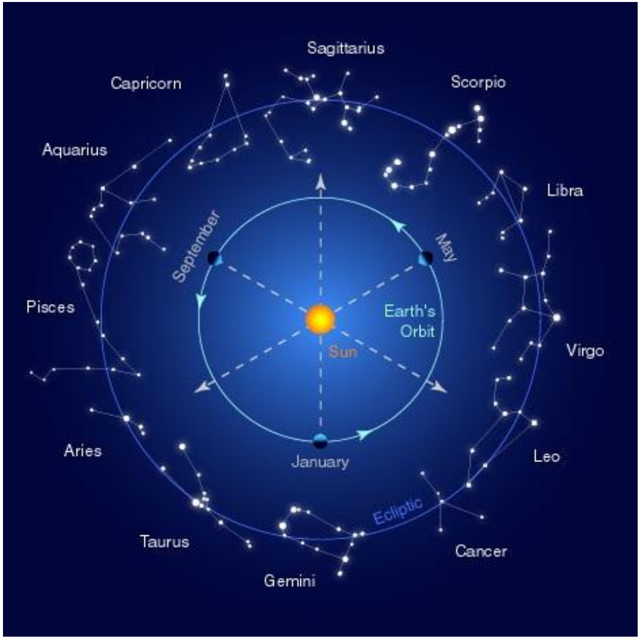
The image is a diagram illustrating the Earth's orbit around the Sun, overlaid with the twelve zodiac constellations. It depicts the Sun at the center and the Earth's orbital path, with markers indicating the positions of Earth in January, May, and September. The constellations are positioned around the orbit, representing their apparent location in the sky at different times of the year.
### Components/Axes
* **Central Element:** A bright yellow circle labeled "Sun".
* **Orbital Path:** A light blue circular path labeled "Earth's Orbit".
* **Earth Positions:** Three black circles representing Earth's position at different times of the year, labeled "January", "May", and "September". These are positioned along the orbital path.
* **Constellations:** Twelve constellations are depicted around the orbit, labeled as follows:
* Capricorn
* Aquarius
* Pisces
* Aries
* Taurus
* Gemini
* Cancer
* Leo
* Virgo
* Libra
* Scorpio
* Sagittarius
* **Ecliptic:** A curved line labeled "Ecliptic" is shown near the bottom of the diagram.
* **Arrows:** White arrows indicate the direction of Earth's orbit.
### Detailed Analysis or Content Details
The diagram shows the Earth orbiting the Sun in a counter-clockwise direction (as viewed from above). The positions of Earth in January, May, and September are approximately 120 degrees apart.
* **January:** Earth is positioned near the constellation Capricorn.
* **May:** Earth is positioned near the constellation Taurus.
* **September:** Earth is positioned near the constellation Libra.
The constellations are arranged in their traditional zodiacal order around the orbit. The "Ecliptic" line appears to represent the apparent path of the Sun across the sky throughout the year, as seen from Earth.
### Key Observations
The diagram visually represents the relationship between Earth's orbit and the apparent positions of the constellations. It demonstrates how the Earth's movement around the Sun causes us to see different constellations at different times of the year. The diagram is a simplified representation, as the actual orbits are elliptical and the constellations are not uniformly spaced along the ecliptic.
### Interpretation
This diagram is a visual aid for understanding the basic principles of astronomy and the zodiac. It illustrates how the Earth's annual orbit around the Sun creates the illusion that the Sun is moving through the constellations of the zodiac. The positions of Earth at January, May, and September provide a snapshot of the Earth's location relative to the constellations at those times. The diagram is a conceptual model, and does not represent the precise astronomical positions of the Earth and constellations. The diagram is a simplified representation of a complex system, but it effectively conveys the fundamental relationship between Earth's orbit, the Sun, and the zodiac constellations. The diagram does not contain any numerical data, but rather serves as a qualitative illustration of astronomical concepts.