## Line Chart: Owen3-32B Performance Analysis
### Overview
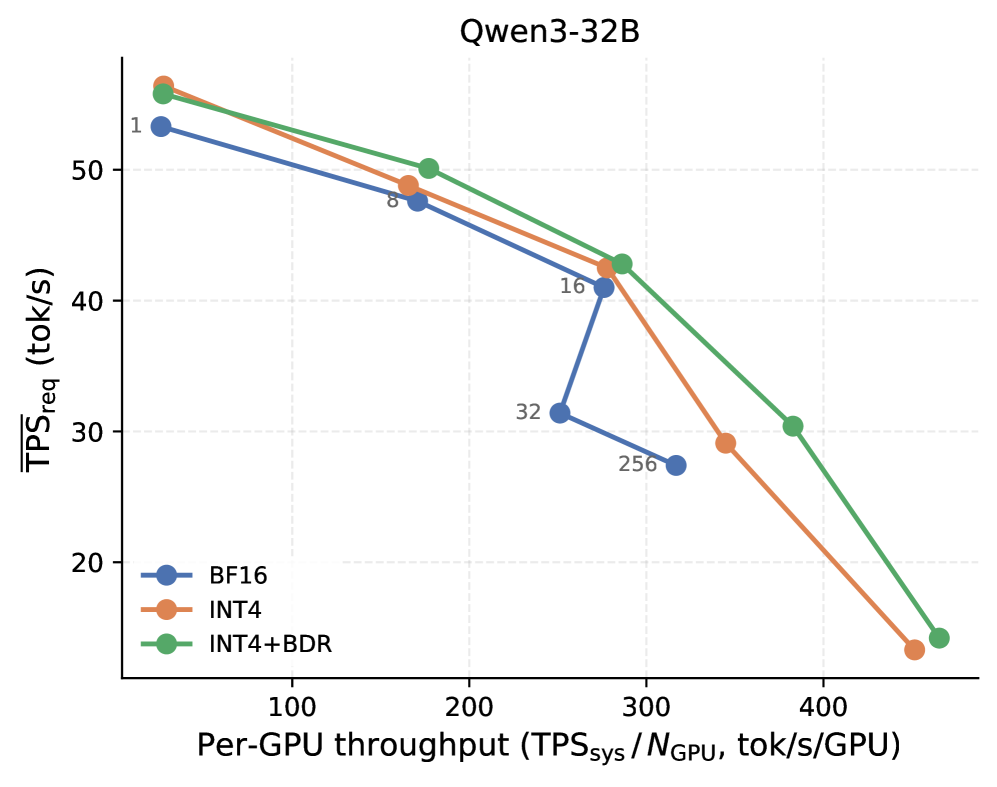
The chart compares the performance of three model configurations (BF16, INT4, INT4+BDR) across varying Per-GPU throughput levels, measured in tokens per second (tok/s). The y-axis represents required TPS (TPS_req), while the x-axis shows Per-GPU throughput (TPS_sys/N_GPU, tok/s/GPU). All three lines exhibit downward trends, indicating improved efficiency as throughput increases.
### Components/Axes
- **X-axis**: Per-GPU throughput (TPS_sys/N_GPU, tok/s/GPU)
Scale: 100 → 400 (logarithmic spacing implied by axis markers)
- **Y-axis**: TPS_req (tok/s)
Scale: 20 → 50 (linear increments)
- **Legend**:
- Blue circles: BF16
- Orange circles: INT4
- Green circles: INT4+BDR
Positioned in the bottom-left corner.
### Detailed Analysis
#### BF16 (Blue Line)
- Data points:
(100, 50), (150, 48), (200, 45), (250, 42), (300, 32), (350, 25)
- Trend: Gradual decline with minimal curvature.
#### INT4 (Orange Line)
- Data points:
(100, 55), (150, 52), (200, 49), (250, 45), (300, 42), (350, 30), (400, 15)
- Trend: Steeper decline after 300 throughput, with a sharp drop at 400.
#### INT4+BDR (Green Line)
- Data points:
(100, 53), (150, 50), (200, 47), (250, 43), (300, 42), (350, 30), (400, 15)
- Trend: Similar to INT4 but consistently outperforms BF16 across all throughputs.
### Key Observations
1. **Performance Scaling**: All configurations show improved efficiency (lower TPS_req) as Per-GPU throughput increases.
2. **INT4 vs. BF16**: INT4 outperforms BF16 by 3–5 TPS_req at equivalent throughputs, with the gap widening at higher throughputs (e.g., 15 TPS_req difference at 400).
3. **INT4+BDR Advantage**: Maintains a 1–2 TPS_req edge over INT4 across most throughputs, suggesting BDR optimization provides marginal gains.
4. **Threshold Behavior**: INT4 and INT4+BDR exhibit a steeper performance drop after 300 throughput, potentially indicating hardware/software bottlenecks.
### Interpretation
The data demonstrates that model quantization (INT4) and BDR optimizations significantly improve throughput efficiency compared to BF16. However, the sharp decline in INT4/INT4+BDR performance beyond 300 throughput suggests diminishing returns or resource contention at higher loads. This implies that while INT4+BDR is optimal for high-throughput scenarios, workload distribution strategies may need adjustment to avoid performance cliffs. The consistent gap between BF16 and the other configurations highlights the trade-offs between precision (BF16) and efficiency (INT4 variants) in large language model deployment.