## Line Graph: EDEN-biased Benefit over TurboQuant-MSE
### Overview
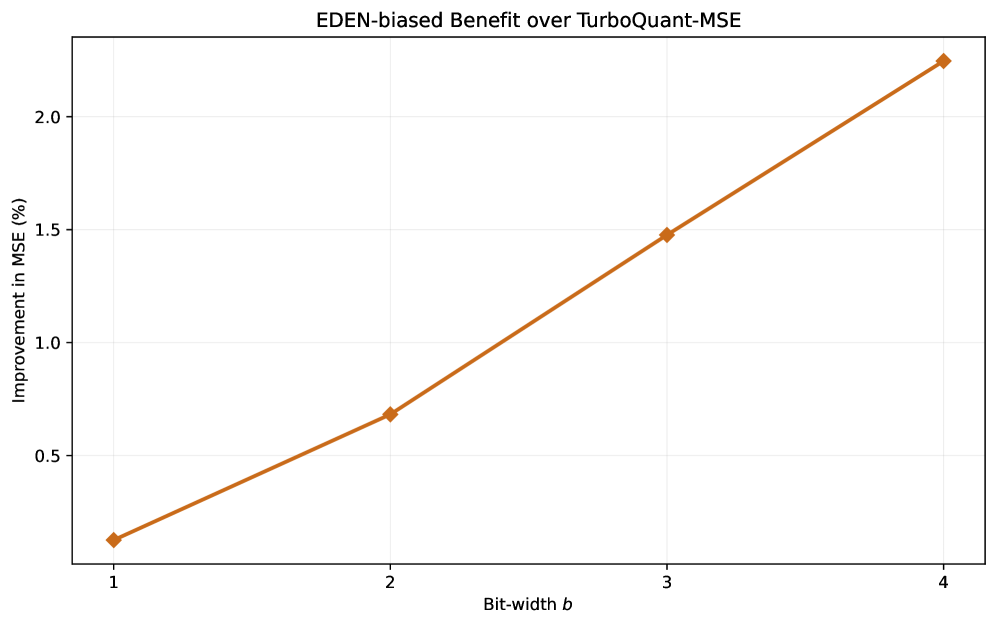
The image is a line graph illustrating the relationship between bit-width (`b`) and improvement in Mean Squared Error (MSE) percentage when using EDEN-biased methods compared to TurboQuant-MSE. The graph shows a single data series with a consistent upward trend.
---
### Components/Axes
- **Title**: "EDEN-biased Benefit over TurboQuant-MSE" (centered at the top).
- **X-axis**: Labeled "Bit-width _b_" with integer markers at 1, 2, 3, and 4.
- **Y-axis**: Labeled "Improvement in MSE (%)" with a scale from 0.0 to 2.25% in increments of 0.5%.
- **Legend**: Not explicitly visible in the image.
- **Line Style**: Single orange line with diamond-shaped markers.
---
### Detailed Analysis
- **Data Points**:
- At `b = 1`: Improvement ≈ 0.1% (orange diamond at the bottom-left).
- At `b = 2`: Improvement ≈ 0.7% (orange diamond midway up the y-axis).
- At `b = 3`: Improvement ≈ 1.5% (orange diamond near the top of the y-axis).
- At `b = 4`: Improvement ≈ 2.25% (orange diamond at the top-right corner).
- **Trend**: The line exhibits a **linear upward slope**, indicating a proportional increase in MSE improvement as bit-width increases.
---
### Key Observations
1. **Consistent Growth**: The improvement in MSE increases predictably with each increment in bit-width.
2. **No Outliers**: All data points align precisely with the linear trendline.
3. **Scale Utilization**: The y-axis fully utilizes its range (0% to 2.25%), with the final data point reaching the maximum value.
---
### Interpretation
The graph demonstrates that higher bit-widths (`b`) correlate with greater MSE improvement when using EDEN-biased methods over TurboQuant-MSE. The linear relationship suggests that increasing bit-width systematically enhances performance, likely due to improved numerical precision or computational efficiency at higher bit-widths. This trend could inform optimization strategies for systems prioritizing MSE reduction, such as machine learning models or signal processing algorithms. The absence of noise or deviations implies a controlled experimental setup or theoretical derivation.