## Heatmap Grid: Heads Importance by Task and Layer
### Overview
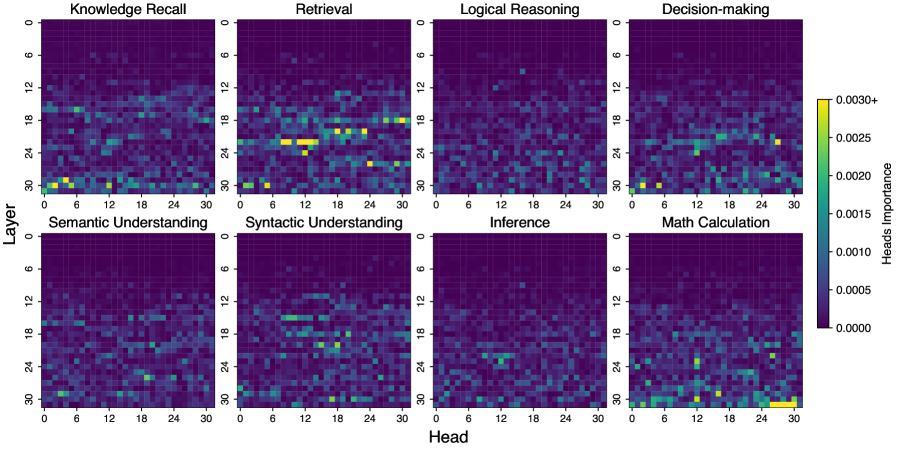
The image presents a grid of heatmaps, each representing the "Heads Importance" for a specific task across different layers and heads of a model. The tasks are: Knowledge Recall, Retrieval, Logical Reasoning, Decision-making, Semantic Understanding, Syntactic Understanding, Inference, and Math Calculation. The heatmaps visualize the importance of each head (x-axis) at each layer (y-axis) for the given task. The color intensity indicates the level of importance, ranging from dark purple (0.0000) to bright yellow (0.0030+).
### Components/Axes
* **X-axis (Head):** Represents the different heads, ranging from 0 to 30.
* **Y-axis (Layer):** Represents the layers, ranging from 0 to 30.
* **Heatmap Grid:** An 2x4 grid of heatmaps, each representing a different task.
* **Color Scale (Heads Importance):**
* Dark Purple: 0.0000
* Blue: 0.0005
* Light Blue: 0.0010
* Green: 0.0015
* Yellow-Green: 0.0020
* Yellow: 0.0025
* Bright Yellow: 0.0030+
* **Task Labels:** Each heatmap is labeled with a task name: Knowledge Recall, Retrieval, Logical Reasoning, Decision-making, Semantic Understanding, Syntactic Understanding, Inference, and Math Calculation.
### Detailed Analysis
**1. Knowledge Recall:**
* Trend: Higher importance is observed in the lower layers (24-30) and some scattered importance in the middle layers.
* Specifics: There are a few heads around layer 30 that show high importance (yellow).
**2. Retrieval:**
* Trend: High importance is concentrated in layers 20-30, with some heads showing significantly higher importance.
* Specifics: Several yellow spots are visible in layers 20-30, indicating high head importance.
**3. Logical Reasoning:**
* Trend: Importance is generally low across all layers and heads.
* Specifics: Mostly dark purple and blue, with a few scattered green spots.
**4. Decision-making:**
* Trend: Similar to Logical Reasoning, importance is generally low.
* Specifics: A few green and yellow-green spots are scattered throughout.
**5. Semantic Understanding:**
* Trend: Importance is scattered, with slightly higher importance in the lower layers.
* Specifics: A mix of blue, green, and yellow-green spots.
**6. Syntactic Understanding:**
* Trend: Importance is concentrated in the middle layers (12-24).
* Specifics: Several green and yellow-green spots are visible in the middle layers.
**7. Inference:**
* Trend: Importance is scattered, with a slight concentration in the lower layers.
* Specifics: Similar to Semantic Understanding, a mix of blue, green, and yellow-green spots.
**8. Math Calculation:**
* Trend: Importance is concentrated in the lower layers (24-30).
* Specifics: Several green and yellow spots are visible in the lower layers.
### Key Observations
* **Task-Specific Head Importance:** The importance of heads varies significantly depending on the task.
* **Layer Dependency:** Some tasks, like Retrieval and Math Calculation, show higher importance in the lower layers, while others, like Syntactic Understanding, show higher importance in the middle layers.
* **Low Importance for Reasoning and Decision-making:** Logical Reasoning and Decision-making tasks generally show lower head importance compared to other tasks.
### Interpretation
The heatmaps provide insights into which heads and layers are most important for different tasks within the model. The concentration of importance in specific layers suggests that certain layers are specialized for particular types of processing. The low importance observed for Logical Reasoning and Decision-making could indicate that these tasks require a more distributed representation or that the model architecture is not well-suited for these tasks. The data suggests that the model utilizes different heads and layers for different cognitive tasks, highlighting the modularity and specialization within the network. The concentration of activity in certain layers for specific tasks could be indicative of a hierarchical processing structure, where lower layers handle more basic features and higher layers handle more abstract concepts.