## Line Chart: Training Batch Accuracy (%)
### Overview
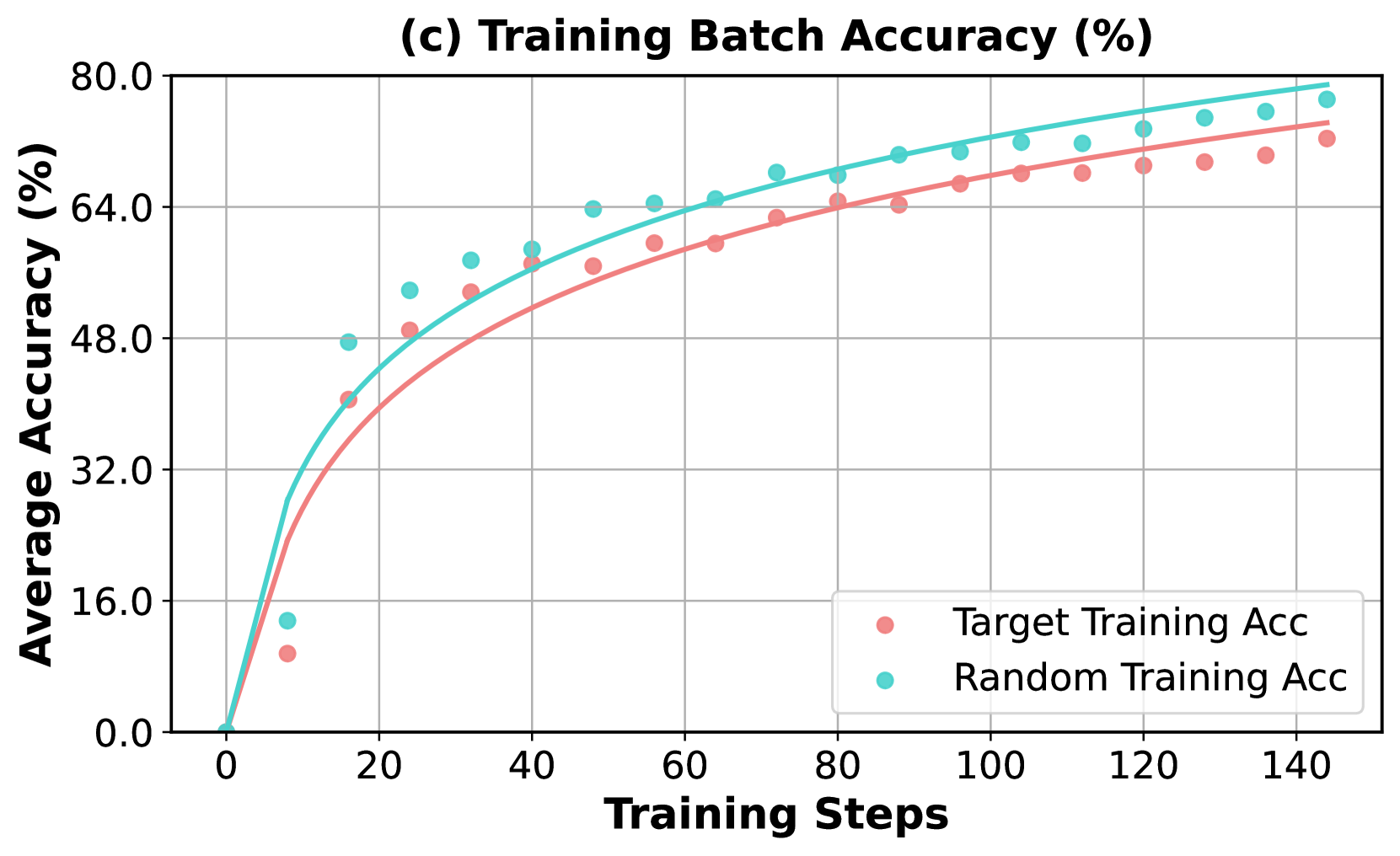
The chart illustrates the progression of training batch accuracy over training steps for two methods: "Target Training Acc" (red line) and "Random Training Acc" (teal line). Both lines show increasing accuracy with more training steps, with the teal line achieving higher final accuracy.
### Components/Axes
- **X-axis**: Training Steps (0 to 140, increments of 20)
- **Y-axis**: Average Accuracy (%) (0 to 80, increments of 16)
- **Legend**: Located at bottom-right, with red for "Target Training Acc" and teal for "Random Training Acc"
- **Lines**:
- Red line (Target Training Acc) starts at (0, 0) and rises steadily.
- Teal line (Random Training Acc) starts at (5, 15) and rises with a slight dip around 20 steps.
### Detailed Analysis
- **Target Training Acc (Red Line)**:
- Data points at:
- (0, 0), (10, ~30), (20, ~48), (30, ~52), (40, ~56), (50, ~58), (60, ~60), (70, ~62), (80, ~64), (90, ~65), (100, ~66), (110, ~67), (120, ~68), (130, ~69), (140, ~72).
- Trend: Smooth upward curve with minimal fluctuations.
- **Random Training Acc (Teal Line)**:
- Data points at:
- (5, 15), (10, 48), (20, ~46), (30, ~58), (40, ~60), (50, ~62), (60, ~64), (70, ~65), (80, ~67), (90, ~68), (100, ~69), (110, ~70), (120, ~71), (130, ~72), (140, ~78).
- Trend: Initial dip at 20 steps (~46%), then steady rise. Final accuracy surpasses the target method.
### Key Observations
1. Both methods show increasing accuracy with training steps.
2. The teal line (Random Training Acc) starts lower but overtakes the red line after ~50 steps.
3. At 140 steps, teal line reaches ~78% accuracy vs. red line's ~72%.
4. Teal line exhibits a minor dip at 20 steps (~46%) before resuming growth.
### Interpretation
The data suggests that while the "Target Training Acc" method provides consistent improvement, the "Random Training Acc" method achieves higher final accuracy despite an initial dip. The convergence of the lines at later steps implies that both approaches may yield similar results with sufficient training, though the random method demonstrates greater efficiency in the long term. The dip in the teal line at 20 steps could indicate transient instability or noise in early training phases.