\n
## Diagram: Grid-Based Path Puzzle
### Overview
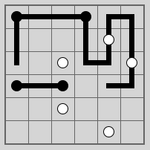
The image displays an 8x8 square grid with a light gray background and darker gray grid lines. Superimposed on this grid are two distinct, continuous black paths and several isolated elements: black line segments and white circles. The diagram appears to be a logic puzzle or a representation of a network/pathfinding problem, where the goal might be to connect specific points or trace routes without crossing.
### Components/Axes
* **Grid:** An 8x8 matrix of squares. No numerical labels or axes are present.
* **Black Paths/Lines:** Thick, solid black lines that follow the grid lines, connecting various intersection points (grid vertices).
* **White Circles:** Solid white circles placed at specific grid intersections. There are 5 circles in total.
* **Black Line Segments:** Shorter, disconnected black line segments that do not form part of the main continuous paths.
### Detailed Analysis
The diagram can be segmented into regions for clarity:
**1. Top-Left Quadrant (Rows 1-4, Columns 1-4):**
* A continuous black path starts at the intersection of Row 2, Column 1. It travels:
* Right 3 units to (Row 2, Column 4).
* Down 1 unit to (Row 3, Column 4).
* Left 2 units to (Row 3, Column 2).
* Down 1 unit to (Row 4, Column 2).
* An isolated horizontal black line segment connects (Row 5, Column 2) to (Row 5, Column 3).
* A white circle is located at the intersection (Row 6, Column 3).
**2. Top-Right Quadrant (Rows 1-4, Columns 5-8):**
* A second continuous black path starts at (Row 1, Column 5). It travels:
* Right 2 units to (Row 1, Column 7).
* Down 2 units to (Row 3, Column 7).
* Left 1 unit to (Row 3, Column 6).
* Down 2 units to (Row 5, Column 6).
* Right 1 unit to (Row 5, Column 7).
* Down 1 unit to (Row 6, Column 7).
* Left 2 units to (Row 6, Column 5).
* A white circle is located at (Row 3, Column 6), which is a point on this path.
* Another white circle is located at (Row 5, Column 7), which is also a point on this path.
**3. Bottom Half (Rows 5-8):**
* The path from the top-right quadrant terminates at (Row 6, Column 5).
* An isolated vertical black line segment connects (Row 6, Column 8) to (Row 7, Column 8).
* A white circle is located at (Row 8, Column 6).
### Key Observations
* **Path Connectivity:** The two main black paths are completely separate and do not intersect or connect to each other.
* **Circle Placement:** Three of the five white circles are positioned directly on the path in the top-right quadrant. The other two circles (at (6,3) and (8,6)) are isolated and not connected to any line.
* **Line Segments:** There are two disconnected line segments: one horizontal in the middle-left and one vertical in the bottom-right.
* **Spatial Distribution:** Elements are concentrated in the top half of the grid. The bottom two rows are mostly empty except for one circle and one line segment.
### Interpretation
This diagram is likely a visual representation of a constraint-based puzzle, such as a "Hashiwokakero" (Bridges) variant or a custom path-connection logic puzzle. The white circles represent nodes or islands, and the black lines represent bridges or paths connecting them.
* **What the data suggests:** The puzzle appears to be in an unsolved or partially solved state. The rule might be to connect all white circles with black lines (paths) that run along the grid lines, possibly without lines crossing. The existing paths and segments could be given clues or incorrect attempts.
* **Relationships:** The key relationship is between the white circle nodes and the black line paths. The circles on the path in the top-right quadrant are "connected," while the isolated circles are "unconnected." The isolated line segments may be red herrings or part of an incomplete solution.
* **Notable Anomalies:** The most significant anomaly is the presence of two entirely separate, non-interacting main paths. In a typical connection puzzle, one would expect a single network. This could indicate the puzzle has multiple independent components or that the image captures an intermediate, incorrect step in solving it. The isolated line segments that connect no circles are also unusual for a final puzzle state.
**Language Declaration:** No textual language is present in the image. The description is based solely on visual elements.