\n
## Commutative Diagram: Equivariant K-Theory Relationships
### Overview
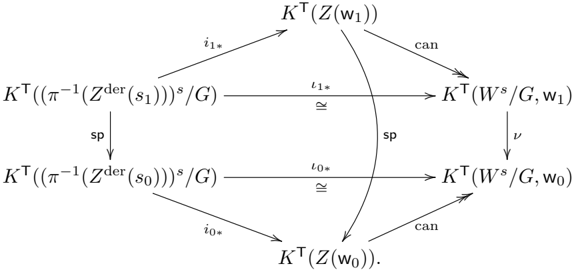
The image displays a commutative diagram from the field of algebraic topology, specifically equivariant K-theory. It illustrates the relationships between various K-theory spaces constructed from derived categories, group actions, and specific vector bundles or sheaves. The diagram consists of six nodes connected by labeled arrows, indicating maps or transformations between these mathematical objects.
### Components/Axes
The diagram is structured as a network of mathematical expressions (nodes) connected by directed arrows (morphisms). There are no traditional axes, as this is a categorical diagram.
**Nodes (Mathematical Expressions):**
1. **Top-Left:** `K^T((π^{-1}(Z^{der}(s_1)))^s / G)`
2. **Top-Center:** `K^T(Z(w_1))`
3. **Top-Right:** `K^T(W^s / G, w_1)`
4. **Bottom-Left:** `K^T((π^{-1}(Z^{der}(s_0)))^s / G)`
5. **Bottom-Center:** `K^T(Z(w_0))`
6. **Bottom-Right:** `K^T(W^s / G, w_0)`
**Arrows (Morphisms/Maps) and Labels:**
* From Top-Left to Top-Center: Arrow labeled `i_{1*}`.
* From Top-Left to Bottom-Left: Arrow labeled `sp`.
* From Top-Center to Top-Right: Arrow labeled `can`.
* From Top-Center to Bottom-Center: Curved arrow labeled `sp`.
* From Top-Right to Bottom-Right: Arrow labeled `ν`.
* From Bottom-Left to Bottom-Center: Arrow labeled `i_{0*}`.
* From Bottom-Left to Top-Left: Arrow labeled `ι_{1*}` with an isomorphism symbol `≅` below it.
* From Bottom-Right to Top-Right: Arrow labeled `ι_{0*}` with an isomorphism symbol `≅` below it.
* From Bottom-Center to Bottom-Right: Arrow labeled `can`.
### Detailed Analysis
The diagram is organized into two horizontal rows and three vertical columns, with additional diagonal and curved connections.
* **Left Column:** Contains nodes based on the construction `K^T((π^{-1}(Z^{der}(s_i)))^s / G)` for `i = 0, 1`. These are connected vertically by a map `sp` (likely a "specialization" map).
* **Center Column:** Contains nodes of the form `K^T(Z(w_i))` for `i = 0, 1`. These are connected by a curved `sp` map.
* **Right Column:** Contains nodes of the form `K^T(W^s / G, w_i)` for `i = 0, 1`. These are connected vertically by a map `ν`.
* **Horizontal Connections:** The left column maps to the center column via `i_{0*}` and `i_{1*}`. The center column maps to the right column via `can` (likely a "canonical" map).
* **Isomorphisms:** The vertical arrows `ι_{1*}` (from Bottom-Left to Top-Left) and `ι_{0*}` (from Bottom-Right to Top-Right) are explicitly marked as isomorphisms (`≅`), indicating these are invertible maps and thus the connected objects are equivalent in the relevant category.
### Key Observations
1. **Symmetry:** The diagram exhibits a clear symmetry between the `s_0` and `s_1` cases (bottom and top rows, respectively). The structure of maps (`i_*`, `can`, `sp`, `ν`) is mirrored.
2. **Commutativity:** The diagram is commutative, meaning that following any two paths of arrows from one node to another yields the same result. For example, the path from Top-Left to Bottom-Right via `sp` then `i_{0*}` then `can` should be equivalent to the path via `i_{1*}` then `sp` then `ν`.
3. **Key Maps:** The diagram highlights three important types of maps in this theory:
* `sp`: Specialization maps (vertical on the left, curved in the center).
* `can`: Canonical maps (horizontal from center to right).
* `ι_*`: Isomorphisms (vertical on the left and right edges).
* `ν`: A map connecting the two `W^s / G` constructions.
4. **Notation:** The notation uses standard conventions: `K^T` for equivariant K-theory, `π^{-1}` for inverse image, `Z^{der}` for a derived category construction, `/ G` for a quotient by a group action, and subscripts `*` on maps to denote the induced map on K-theory.
### Interpretation
This diagram is a formal representation of relationships in a specialized area of mathematics, likely equivariant K-theory or derived algebraic geometry. It serves as a visual proof or summary of how different constructions are related.
* **What it Demonstrates:** The diagram shows that the K-theory of certain quotient spaces (`(π^{-1}(Z^{der}(s_i)))^s / G` and `W^s / G`) can be related to the K-theory of simpler spaces (`Z(w_i)`) through canonical maps and specializations. The presence of isomorphisms (`ι_*`) indicates that some of these relationships are equivalences, which is a powerful result.
* **Relationships:** The core relationship is between a "derived" construction (left column), a "zero-section" or "central" construction (center column), and a "global" or "ambient" construction (right column). The `sp` maps likely relate theories at different "points" or "parameters" (`s_0` and `s_1`), while the `can` maps embed the central theory into the global one.
* **Purpose:** For a researcher, this diagram encapsulates a theorem or a key lemma. It allows them to track how information (like K-theory classes) transforms under different operations and guarantees that certain computations can be performed in a more convenient part of the diagram (e.g., in the center column) with the results being valid elsewhere due to commutativity and the isomorphisms.
* **Notable Feature:** The curved `sp` arrow in the center is a distinctive visual element, emphasizing that the specialization map between the `Z(w_i)` nodes has a different character or is derived from a different process than the vertical `sp` map on the left.