## Diagram: LLM and KG Synergies
### Overview
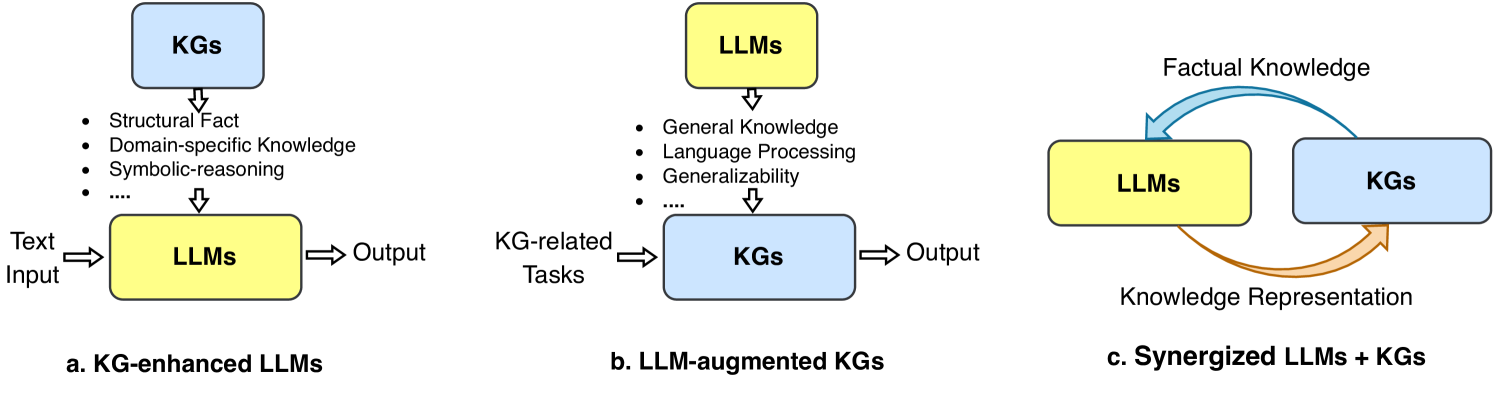
The image presents three diagrams illustrating different ways Large Language Models (LLMs) and Knowledge Graphs (KGs) can be integrated. The diagrams depict KG-enhanced LLMs, LLM-augmented KGs, and synergized LLMs + KGs, showing the flow of information and the types of knowledge each component contributes.
### Components/Axes
* **Diagram a. KG-enhanced LLMs:**
* Input: "Text Input" with an arrow pointing to the left into the LLMs block.
* Top Block: "KGs" (light blue rounded rectangle)
* List of characteristics:
* Structural Fact
* Domain-specific Knowledge
* Symbolic-reasoning
* .... (more items not specified)
* Arrow pointing down from the KGs block to the LLMs block.
* Bottom Block: "LLMs" (light yellow rounded rectangle)
* Output: "Output" with an arrow pointing to the right from the LLMs block.
* **Diagram b. LLM-augmented KGs:**
* Input: "KG-related Tasks" with an arrow pointing to the left into the KGs block.
* Top Block: "LLMs" (light yellow rounded rectangle)
* List of characteristics:
* General Knowledge
* Language Processing
* Generalizability
* .... (more items not specified)
* Arrow pointing down from the LLMs block to the KGs block.
* Bottom Block: "KGs" (light blue rounded rectangle)
* Output: "Output" with an arrow pointing to the right from the KGs block.
* **Diagram c. Synergized LLMs + KGs:**
* Left Block: "LLMs" (light yellow rounded rectangle)
* Right Block: "KGs" (light blue rounded rectangle)
* Top Arrow: A light blue arrow labeled "Factual Knowledge" pointing from the KGs block to the LLMs block.
* Bottom Arrow: A light orange arrow labeled "Knowledge Representation" pointing from the LLMs block to the KGs block.
### Detailed Analysis
* **KG-enhanced LLMs (a):** This diagram shows KGs providing structural facts, domain-specific knowledge, and symbolic reasoning to LLMs. Text input goes into the LLMs, which are enhanced by the knowledge from the KGs, resulting in an output.
* **LLM-augmented KGs (b):** This diagram shows LLMs providing general knowledge, language processing, and generalizability to KGs. KG-related tasks are input into the KGs, which are augmented by the capabilities of the LLMs, resulting in an output.
* **Synergized LLMs + KGs (c):** This diagram illustrates a synergistic relationship between LLMs and KGs. Factual knowledge flows from KGs to LLMs, while knowledge representation flows from LLMs to KGs, creating a feedback loop.
### Key Observations
* The diagrams highlight the complementary strengths of LLMs and KGs.
* LLMs are shown to provide general knowledge and language processing capabilities.
* KGs are shown to provide structured and domain-specific knowledge.
* The synergized approach suggests a bidirectional flow of information between LLMs and KGs.
### Interpretation
The diagrams illustrate three different approaches to integrating LLMs and KGs. The first two approaches, KG-enhanced LLMs and LLM-augmented KGs, represent unidirectional flows of information, where one component enhances the other. The third approach, synergized LLMs + KGs, represents a bidirectional flow of information, where the two components work together to create a more powerful system. This suggests that a synergistic approach may be the most effective way to leverage the strengths of both LLMs and KGs. The diagrams suggest that by combining the strengths of LLMs and KGs, it is possible to create systems that are more knowledgeable, more accurate, and more efficient.