\n
## Diagram: LLM Tool Use Architectures
### Overview
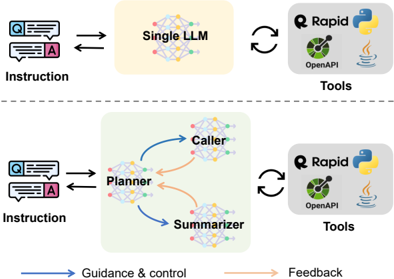
The image presents a comparative diagram illustrating two architectures for utilizing Large Language Models (LLMs) with external tools. The top panel depicts a single LLM directly interacting with tools, while the bottom panel shows a more complex architecture involving a "Planner," "Caller," and "Summarizer" LLM agents coordinating tool use. The diagram emphasizes the flow of instructions, feedback, and control between the LLMs and tools.
### Components/Axes
The diagram is divided into two main sections separated by a dashed line. Each section contains the following components:
* **Instruction:** Represented by a speech bubble with a question mark ("Q") and a document with text ("A").
* **LLM:** Depicted as a network of nodes. The top panel shows a "Single LLM," while the bottom panel shows three LLMs: "Planner," "Caller," and "Summarizer."
* **Tools:** Represented by icons for "Rapid," "Python," "OpenAPI," and "Java."
* **Arrows:** Blue arrows indicate "Guidance & control," and orange arrows indicate "Feedback."
### Detailed Analysis or Content Details
**Top Panel (Single LLM):**
* The "Instruction" block (Q&A) has a bidirectional arrow connecting it to the "Single LLM."
* The "Single LLM" has a bidirectional arrow connecting it to the "Tools" block (Rapid, Python, OpenAPI, Java).
* This suggests a direct interaction between the instruction and the LLM, which in turn directly interacts with the tools.
**Bottom Panel (Multi-Agent Architecture):**
* The "Instruction" block (Q&A) has a bidirectional arrow connecting it to the "Planner" LLM.
* The "Planner" LLM is connected to the "Caller" LLM with a blue arrow (Guidance & control) and an orange arrow (Feedback).
* The "Planner" LLM is also connected to the "Summarizer" LLM with a blue arrow (Guidance & control) and an orange arrow (Feedback).
* The "Caller" LLM has a bidirectional arrow connecting it to the "Tools" block (Rapid, Python, OpenAPI, Java).
* The "Summarizer" LLM has no direct connection to the tools, but receives feedback from the Planner.
* The "Tools" block (Rapid, Python, OpenAPI, Java) is identical to the top panel.
### Key Observations
* The bottom panel introduces a modular architecture with specialized LLM agents.
* The "Planner" appears to orchestrate the tool usage, delegating tasks to the "Caller" and receiving summaries from the "Summarizer."
* The feedback loops (orange arrows) suggest an iterative process where the LLMs refine their actions based on the results from the tools.
* The use of color-coded arrows clearly distinguishes between control flow and feedback mechanisms.
### Interpretation
This diagram illustrates a shift in how LLMs are being integrated with external tools. The single LLM approach is simple but may lack the sophistication to handle complex tasks requiring multiple tool interactions. The multi-agent architecture, with its specialized LLMs, offers a more structured and potentially more effective approach. The "Planner" acts as a central coordinator, breaking down the instruction into manageable steps and assigning them to the appropriate agents. The "Caller" handles the actual interaction with the tools, while the "Summarizer" provides a consolidated view of the results. The feedback loops are crucial for enabling the LLMs to learn and adapt their strategies over time. This architecture suggests a move towards more autonomous and intelligent agents capable of solving complex problems by leveraging the power of both LLMs and external tools. The diagram does not provide any quantitative data, but rather a conceptual overview of the architectural differences.