## Grid Puzzle: Number Placement with Path Constraints
### Overview
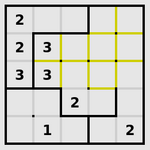
The image depicts a 5x5 grid with numerical values (1, 2, 3) placed in specific cells and yellow lines forming a partial path. The grid is bordered by black lines, and the yellow lines are positioned to create a maze-like structure. The numbers are distributed unevenly, with some cells containing multiple instances of the same value.
### Components/Axes
- **Grid Structure**:
- 5 rows and 5 columns, each cell separated by black lines.
- Yellow lines are placed as follows:
- **Horizontal**: Row 2 (columns 3–5), Row 3 (columns 3–5).
- **Vertical**: Column 3 (rows 2–3).
- **Numerical Values**:
- **1**: Located at (5, 2) (bottom row, second column).
- **2**: Located at (1, 1), (3, 4), (5, 5).
- **3**: Located at (2, 2), (3, 2).
- **Legend**: No explicit legend is present.
### Detailed Analysis
- **Number Placement**:
- The number **1** is isolated in the bottom row, suggesting it may represent a starting or critical point.
- The number **2** appears in the top-left corner (1,1), middle-right (3,4), and bottom-right (5,5), potentially indicating a progression or endpoint.
- The number **3** is concentrated in the middle-left (2,2) and (3,2), possibly marking a central or transitional area.
- **Path Constraints**:
- Yellow lines block movement in certain directions:
- Horizontal lines in rows 2 and 3 prevent vertical movement between columns 3–5.
- Vertical line in column 3 (rows 2–3) restricts horizontal movement.
- The path appears to start at (1,1) and could extend toward (5,5), but the lines create barriers that require navigation.
### Key Observations
- The **1** at (5,2) is the only instance of its value, making it a potential focal point.
- The **3s** are clustered in the middle-left, suggesting a possible "hub" or checkpoint.
- The **2s** are distributed along a diagonal path from (1,1) to (5,5), which may indicate a goal or sequence.
- The yellow lines create a fragmented path, requiring strategic movement to traverse the grid.
### Interpretation
This grid likely represents a **pathfinding or puzzle-solving scenario**, where the numbers denote values to collect or steps to take. The yellow lines act as barriers, forcing the solver to navigate around them. The placement of **1** at the bottom and **2s** at the corners suggests a progression from start (1) to end (2s). The **3s** in the middle may represent intermediate challenges or resources. The absence of a legend implies the numbers and lines are self-explanatory, relying on spatial logic rather than explicit labels. The grid’s design emphasizes constraints and strategic movement, typical of logic puzzles or maze-based challenges.