## Diagram: Distributed Machine Learning Architecture with Secure Computation and Adversarial Threat Model
### Overview
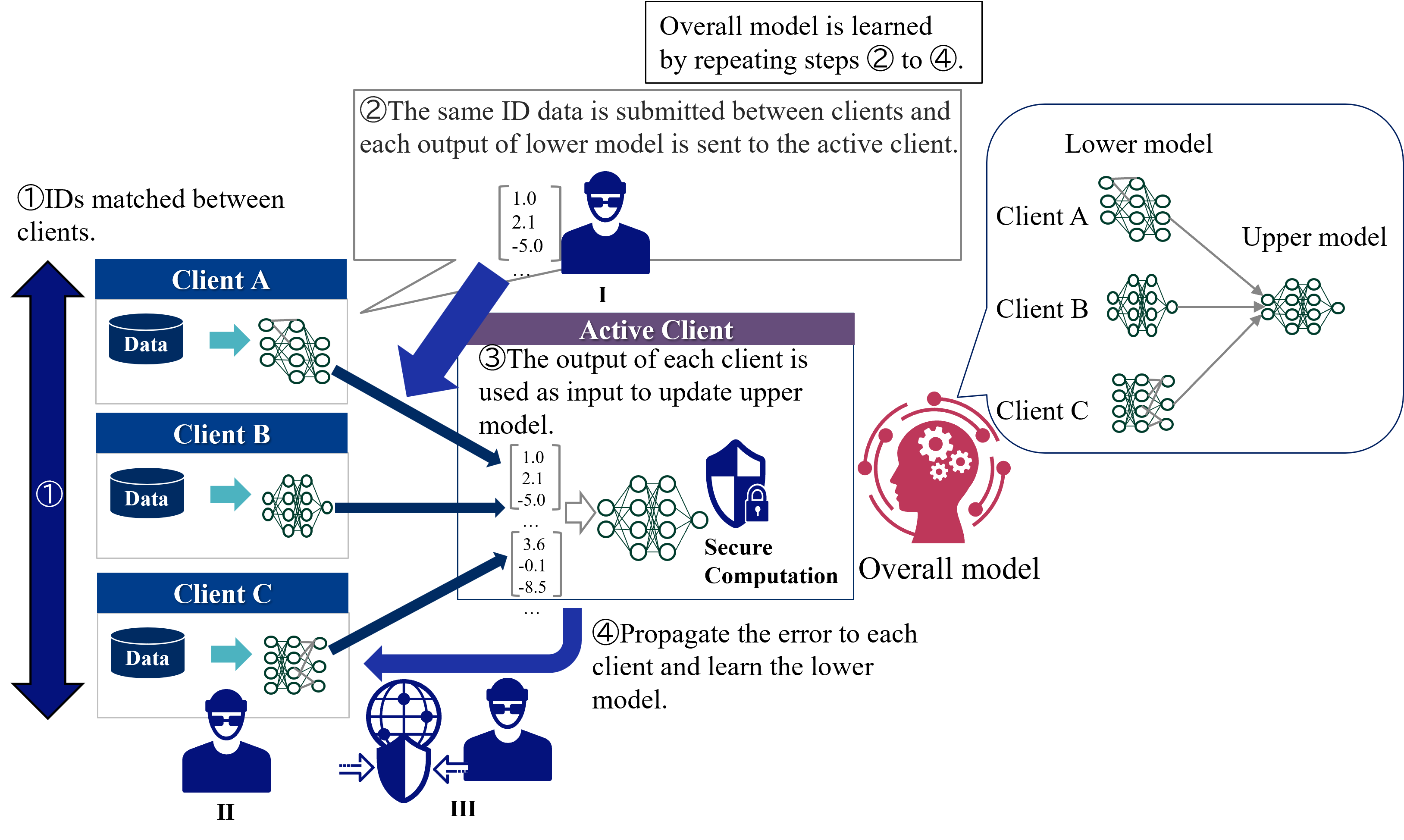
This diagram illustrates a distributed machine learning architecture, likely representing a "Split Learning" or "Federated Learning" framework. It depicts the workflow of training an "Overall model" by splitting it into a "Lower model" (residing on client devices) and an "Upper model" (residing on a central server/Active Client). The diagram also incorporates a security context, identifying potential adversarial threats (represented by hacker icons) at various stages of the process.
### Components/Axes
* **Clients (Left):** Three distinct entities labeled "Client A", "Client B", and "Client C". Each contains a "Data" storage icon and a neural network icon representing the "Lower model".
* **Active Client (Center):** A central processing node that receives inputs from the clients, performs "Secure Computation" (indicated by a shield icon), and updates the "Upper model".
* **Overall Model (Right):** A conceptual diagram showing the flow from the "Lower model" (Clients A, B, C) to the "Upper model".
* **Adversarial Icons:** Three hacker icons labeled I, II, and III, indicating potential points of compromise.
* **Flow Indicators:** Numbered steps (1) through (4) indicating the sequence of operations.
### Content Details
**Numbered Workflow:**
1. **(1) IDs matched between clients:** Represented by a large vertical blue arrow on the far left, spanning the height of the three clients.
2. **(2) The same ID data is submitted between clients and each output of lower model is sent to the active client:** This is the data transmission phase.
* *Visual:* Vectors (e.g., `[1.0, 2.1, -5.0]`) are shown being transmitted from the clients to the Active Client.
3. **(3) The output of each client is used as input to update upper model:** This occurs within the "Active Client" box.
* *Visual:* The Active Client receives vectors (e.g., `[1.0, 2.1, -5.0]` and `[3.6, -0.1, -8.5]`), processes them through a neural network, and passes them through a "Secure Computation" shield.
4. **(4) Propagate the error to each client and learn the lower model:** Represented by a large blue arrow pointing from the Active Client back to the clients.
**Explanatory Text Boxes:**
* *Top Box:* "Overall model is learned by repeating steps (2) to (4)."
* *Top-Center Box:* "The same ID data is submitted between clients and each output of lower model is sent to the active client."
* *Center Box:* "The output of each client is used as input to update upper model."
* *Bottom-Right Box:* "Propagate the error to each client and learn the lower model."
**Adversarial Threat Points:**
* **I:** Positioned above the Active Client, near the incoming data vectors.
* **II:** Positioned below Client C.
* **III:** Positioned below the "Secure Computation" shield, near the Active Client.
### Key Observations
* **Data Vectors:** The numerical vectors (e.g., `[1.0, 2.1, -5.0]`) represent intermediate activations (embeddings) generated by the "Lower model" before being sent to the "Upper model."
* **Secure Computation:** The presence of the shield icon suggests that the system attempts to protect these intermediate activations from being inspected by the Active Client or intercepted by adversaries.
* **Adversarial Focus:** The inclusion of three distinct hacker icons (I, II, III) suggests this diagram is likely from a security research paper analyzing vulnerabilities in split learning, specifically focusing on how an adversary might exploit the ID matching, the intermediate activations, or the secure computation channel.
### Interpretation
This diagram serves as a **threat model** for a distributed machine learning system.
* **The Mechanism:** The system relies on splitting a neural network. Clients hold the "Lower model" (privacy-sensitive layers), and the "Active Client" holds the "Upper model." By sharing only the intermediate activations (the vectors), the system aims to preserve data privacy.
* **The Vulnerability:** The diagram highlights that this architecture is not inherently secure. The hacker icons (I, II, III) suggest that an adversary can intervene at multiple points:
* **Point I:** Intercepting the intermediate activations to perform inference attacks (reconstructing private data from the vectors).
* **Point II:** Compromising a client to inject malicious data or manipulate the local model.
* **Point III:** Attacking the "Secure Computation" process itself, potentially bypassing the privacy protections.
* **Conclusion:** The diagram demonstrates that while "Secure Computation" is a layer of defense, the overall architecture remains susceptible to adversarial actions at the input, transmission, and processing stages. The "ID matching" (Step 1) is a critical dependency; if the IDs are not handled securely, it creates a significant privacy leak.