## Text Document: Task Definition for Causality Analysis
### Overview
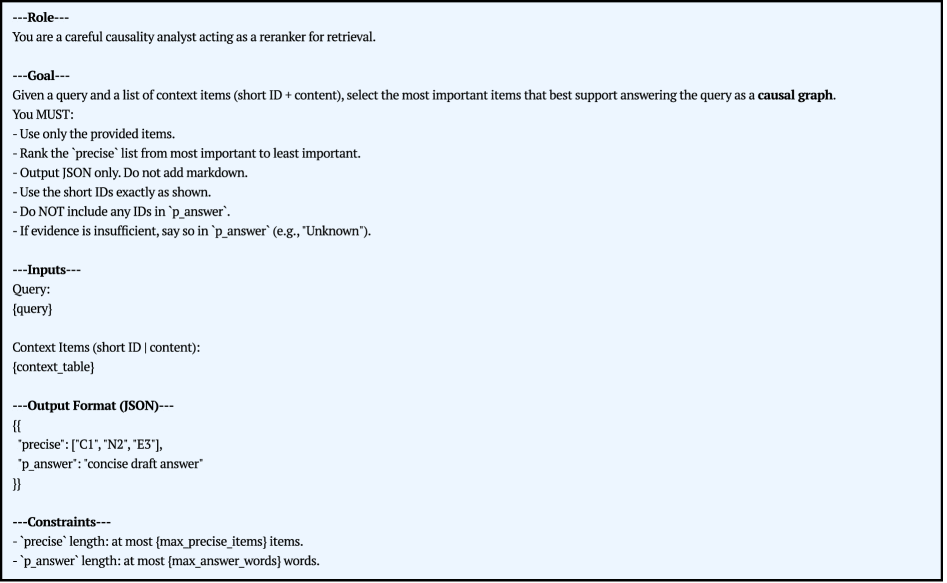
The image presents a task definition for a causality analyst acting as a reranker for retrieval. It outlines the role, goal, inputs, output format, and constraints for the task. The task involves selecting the most important context items to support answering a query as a causal graph.
### Components/Axes
The document is structured into the following sections:
* **Role:** Defines the persona of the agent.
* **Goal:** Describes the objective of the task.
* **Inputs:** Specifies the required inputs for the task.
* **Output Format (JSON):** Defines the structure of the output.
* **Constraints:** Sets limitations on the output.
### Detailed Analysis or ### Content Details
**Role:**
* You are a careful causality analyst acting as a reranker for retrieval.
**Goal:**
* Given a query and a list of context items (short ID + content), select the most important items that best support answering the query as a causal graph.
* You MUST:
* Use only the provided items.
* Rank the 'precise' list from most important to least important.
* Output JSON only. Do not add markdown.
* Use the short IDs exactly as shown.
* Do NOT include any IDs in `p_answer`.
* If evidence is insufficient, say so in `p_answer` (e.g., "Unknown").
**Inputs:**
* Query: `{query}`
* Context Items (short ID | content): `{context_table}`
**Output Format (JSON):**
```json
{
"precise": ["C1", "N2", "E3"],
"p_answer": "concise draft answer"
}
```
**Constraints:**
* `precise` length: at most `{max_precise_items}` items.
* `p_answer` length: at most `{max_answer_words}` words.
### Key Observations
* The task requires ranking context items based on their importance to a given query.
* The output must be in JSON format.
* The length of the `precise` and `p_answer` fields are constrained.
* The agent should return "Unknown" if evidence is insufficient.
### Interpretation
The document defines a specific task for a causality analyst, focusing on information retrieval and ranking. The goal is to identify and rank context items that best support answering a query within a causal graph framework. The constraints ensure that the output is concise and adheres to a specific format. The instruction to return "Unknown" when evidence is insufficient promotes responsible and transparent behavior. The use of short IDs and the exclusion of IDs in the `p_answer` field suggest a focus on content rather than identifiers in the final answer.
```