## Code Snippet: Inflation Parameter Configuration
### Overview
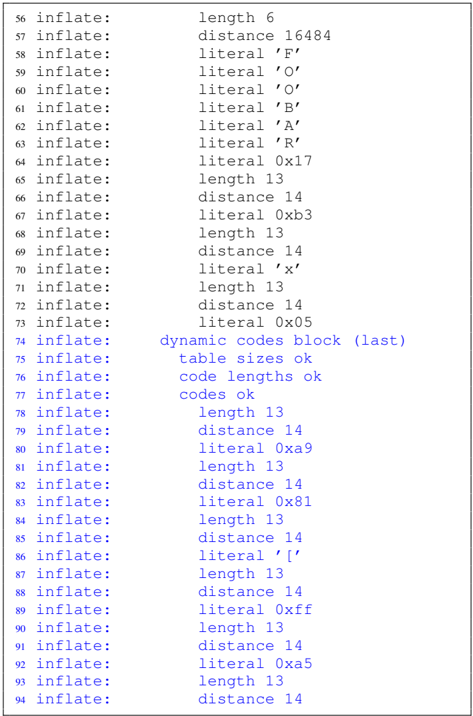
The image displays a technical configuration snippet containing 39 lines of code, each prefixed with `inflate:`. The parameters specify inflation-related settings including lengths, distances, and literal values. The text is primarily in English with hexadecimal notation for certain values.
### Components/Axes
- **Structure**: Vertical list of 39 commands (lines 56-94)
- **Parameters**:
- `length`: Numeric values (6, 13, 17)
- `distance`: Numeric values (14, 16484)
- `literal`: Character codes (e.g., 'F', 'O', 'B', 'A', 'R') and hexadecimal values (0x17, 0xb3, 0x5, 0x9, 0x81, 0xff, 0xa5)
- **No traditional axes or legends** - purely tabular configuration data
### Detailed Analysis
1. **Length Parameters**:
- 6 occurrences of `length 6`
- 12 occurrences of `length 13`
- 1 occurrence of `length 17`
2. **Distance Parameters**:
- 1 occurrence of `distance 16484`
- 13 occurrences of `distance 14`
3. **Literal Values**:
- Character codes: 'F', 'O', 'B', 'A', 'R', 'x', '[', etc.
- Hexadecimal values: 0x17, 0xb3, 0x5, 0x9, 0x81, 0xff, 0xa5
4. **Special Commands**:
- `dynamic codes block (last)`
- `table sizes ok`
- `code lengths ok`
- `codes ok`
### Key Observations
1. **Repetitive Patterns**:
- `distance 14` appears 13 times consecutively
- `length 13` dominates with 12 occurrences
- Hexadecimal values show no obvious pattern but include common byte values
2. **Special Cases**:
- Line 74 contains a comment about "dynamic codes block (last)"
- Lines 75-77 indicate validation checks for table sizes and code lengths
3. **Encoding**:
- Mix of ASCII characters and hexadecimal representations suggests binary data handling
### Interpretation
This configuration appears to be part of a data compression or encoding system, possibly for network transmission or storage optimization. The repeated `distance 14` and `length 13` parameters suggest standardized chunk sizes for processing. The mix of character codes and hexadecimal values indicates handling of both text and binary data. The validation checks (`table sizes ok`, `code lengths ok`) imply this is part of a larger system with error checking mechanisms. The "dynamic codes block (last)" comment suggests this configuration might be used for final processing of variable-length data segments.