## Scatter Chart: Accuracy vs. Time-to-Answer
### Overview
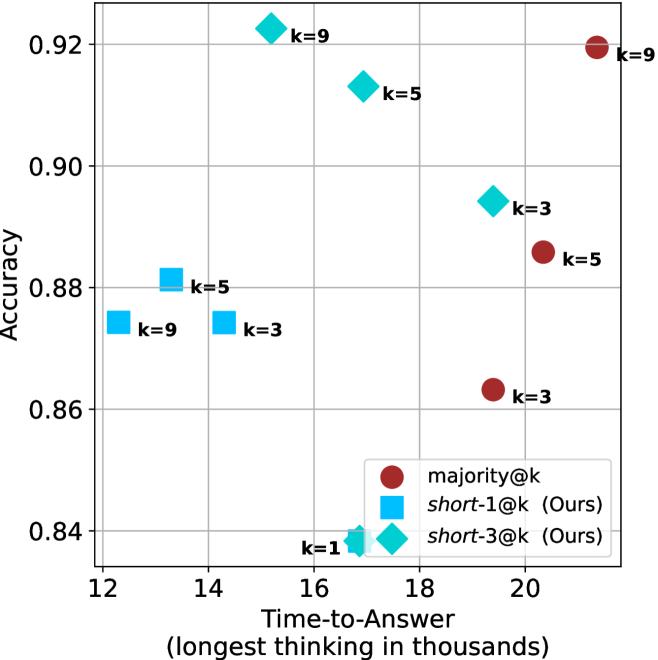
The image is a scatter plot comparing the accuracy of different methods (majority@k, short-1@k, and short-3@k) against the time taken to answer, measured in thousands. Each data point is labeled with a 'k' value, indicating a parameter associated with the method.
### Components/Axes
* **X-axis:** Time-to-Answer (longest thinking in thousands). Scale ranges from 12 to 20 in increments of 2.
* **Y-axis:** Accuracy. Scale ranges from 0.84 to 0.92 in increments of 0.02.
* **Legend (bottom-right):**
* Brown circle: majority@k
* Cyan square: short-1@k (Ours)
* Cyan diamond: short-3@k (Ours)
* **Data Points:** Each point is labeled with its corresponding 'k' value.
### Detailed Analysis
**1. majority@k (Brown Circles):**
* Trend: Accuracy generally increases with Time-to-Answer.
* k=3: Time-to-Answer ≈ 19, Accuracy ≈ 0.86
* k=5: Time-to-Answer ≈ 20, Accuracy ≈ 0.885
* k=9: Time-to-Answer ≈ 21, Accuracy ≈ 0.92
**2. short-1@k (Cyan Squares):**
* Trend: Accuracy is relatively stable with Time-to-Answer.
* k=9: Time-to-Answer ≈ 12.5, Accuracy ≈ 0.875
* k=5: Time-to-Answer ≈ 13.5, Accuracy ≈ 0.88
* k=3: Time-to-Answer ≈ 14.5, Accuracy ≈ 0.875
**3. short-3@k (Cyan Diamonds):**
* Trend: Accuracy increases with Time-to-Answer.
* k=1: Time-to-Answer ≈ 17, Accuracy ≈ 0.84
* k=3: Time-to-Answer ≈ 19, Accuracy ≈ 0.895
* k=5: Time-to-Answer ≈ 17.5, Accuracy ≈ 0.91
* k=9: Time-to-Answer ≈ 17, Accuracy ≈ 0.925
### Key Observations
* The 'majority@k' method shows a clear positive correlation between Time-to-Answer and Accuracy.
* The 'short-1@k' method has a relatively consistent accuracy, regardless of Time-to-Answer.
* The 'short-3@k' method demonstrates a positive correlation between Time-to-Answer and Accuracy, with the highest accuracy among the three methods for k=9.
* For 'short-3@k', k=1 has the lowest accuracy and shortest time.
### Interpretation
The scatter plot visualizes the trade-off between accuracy and time-to-answer for different methods. The 'majority@k' method benefits from increased thinking time, leading to higher accuracy. The 'short-1@k' method prioritizes speed, achieving a stable accuracy level regardless of time spent. The 'short-3@k' method appears to offer a balance, achieving high accuracy with a moderate time investment, especially for higher 'k' values. The data suggests that the choice of method depends on the specific requirements of the application, balancing the need for accuracy with the constraints on response time. The 'k' parameter seems to influence the performance of 'majority@k' and 'short-3@k' significantly.