## Diagram: GRPO Process Flow
### Overview
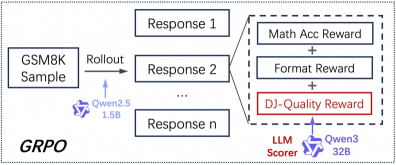
The image is a diagram illustrating the GRPO process flow, starting with a GSM8K sample and culminating in a DJ-Quality Reward. The process involves a rollout, multiple responses, and an LLM scorer.
### Components/Axes
* **Input:** GSM8K Sample
* **Rollout:** Process step indicated by an arrow pointing from the GSM8K Sample to the responses.
* **Responses:** Response 1, Response 2, ..., Response n. These are outputs from the rollout.
* **Rewards:** Math Acc Reward, Format Reward, DJ-Quality Reward. These are components of the final reward calculation.
* **LLM Scorer:** Used to evaluate the DJ-Quality Reward.
* **Models:** Qwen2.5 (1.5B), Qwen3 (32B)
### Detailed Analysis
1. **GSM8K Sample:** The process begins with a GSM8K sample.
2. **Rollout:** The GSM8K sample undergoes a "Rollout" process, powered by Qwen2.5 (1.5B).
3. **Responses:** The rollout generates multiple responses: Response 1, Response 2, and so on, up to Response n.
4. **Reward Calculation:** The Math Acc Reward and Format Reward are combined with the DJ-Quality Reward. The DJ-Quality Reward is determined by the LLM Scorer, which uses Qwen3 (32B).
5. **GRPO:** The overall process is labeled as GRPO.
### Key Observations
* The diagram illustrates a sequential process, starting with a sample and ending with a reward.
* The rollout step generates multiple responses, suggesting an iterative or parallel process.
* The LLM Scorer plays a crucial role in determining the DJ-Quality Reward.
* Two different Qwen models are used: Qwen2.5 for the rollout and Qwen3 for scoring.
### Interpretation
The diagram depicts a reinforcement learning or optimization process (GRPO) where a model (Qwen2.5) generates multiple responses to a given sample (GSM8K). These responses are then evaluated based on multiple criteria (Math Acc, Format, and DJ-Quality), with the DJ-Quality being assessed by another model (Qwen3). The combination of these rewards likely guides the learning process, improving the model's ability to generate high-quality responses. The use of different models for rollout and scoring suggests a potential strategy for leveraging different model strengths or reducing computational costs. The "..." indicates that there can be many responses, suggesting a sampling approach.