TECHNICAL ASSET FINGERPRINT
a8e4dd5b9ab2437df24dfcd0
Click to view fullscreen
Press ESC or click to close
FOUND IN PAPERS
EXPERT: healer-alpha-free VERSION 1
RUNTIME: free/openrouter/healer-alpha
INTEL_VERIFIED
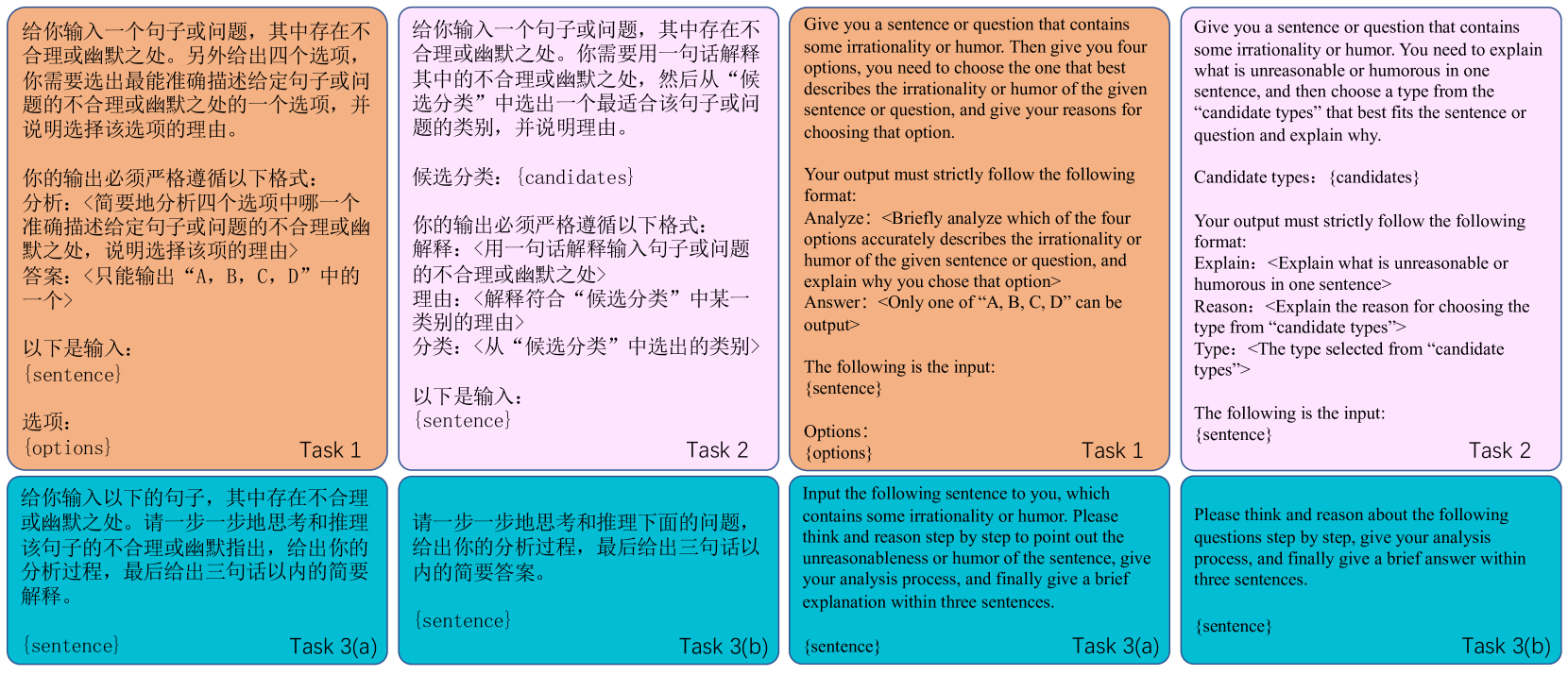
## Diagram: Task Instruction Templates for Analyzing Irrationality or Humor
### Overview
The image displays a structured grid of eight colored text boxes, each containing instructions for a specific task. The tasks involve analyzing a given sentence or question that contains irrationality or humor. The boxes are arranged in two rows of four. The top row contains four boxes (two orange, two purple) detailing "Task 1" and "Task 2" with multiple-choice formats. The bottom row contains four blue boxes detailing "Task 3(a)" and "Task 3(b)" with a step-by-step reasoning format. The instructions are presented bilingually, with the left half of the image in Chinese and the right half providing direct English translations of the same instructions.
### Components/Axes
The image is a diagram, not a chart. Its components are the eight instruction boxes.
* **Layout**: 2 rows x 4 columns grid.
* **Color Coding**:
* Top Row, Column 1: Orange box (Chinese, Task 1)
* Top Row, Column 2: Purple box (Chinese, Task 2)
* Top Row, Column 3: Orange box (English, Task 1)
* Top Row, Column 4: Purple box (English, Task 2)
* Bottom Row, Columns 1-4: All Blue boxes. Columns 1 & 3 are Task 3(a), Columns 2 & 4 are Task 3(b). Left two are Chinese, right two are English.
* **Text Language**: The left two columns contain instructions in **Chinese**. The right two columns contain the corresponding **English** translations.
### Detailed Analysis
**Top Row - Task 1 (Multiple-Choice Selection)**
* **Position**: Top-left (Chinese) and Top-center-right (English).
* **Color**: Orange.
* **Task Label**: "Task 1".
* **Content (Chinese Transcription)**:
> 给你输入一个句子或问题,其中存在不合理或幽默之处。另外给出四个选项,你需要选出最能准确描述给定句子或问题的不合理或幽默之处的一个选项,并说明选择该选项的理由。
> 你的输出必须严格遵循以下格式:
> 分析:<简要地分析四个选项中哪一个准确描述给定句子或问题的不合理或幽默之处,说明选择该项的理由>
> 答案:<只能输出 “A, B, C, D” 中的一个>
> 以下是输入:
> {sentence}
> 选项:
> {options}
* **Content (English Translation - as provided in the image)**:
> Give you a sentence or question that contains some irrationality or humor. Then give you four options, you need to choose the one that best describes the irrationality or humor of the given sentence or question, and give your reasons for choosing that option.
> Your output must strictly follow the following format:
> Analyze: <Briefly analyze which of the four options accurately describes the irrationality or humor of the given sentence or question, and explain why you chose that option>
> Answer: <Only one of “A, B, C, D” can be output>
> The following is the input:
> {sentence}
> Options:
> {options}
**Top Row - Task 2 (Categorization)**
* **Position**: Top-center-left (Chinese) and Top-right (English).
* **Color**: Purple.
* **Task Label**: "Task 2".
* **Content (Chinese Transcription)**:
> 给你输入一个句子或问题,其中存在不合理或幽默之处。你需要用一句话解释其中的不合理或幽默之处,然后从“候选分类”中选出一个最适合该句子或问题的类别,并说明理由。
> 候选分类:{candidates}
> 你的输出必须严格遵循以下格式:
> 解释:<用一句话解释输入句子或问题的不合理或幽默之处>
> 理由:<解释符合“候选分类”中某一类别的理由>
> 分类:<从“候选分类”中选出的类别>
> 以下是输入:
> {sentence}
* **Content (English Translation - as provided in the image)**:
> Give you a sentence or question that contains some irrationality or humor. You need to explain what is unreasonable or humorous in one sentence, and then choose a type from the “candidate types” that best fits the sentence or question and explain why.
> Candidate types: {candidates}
> Your output must strictly follow the following format:
> Explain: <Explain what is unreasonable or humorous in one sentence>
> Reason: <Explain the reason for choosing the type from “candidate types”>
> Type: <The type selected from “candidate types”>
> The following is the input:
> {sentence}
**Bottom Row - Task 3(a) (Step-by-Step Reasoning with Brief Explanation)**
* **Position**: Bottom-left (Chinese) and Bottom-center-right (English).
* **Color**: Blue.
* **Task Label**: "Task 3(a)".
* **Content (Chinese Transcription)**:
> 给你输入以下的句子,其中存在不合理或幽默之处。请一步一步地思考和推理该句子的不合理或幽默指出,给出你的分析过程,最后给出三句话以内的简要解释。
> {sentence}
* **Content (English Translation - as provided in the image)**:
> Input the following sentence to you, which contains some irrationality or humor. Please think and reason step by step to point out the unreasonableness or humor of the sentence, give your analysis process, and finally give a brief explanation within three sentences.
> {sentence}
**Bottom Row - Task 3(b) (Step-by-Step Reasoning with Brief Answer)**
* **Position**: Bottom-center-left (Chinese) and Bottom-right (English).
* **Color**: Blue.
* **Task Label**: "Task 3(b)".
* **Content (Chinese Transcription)**:
> 请一步一步地思考和推理下面的问题,给出你的分析过程,最后给出三句话以内的简要答案。
> {sentence}
* **Content (English Translation - as provided in the image)**:
> Please think and reason about the following questions step by step, give your analysis process, and finally give a brief answer within three sentences.
> {sentence}
### Key Observations
1. **Bilingual Presentation**: The diagram is explicitly bilingual. The left half (Columns 1 & 2) presents all instructions in **Chinese**. The right half (Columns 3 & 4) provides direct English translations of the corresponding tasks from the left.
2. **Task Taxonomy**: There are three primary task types:
* **Task 1**: Multiple-choice selection with justification.
* **Task 2**: Open-ended explanation followed by categorization from a provided list.
* **Task 3**: Step-by-step reasoning leading to a brief output. Task 3 is split into two sub-variants: 3(a) asks for a brief *explanation*, while 3(b) asks for a brief *answer*.
3. **Structured Output Format**: Each task mandates a strict, labeled output format (e.g., "Analyze:", "Answer:", "Explain:", "Reason:", "Type:").
4. **Input Placeholders**: All tasks use `{sentence}` as a placeholder for the input text. Tasks 1 and 2 also use `{options}` and `{candidates}` respectively for their additional input parameters.
5. **Color-Coded Grouping**: Color is used to group related tasks. Orange for Task 1, purple for Task 2, and blue for all Task 3 variants.
### Interpretation
This image serves as a technical specification or prompt template sheet for a natural language processing (NLP) system or human annotators tasked with analyzing linguistic irrationality or humor. It defines a clear, multi-faceted evaluation framework.
* **Purpose**: The diagram outlines a methodology for dissecting non-literal language. It moves from simple recognition and selection (Task 1) to explanation and classification (Task 2), and finally to deep, transparent reasoning (Task 3). This progression suggests a need to test or implement different levels of analytical depth.
* **Relationship Between Elements**: The tasks are complementary. Task 1 tests discriminative ability among predefined descriptions. Task 2 tests generative explanation and taxonomic understanding. Task 3 tests the reasoning chain itself, prioritizing process over a specific output format. The bilingual nature indicates the framework is designed for a cross-lingual context or for validation across language speakers.
* **Notable Design Choices**: The strict output formatting is critical for automated processing or consistent human evaluation. The separation of Task 3 into (a) and (b) highlights a nuanced distinction between providing an explanatory summary versus a concise answer, both derived from the same reasoning process. The use of placeholders (`{sentence}`, etc.) confirms these are templates meant to be populated with specific test cases.
DECODING INTELLIGENCE...