## Diagram Series: Grid-Based Puzzle Level Layouts
### Overview
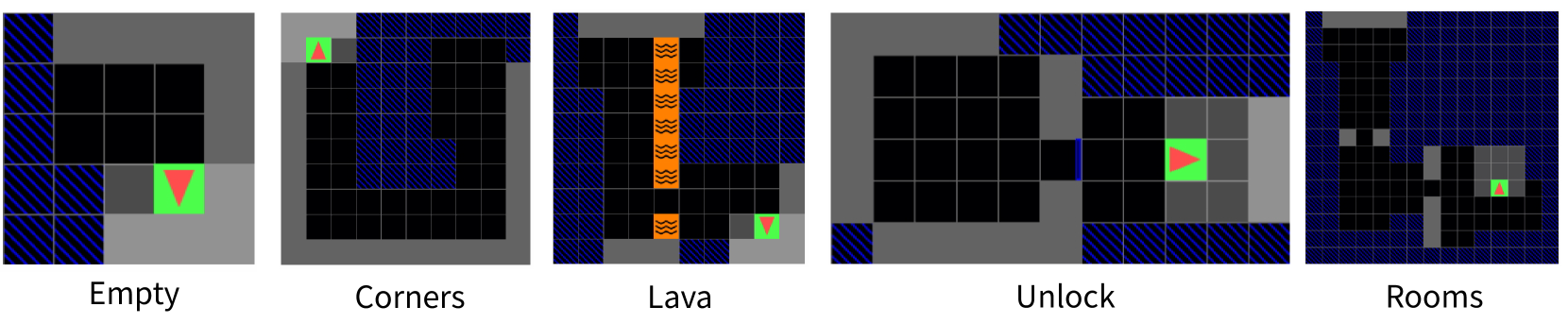
The image displays a horizontal sequence of five distinct grid-based diagrams, each representing a different puzzle or game level layout. Each diagram is a rectangular grid composed of colored tiles and is labeled with a title below it. The diagrams appear to illustrate different environmental mechanics or challenges, likely from a puzzle game or a level design document.
### Components/Axes
* **Structure:** Five separate grid diagrams arranged horizontally.
* **Common Elements:**
* **Grid:** Each diagram is a grid of square tiles (approximately 8x8 or similar).
* **Tile Types (by color/pattern):**
* **Black:** Solid, impassable walls or obstacles.
* **Gray:** Open, passable floor or ground.
* **Dark Blue with Diagonal Stripes:** A distinct terrain type, possibly water, void, or a special boundary.
* **Green with Red Triangle:** A special tile, likely representing the player character, start point, or an interactive element. The red triangle points in a direction (down, up, right).
* **Orange with Black Wavy Lines:** A hazard tile, explicitly labeled as "Lava."
* **Labels:** Each diagram has a text label centered beneath it: "Empty", "Corners", "Lava", "Unlock", "Rooms".
### Detailed Analysis
**Panel 1: "Empty"**
* **Layout:** A large, roughly rectangular black area occupies the center-left. Gray floor surrounds it. A column of blue-striped tiles runs along the far left edge.
* **Key Element:** The green/red triangle tile is located in the bottom-right quadrant on a gray tile. The triangle points downward.
**Panel 2: "Corners"**
* **Layout:** The black area forms a more complex, angular shape. Blue-striped tiles are prominent in the top-left and top-right corners, creating a framed effect.
* **Key Element:** The green/red triangle tile is positioned in the top-left corner on a gray tile. The triangle points upward.
**Panel 3: "Lava"**
* **Layout:** Features a vertical column of orange "Lava" tiles running down the center. Black walls are on either side. Blue-striped tiles are present on the left and right edges.
* **Key Element:** The green/red triangle tile is in the bottom-right corner, adjacent to the lava column. The triangle points downward.
**Panel 4: "Unlock"**
* **Layout:** Shows two main black rectangular areas separated by a narrow gray corridor. A single vertical blue line (possibly a door or barrier) is visible in the corridor. Blue-striped tiles are at the top and bottom edges.
* **Key Element:** The green/red triangle tile is located in the right-hand black area, on a gray tile within it. The triangle points to the right.
**Panel 5: "Rooms"**
* **Layout:** The most complex layout, featuring multiple distinct black "rooms" connected by narrow gray corridors. The blue-striped tiles form a large outer boundary.
* **Key Element:** The green/red triangle tile is situated inside a small, central black room. The triangle points upward.
### Key Observations
1. **Progression of Complexity:** The diagrams show a clear increase in structural complexity from "Empty" (simple block) to "Rooms" (multiple interconnected chambers).
2. **Mechanic Introduction:** Each panel introduces or highlights a specific game mechanic: basic navigation ("Empty"), angular movement ("Corners"), environmental hazard ("Lava"), a gating mechanism ("Unlock"), and multi-room exploration ("Rooms").
3. **Player Start Position:** The green tile's location and orientation change in each diagram, suggesting different starting scenarios or objectives for each level.
4. **Consistent Visual Language:** The color and pattern coding for walls, floors, hazards, and the player is consistent across all five diagrams.
### Interpretation
This image is a technical or design document illustrating a set of foundational puzzle templates or level archetypes. The diagrams are not random; they are carefully constructed to teach or test specific player skills and understanding of game rules.
* **"Empty"** teaches basic movement and goal identification (reach the green tile?).
* **"Corners"** introduces navigation around obstacles with diagonal boundaries.
* **"Lava"** adds a dynamic hazard, requiring pathfinding that avoids a specific tile type.
* **"Unlock"** implies a conditional progression mechanic (e.g., finding a key to remove the blue barrier).
* **"Rooms"** combines previous elements into a more complex spatial reasoning challenge involving exploration and possibly backtracking.
The sequence suggests a pedagogical or iterative design approach, where each level builds upon the mechanics introduced in the previous ones. The consistent use of the green/red triangle tile anchors the player's perspective across all varying environments. This is likely a reference for developers, artists, or testers to understand the core puzzle logic of a game.