## Line Chart: Performance Metrics Over Time
### Overview
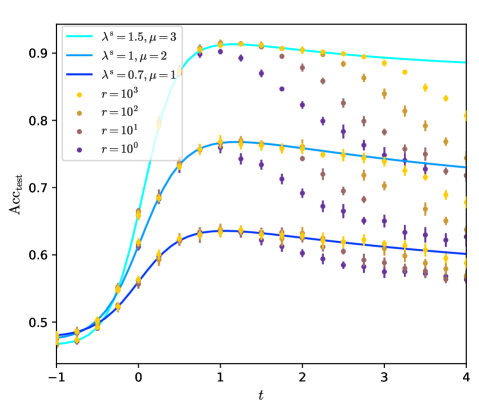
The chart displays three performance curves (Acc_test) plotted against time (t) for different parameter combinations. Each curve represents a unique configuration of λ*, μ, and r values, with data points showing empirical results across time intervals.
### Components/Axes
- **X-axis (t)**: Time, ranging from -1 to 4 in increments of 1.
- **Y-axis (Acc_test)**: Performance metric, scaled from 0.5 to 0.9 in increments of 0.1.
- **Legend**: Located in the top-left corner, mapping colors to parameter sets:
- Cyan: λ* = 1.5, μ = 3
- Blue: λ* = 1, μ = 2
- Orange: λ* = 0.7, μ = 1
- **Data Points**: Diamond-shaped markers in colors matching their respective legend entries.
### Detailed Analysis
1. **Cyan Line (λ* = 1.5, μ = 3)**:
- Starts at ~0.45 at t = -1.
- Peaks sharply at ~0.9 near t = 1.
- Declines gradually to ~0.85 by t = 4.
- Data points (r = 10³, 10², 10¹, 10⁰) align closely with the curve, showing minor variance.
2. **Blue Line (λ* = 1, μ = 2)**:
- Begins at ~0.48 at t = -1.
- Rises to ~0.85 at t = 1.
- Drops to ~0.75 by t = 4.
- Data points (r = 10³, 10², 10¹, 10⁰) follow the trend with slight scatter.
3. **Orange Line (λ* = 0.7, μ = 1)**:
- Starts at ~0.52 at t = -1.
- Peaks at ~0.75 near t = 1.
- Declines to ~0.65 by t = 4.
- Data points (r = 10³, 10², 10¹, 10⁰) show increasing deviation from the curve as r decreases.
### Key Observations
- **Peak Performance**: The cyan line (λ* = 1.5, μ = 3) achieves the highest Acc_test (~0.9), while the orange line (λ* = 0.7, μ = 1) has the lowest peak (~0.75).
- **Decay Rate**: Higher λ* and μ values correlate with faster initial gains but steeper declines post-t = 1.
- **r Value Impact**: For fixed λ* and μ, lower r values (e.g., r = 10⁰) exhibit greater divergence from the theoretical curve, suggesting r may represent sample size or another scaling factor inversely related to performance stability.
### Interpretation
The chart demonstrates that parameter tuning (λ*, μ) significantly impacts both peak performance and temporal stability. The cyan configuration (high λ*, μ) maximizes short-term gains but suffers from rapid decay, while the orange configuration (low λ*, μ) shows more gradual but sustained performance. The r values likely represent experimental conditions (e.g., dataset size), with smaller r values introducing greater variability. This suggests a trade-off between aggressive parameter settings for immediate results and conservative settings for long-term reliability. The empirical data points validate the theoretical curves but highlight practical limitations at smaller scales (r = 10⁰).