## Heatmap: Emotion Prediction Accuracy
### Overview
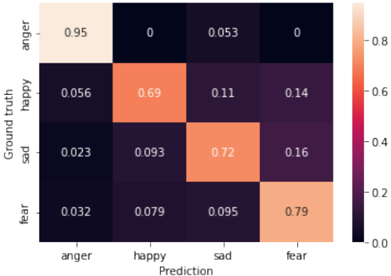
This heatmap visualizes the performance of an emotion classification model, showing the probability distribution of predicted emotions against ground truth labels. The matrix reveals model confidence in correctly identifying emotions and cross-prediction errors.
### Components/Axes
- **Vertical Axis (Ground Truth)**:
- Categories: anger, happy, sad, fear
- **Horizontal Axis (Prediction)**:
- Categories: anger, happy, sad, fear
- **Color Legend**:
- Scale: 0.0 (dark purple) to 0.8 (light yellow)
- Position: Right side of the heatmap
### Detailed Analysis
1. **Anger (Ground Truth)**:
- Predicted as anger: 0.95 (light yellow)
- Predicted as happy: 0.00
- Predicted as sad: 0.053 (dark purple)
- Predicted as fear: 0.00
2. **Happy (Ground Truth)**:
- Predicted as anger: 0.056 (dark purple)
- Predicted as happy: 0.69 (orange)
- Predicted as sad: 0.11 (dark purple)
- Predicted as fear: 0.14 (dark purple)
3. **Sad (Ground Truth)**:
- Predicted as anger: 0.023 (dark purple)
- Predicted as happy: 0.093 (dark purple)
- Predicted as sad: 0.72 (orange)
- Predicted as fear: 0.16 (dark purple)
4. **Fear (Ground Truth)**:
- Predicted as anger: 0.032 (dark purple)
- Predicted as happy: 0.079 (dark purple)
- Predicted as sad: 0.095 (dark purple)
- Predicted as fear: 0.79 (light yellow)
### Key Observations
- **High Accuracy for Anger/Fear**:
- Anger predictions show near-perfect accuracy (0.95) with minimal cross-prediction errors.
- Fear predictions also demonstrate strong performance (0.79) but with slightly more confusion (0.095 for sad).
- **Happy/Sad Confusion**:
- Happy emotions are misclassified as fear (0.14) and sad (0.11) at similar rates.
- Sad emotions are misclassified as fear (0.16) more frequently than happy (0.093).
- **Model Bias**:
- The diagonal dominance (correct predictions) suggests the model prioritizes anger and fear classifications.
- Happy and sad emotions exhibit lower overall accuracy (0.69 and 0.72 respectively) with significant cross-prediction.
### Interpretation
The model excels at identifying anger and fear, likely due to distinct features in training data for these emotions. However, happy and sad classifications suffer from lower accuracy and notable confusion between these two categories, suggesting overlapping emotional cues in the dataset. The near-zero values for anger predictions in non-anger categories indicate high confidence in anger detection, while the 0.053 sad prediction for anger suggests rare but notable misclassifications. This pattern highlights potential limitations in handling nuanced emotional states and opportunities for improving happy/sad differentiation through feature engineering or model refinement.