## Flowchart: Automated Query Processing Workflow
### Overview
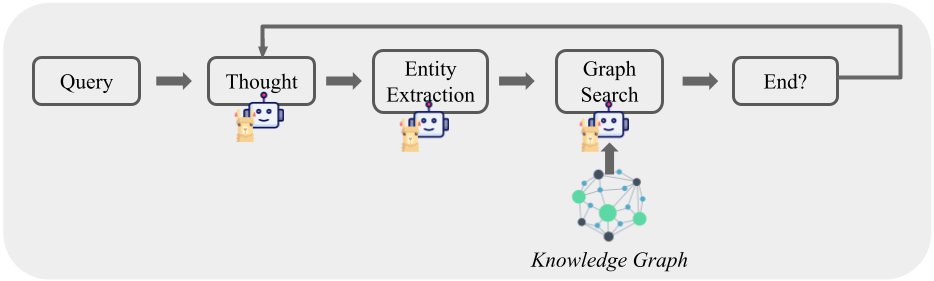
The image depicts a linear workflow diagram with five sequential steps, each represented by a labeled box connected by arrows. A "Knowledge Graph" visual element is positioned below the flowchart, connected to the "Graph Search" step. Robot emojis (🤖) are embedded in each step box, suggesting automation or AI involvement.
### Components/Axes
1. **Steps/Nodes**:
- Query (top-left)
- Thought (center-left)
- Entity Extraction (center)
- Graph Search (center-right)
- End? (top-right)
2. **Arrows**:
- Directed flow from left to right, top to bottom
- Feedback loop from "End?" back to "Thought"
3. **Visual Elements**:
- Robot emojis (🤖) in each step box
- Knowledge Graph (bottom-center): A network diagram with green/blue nodes and gray edges
### Detailed Analysis
1. **Query → Thought**:
- Input query triggers initial processing ("Thought" step)
2. **Thought → Entity Extraction**:
- Processed query leads to entity identification
3. **Entity Extraction → Graph Search**:
- Extracted entities inform knowledge graph queries
4. **Graph Search → End?**:
- Search results determine process termination
5. **Feedback Loop**:
- "End?" connects back to "Thought" for potential iteration
### Key Observations
- **Automation Theme**: Consistent robot emojis suggest AI/ML integration throughout the process
- **Knowledge Graph Dependency**: The network diagram implies structured data relationships are critical for the Graph Search step
- **Iterative Potential**: Feedback loop indicates possible cyclical processing until termination conditions are met
- **Ambiguous Terminology**: "Thought" and "End?" steps lack specific definitions in the diagram
### Interpretation
This flowchart represents an automated information retrieval system where:
1. Queries are processed through successive stages of analysis
2. Entity recognition feeds into knowledge graph queries
3. The system may iterate between "Thought" and "End?" based on search results
4. The Knowledge Graph serves as the authoritative data source for the Graph Search step
The diagram emphasizes machine-driven decision-making, with human intervention implied only at the initial Query stage. The lack of explicit termination criteria in the "End?" box suggests either:
- A binary yes/no decision point
- A confidence threshold for result acceptance
- A placeholder for additional conditional logic
The Knowledge Graph's central position highlights its importance as the system's knowledge base, while the robot emojis reinforce the theme of automated cognitive processing.