## Visual Logic Puzzle: Grid Pattern Recognition
### Overview
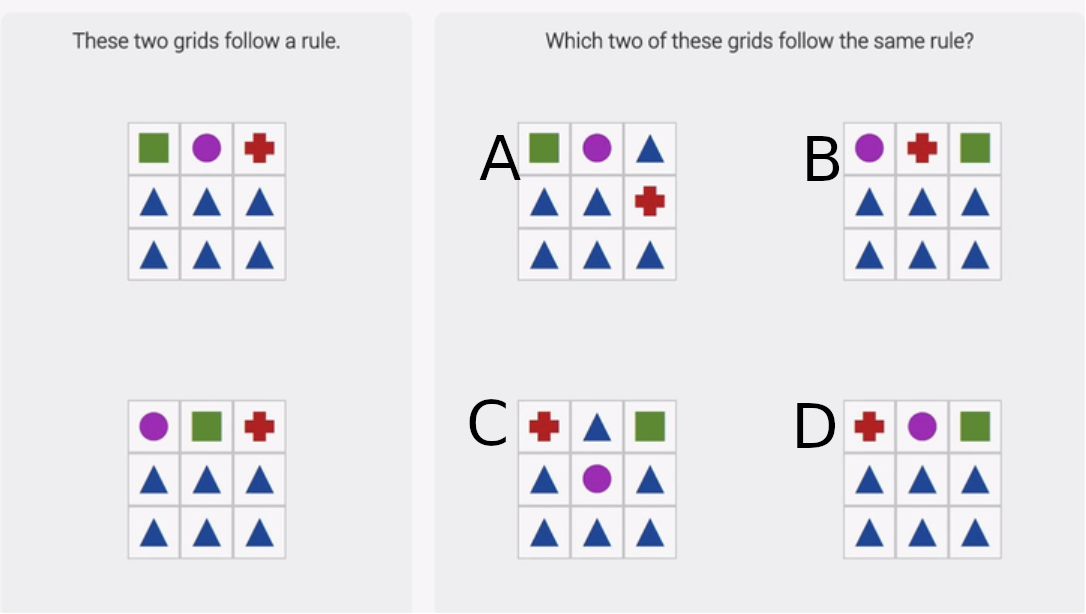
The image presents a visual logic puzzle divided into two main panels. The left panel establishes a rule using two example 3x3 grids. The right panel poses a question, asking the viewer to identify which two of four option grids (A, B, C, D) follow the same established rule. The puzzle uses a set of colored geometric symbols.
### Components/Axes
**Textual Content:**
* **Left Panel Header:** "These two grids follow a rule."
* **Right Panel Header:** "Which two of these grids follow the same rule?"
* **Option Labels:** The letters "A", "B", "C", and "D" are placed to the left of their respective grids.
**Visual Elements (Symbols):**
The puzzle uses four distinct symbols, each with a consistent color:
1. **Green Square**
2. **Purple Circle**
3. **Red Plus Sign (+)**
4. **Blue Triangle**
**Grid Structure:**
All grids are 3x3 matrices (3 rows, 3 columns).
### Detailed Analysis
**1. Example Grids (Left Panel - Establishing the Rule):**
* **Top Example Grid:**
* Row 1: [Green Square] [Purple Circle] [Red Plus]
* Row 2: [Blue Triangle] [Blue Triangle] [Blue Triangle]
* Row 3: [Blue Triangle] [Blue Triangle] [Blue Triangle]
* **Bottom Example Grid:**
* Row 1: [Purple Circle] [Green Square] [Red Plus]
* Row 2: [Blue Triangle] [Blue Triangle] [Blue Triangle]
* Row 3: [Blue Triangle] [Blue Triangle] [Blue Triangle]
**2. Option Grids (Right Panel - Applying the Rule):**
* **Grid A:**
* Row 1: [Green Square] [Purple Circle] [Blue Triangle]
* Row 2: [Blue Triangle] [Blue Triangle] [Red Plus]
* Row 3: [Blue Triangle] [Blue Triangle] [Blue Triangle]
* **Grid B:**
* Row 1: [Purple Circle] [Red Plus] [Green Square]
* Row 2: [Blue Triangle] [Blue Triangle] [Blue Triangle]
* Row 3: [Blue Triangle] [Blue Triangle] [Blue Triangle]
* **Grid C:**
* Row 1: [Red Plus] [Blue Triangle] [Green Square]
* Row 2: [Blue Triangle] [Purple Circle] [Blue Triangle]
* Row 3: [Blue Triangle] [Blue Triangle] [Blue Triangle]
* **Grid D:**
* Row 1: [Red Plus] [Purple Circle] [Green Square]
* Row 2: [Blue Triangle] [Blue Triangle] [Blue Triangle]
* Row 3: [Blue Triangle] [Blue Triangle] [Blue Triangle]
### Key Observations
1. **Rule Deduction:** The two example grids share a strict pattern: The **first row contains exactly one of each of the three non-triangle symbols** (Green Square, Purple Circle, Red Plus) in some order. The **second and third rows consist entirely of Blue Triangles**.
2. **Grid A Violation:** The first row contains a Blue Triangle, and the second row contains a Red Plus. This breaks both parts of the deduced rule.
3. **Grid C Violation:** The first row contains a Blue Triangle, and the second row contains a Purple Circle. This also breaks both parts of the rule.
4. **Grids B & D Compliance:** Both Grid B and Grid D have a first row containing the three unique symbols (Square, Circle, Plus) in different permutations. Their second and third rows are composed solely of Blue Triangles, perfectly matching the pattern from the examples.
### Interpretation
This is a non-verbal reasoning test of pattern recognition and rule application. The puzzle's core logic is based on **set composition and positional constraints**.
* **What the data suggests:** The rule defines a specific "signature" for a valid grid: a unique symbol trio in the primary (top) row and uniformity (all triangles) in the secondary rows. The order of the trio in the top row is variable, but its composition is fixed.
* **How elements relate:** The example grids serve as the "training data," defining the rule. The option grids are test cases. The solver must abstract the rule from the examples and then apply it deductively to the new cases.
* **Notable patterns/anomalies:** The most common failure modes in the incorrect options (A and C) are the intrusion of a triangle into the top row or the placement of a unique symbol (Plus or Circle) into the lower rows. The correct answers (B and D) are distinguished only by the permutation of the top-row symbols, demonstrating that the rule cares about the *set* of symbols in the top row, not their specific sequence.
**Conclusion:** Based on the extracted visual data and the deduced rule, **Grids B and D** are the two grids that follow the same rule as the provided examples.