## Code Snippet: Equation Definition
### Overview
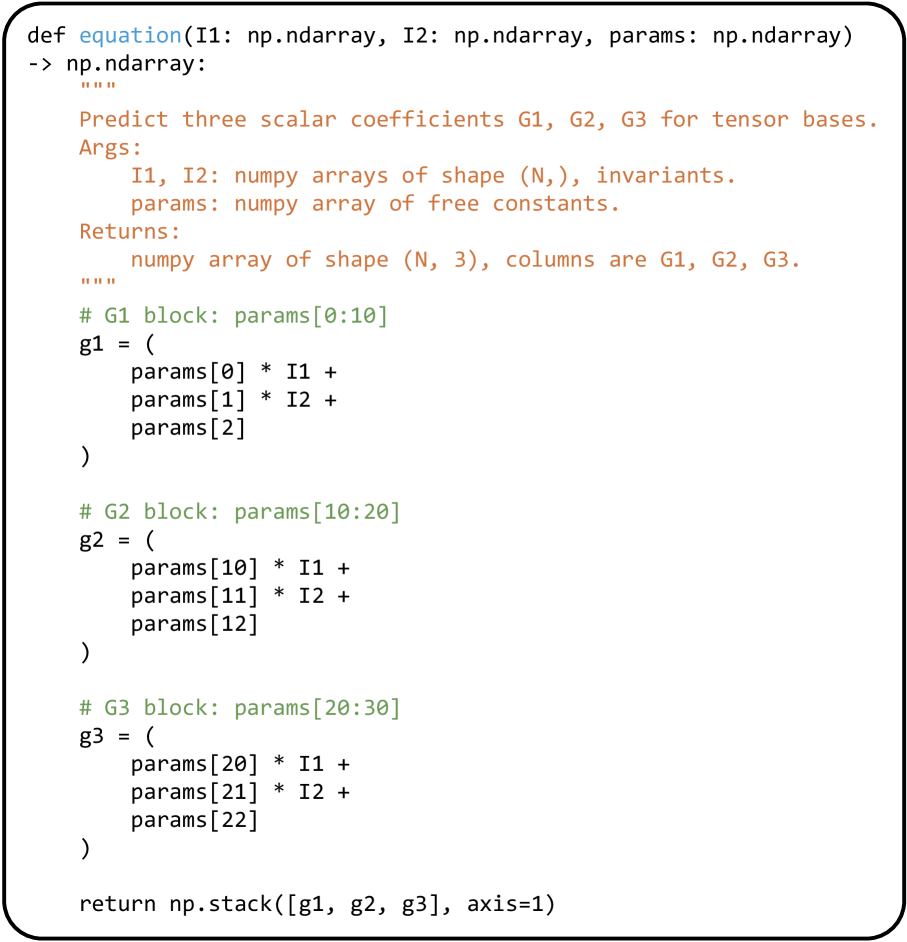
The image presents a Python code snippet defining a function named `equation` using the NumPy library. The function predicts three scalar coefficients (G1, G2, G3) for tensor bases based on input arrays I1, I2, and params.
### Components/Axes
* **Function Definition:** `def equation(I1: np.ndarray, I2: np.ndarray, params: np.ndarray) -> np.ndarray:`
* Defines a function named "equation" that takes three NumPy array arguments: `I1`, `I2`, and `params`.
* Specifies the return type as a NumPy array (`np.ndarray`).
* **Docstring:**
* "Predict three scalar coefficients G1, G2, G3 for tensor bases." - Describes the function's purpose.
* "Args:" - Specifies the input arguments:
* "I1, I2: numpy arrays of shape (N,), invariants." - Describes `I1` and `I2` as NumPy arrays of shape (N,) representing invariants.
* "params: numpy array of free constants." - Describes `params` as a NumPy array of free constants.
* "Returns:" - Specifies the return value:
* "numpy array of shape (N, 3), columns are G1, G2, G3." - Describes the return value as a NumPy array of shape (N, 3) with columns representing G1, G2, and G3.
* **G1 Block:** `# G1 block: params[0:10]`
* Calculates `g1` based on `params[0]`, `params[1]`, `params[2]`, `I1`, and `I2`.
* `g1 = (params[0] * I1 + params[1] * I2 + params[2])`
* **G2 Block:** `# G2 block: params[10:20]`
* Calculates `g2` based on `params[10]`, `params[11]`, `params[12]`, `I1`, and `I2`.
* `g2 = (params[10] * I1 + params[11] * I2 + params[12])`
* **G3 Block:** `# G3 block: params[20:30]`
* Calculates `g3` based on `params[20]`, `params[21]`, `params[22]`, `I1`, and `I2`.
* `g3 = (params[20] * I1 + params[21] * I2 + params[22])`
* **Return Statement:** `return np.stack([g1, g2, g3], axis=1)`
* Stacks `g1`, `g2`, and `g3` horizontally (along `axis=1`) to create the output array.
### Detailed Analysis or ### Content Details
The function `equation` computes three values, `g1`, `g2`, and `g3`, each representing a linear combination of the input arrays `I1` and `I2`, plus a constant term. The coefficients for these linear combinations are extracted from the `params` array using array slicing. Specifically:
* `g1` uses `params[0]`, `params[1]`, and `params[2]`.
* `g2` uses `params[10]`, `params[11]`, and `params[12]`.
* `g3` uses `params[20]`, `params[21]`, and `params[22]`.
The function then stacks these three values horizontally to create a NumPy array of shape (N, 3), where N is the length of the input arrays `I1` and `I2`.
### Key Observations
* The function uses array slicing to extract different sets of parameters from the `params` array for calculating `g1`, `g2`, and `g3`.
* The calculations for `g1`, `g2`, and `g3` are structurally identical, differing only in the indices used to access the `params` array.
* The final output is created by stacking the calculated values horizontally.
### Interpretation
The code snippet defines a function that predicts three scalar coefficients (G1, G2, G3) for tensor bases. It takes two invariant arrays (I1, I2) and a parameter array as input. The function calculates G1, G2, and G3 as linear combinations of I1 and I2, using different subsets of the parameter array as coefficients. The resulting G1, G2, and G3 values are then stacked into a single array, which is returned. This function is likely part of a larger system for tensor analysis or machine learning where the parameters are learned or optimized to predict the tensor coefficients.