\n
## Code Block: Python Function Definition
### Overview
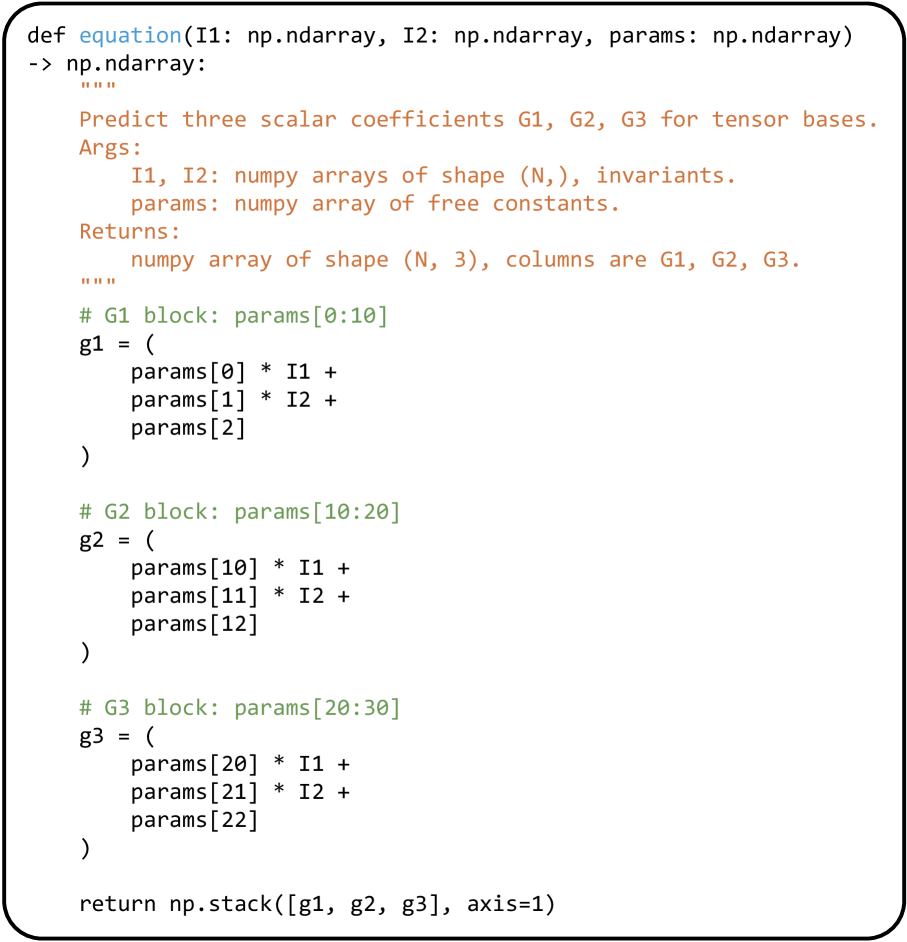
The image presents a Python code block defining a function named `equation`. This function takes three NumPy arrays as input: `I1`, `I2`, and `params`, and returns a NumPy array. The function's purpose is to predict three scalar coefficients (G1, G2, G3) based on tensor bases.
### Components/Axes
The code block consists of:
- A function definition line: `def equation(I1: np.ndarray, I2: np.ndarray, params: np.ndarray) -> np.ndarray:`
- A docstring explaining the function's purpose, arguments, and return value.
- Three blocks of code, each calculating one of the coefficients (G1, G2, G3).
- A return statement that stacks the calculated coefficients into a single NumPy array.
### Detailed Analysis or Content Details
The function `equation` is defined as follows:
```python
def equation(I1: np.ndarray, I2: np.ndarray, params: np.ndarray) -> np.ndarray:
"""
Predict three scalar coefficients G1, G2, G3 for tensor bases.
Args:
I1, I2: numpy arrays of shape (N), invariants.
params: numpy array of free constants.
Returns:
numpy array of shape (N, 3), columns are G1, G2, G3.
"""
# G1 block: params[0:10]
g1 = (
params[0] * I1 +
params[1] * I2 +
params[2]
)
# G2 block: params[10:20]
g2 = (
params[10] * I1 +
params[11] * I2 +
params[12]
)
# G3 block: params[20:30]
g3 = (
params[20] * I1 +
params[21] * I2 +
params[22]
)
return np.stack((g1, g2, g3), axis=1)
```
- **Input Arguments:**
- `I1`: A NumPy array of shape (N).
- `I2`: A NumPy array of shape (N).
- `params`: A NumPy array containing free constants.
- **Coefficient Calculation:**
- `g1` is calculated using `params[0]`, `params[1]`, and `params[2]`.
- `g2` is calculated using `params[10]`, `params[11]`, and `params[12]`.
- `g3` is calculated using `params[20]`, `params[21]`, and `params[22]`.
- **Return Value:**
- A NumPy array of shape (N, 3), where each column represents one of the coefficients (G1, G2, G3).
### Key Observations
- The function uses a linear combination of `I1` and `I2` to calculate each coefficient.
- The `params` array is partitioned into three blocks: `params[0:10]` for G1, `params[10:20]` for G2, and `params[20:30]` for G3.
- The function utilizes NumPy's `np.stack` function to combine the calculated coefficients into a single array.
### Interpretation
The code implements a linear regression-like model to predict three coefficients (G1, G2, G3) based on two input arrays (I1, I2) and a set of parameters. The parameters are organized into blocks, suggesting that each block corresponds to a specific coefficient. The function's structure suggests that it could be used as part of a larger system for tensor decomposition or model fitting. The use of NumPy arrays indicates that the function is designed for efficient numerical computation. The docstring provides clear documentation of the function's purpose, arguments, and return value, which is good programming practice.