## Diagram: Geometric/Topological Classification of Types and Methods
### Overview
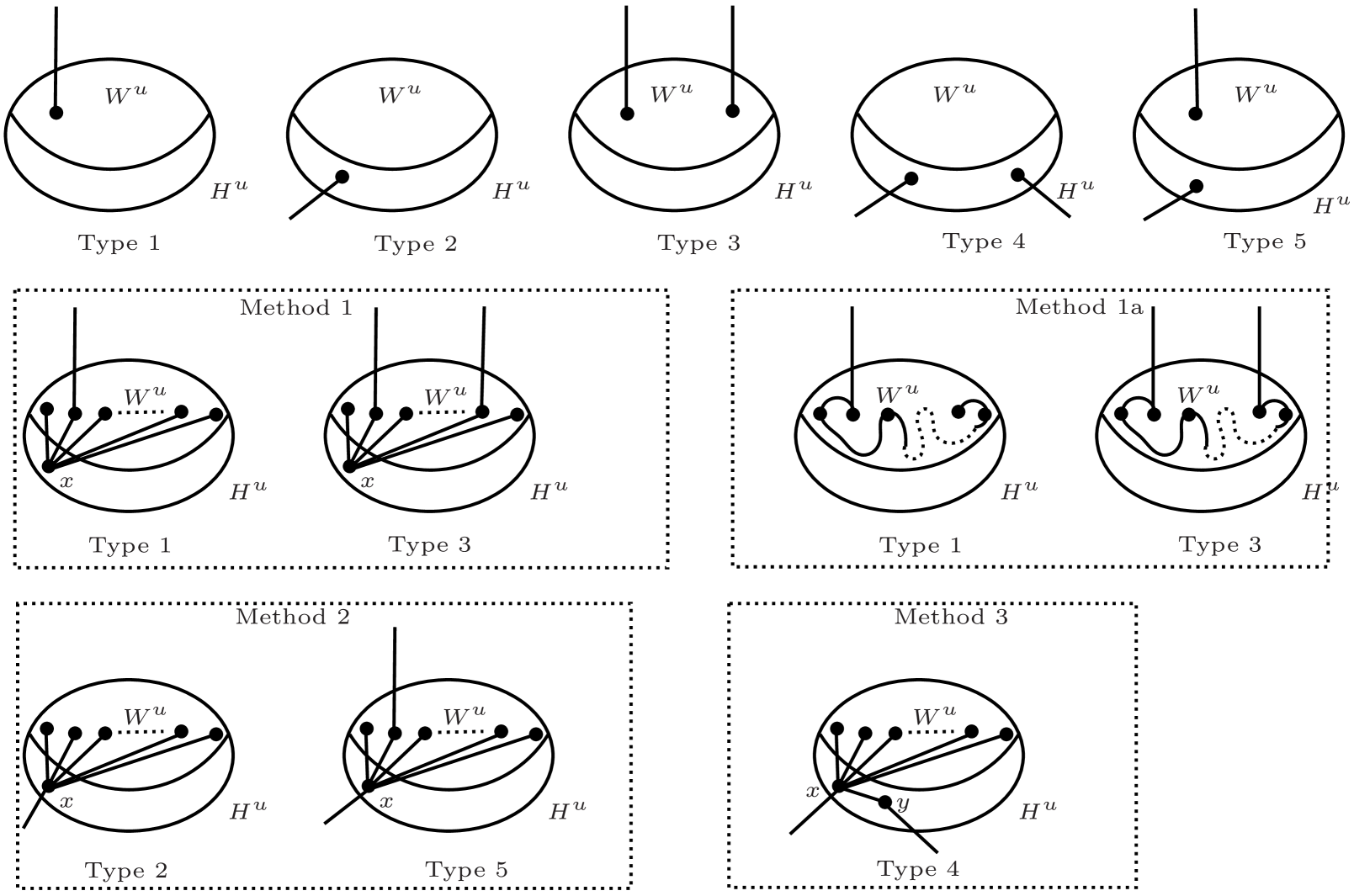
The image presents a series of schematic diagrams illustrating topological or geometric configurations, likely related to handlebody theory, surface topology, or graph embeddings. The diagrams are organized into two sections: a top row defining five distinct "Types" (1 through 5) and a lower section grouping these types into "Methods" (1, 1a, 2, and 3). Each diagram features an ellipse representing a space, with internal points and connecting lines indicating structural relationships.
### Components/Axes
* **Labels:**
* **$W^u$**: Denotes the upper region or interior of the ellipse.
* **$H^u$**: Denotes the lower region or boundary of the ellipse.
* **$x$**: A specific basepoint or root vertex located on the left side of the ellipse boundary.
* **$y$**: A specific point located on the lower boundary of the ellipse (only in Method 3).
* **Types 1-5**: Classifications of the geometric configuration.
* **Methods 1, 1a, 2, 3**: Groupings of specific types, indicating operations or constructions.
### Detailed Analysis
#### Top Row: Baseline Types
* **Type 1**: An ellipse with one point on the upper boundary ($W^u$) and one vertical line extending upward from it.
* **Type 2**: An ellipse with one point on the lower boundary ($H^u$) and one line extending downward from it.
* **Type 3**: An ellipse with two points on the upper boundary ($W^u$), each with a vertical line extending upward.
* **Type 4**: An ellipse with two points on the lower boundary ($H^u$), each with a line extending downward.
* **Type 5**: An ellipse with one point on the upper boundary ($W^u$) and one point on the lower boundary ($H^u$), with lines extending both upward and downward.
#### Boxed Methods
* **Method 1 (Left Box)**:
* **Type 1**: A central point $x$ on the left is connected by solid lines to four points on the upper boundary ($W^u$).
* **Type 3**: Similar to Type 1, but with an additional vertical line extending upward from the rightmost point on the upper boundary.
* **Method 1a (Right Box)**:
* **Type 1**: Points on the upper boundary ($W^u$) are connected to each other via curved, dashed lines.
* **Type 3**: Similar to Type 1, but with an additional vertical line extending upward from the rightmost point on the upper boundary.
* **Method 2 (Bottom Left Box)**:
* **Type 2**: A central point $x$ on the left is connected by solid lines to four points on the upper boundary ($W^u$).
* **Type 5**: Similar to Type 2, but with an additional vertical line extending upward from the rightmost point on the upper boundary.
* **Method 3 (Bottom Right Box)**:
* **Type 4**: A central point $x$ on the left is connected by solid lines to four points on the upper boundary ($W^u$). Additionally, there is a point $y$ on the lower boundary ($H^u$) connected to the central point $x$.
### Key Observations
* **Structural Progression**: The "Methods" appear to be applying a "star graph" structure (rooted at $x$) to the baseline "Types" defined in the top row.
* **Line Styles**:
* **Solid lines** (Methods 1, 2, 3) suggest direct connections or edges in a graph.
* **Dashed/Curved lines** (Method 1a) suggest a different type of relationship, possibly representing paths, homotopy, or specific boundary interactions distinct from the solid-line connections.
* **Point $x$**: In all boxed methods, $x$ acts as a primary hub or root vertex from which connections emanate to the rest of the structure.
### Interpretation
This diagram likely originates from a mathematical paper concerning **Heegaard splittings**, **train tracks on surfaces**, or **handlebody decompositions**.
* **The "Types"**: These represent fundamental building blocks or "handles" of a manifold. The distinction between $W^u$ (upper) and $H^u$ (lower) suggests a splitting of a surface or 3-manifold.
* **The "Methods"**: These represent different ways to construct or modify these manifolds.
* **Method 1/2/3** likely represent the construction of a graph embedded within the manifold, where $x$ is a basepoint.
* **Method 1a** is distinct because it uses dashed lines, implying it describes a different topological operation—perhaps a "cut-and-paste" operation or a specific type of curve system on the surface that differs from the graph-based connections in the other methods.
* **Peircean Investigative Note**: The consistency of the "Type" labels across the top row and the boxed sections suggests that the boxed sections are *instantiations* or *applications* of these types within a larger, more complex system. The transition from Type 1 to Type 3 in the boxed sections (adding an extra vertical line) suggests an incremental increase in complexity or "genus" of the underlying structure.