TECHNICAL ASSET FINGERPRINT
ac8ec8a04582e9a927c59adb
Click to view fullscreen
Press ESC or click to close
FOUND IN PAPERS
EXPERT: healer-alpha-free VERSION 1
RUNTIME: free/openrouter/healer-alpha
INTEL_VERIFIED
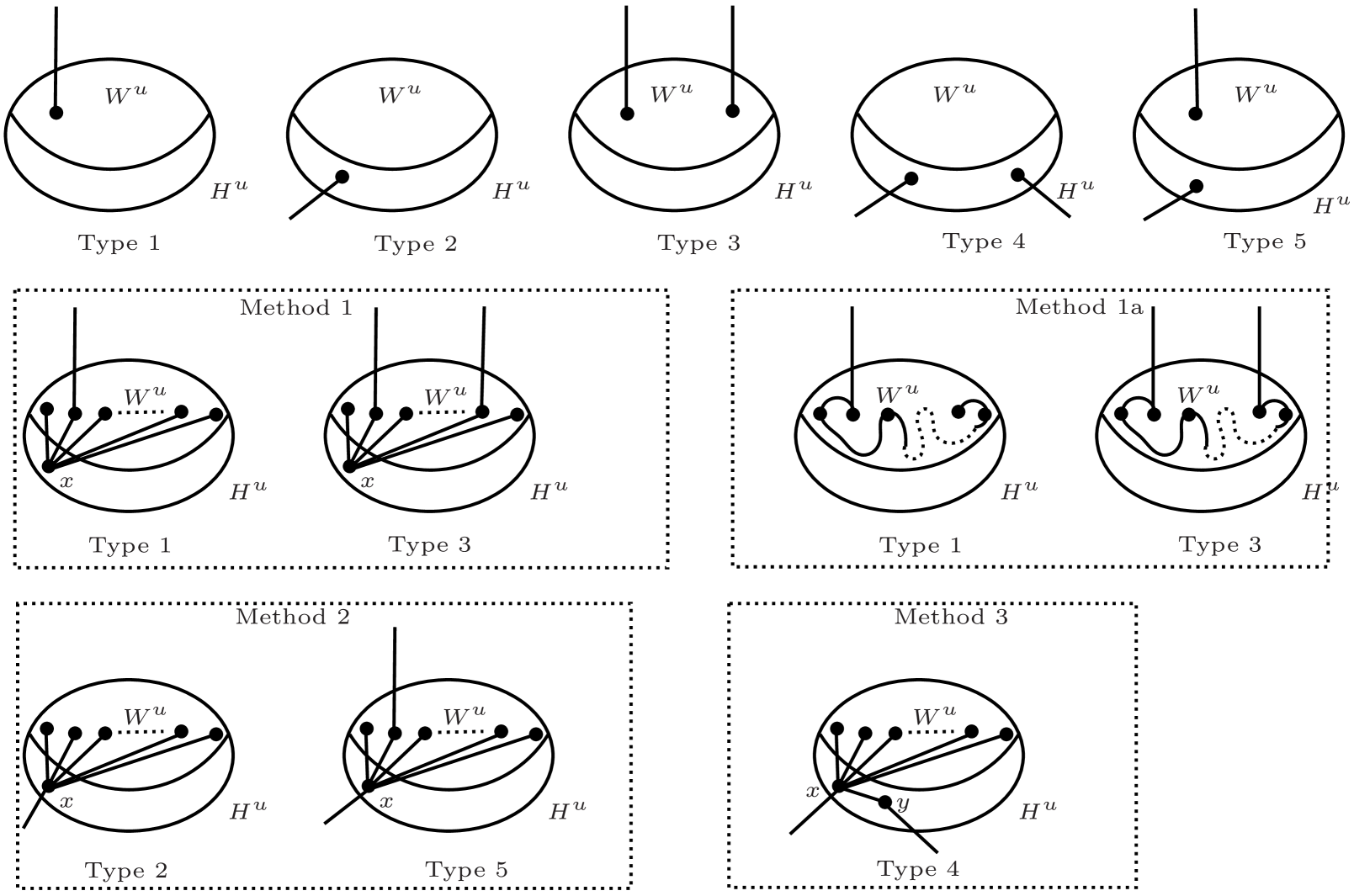
## Diagram: Classification of Intersection Types and Methods for Unstable Manifolds ($W^u$) with Hyperbolic Sets ($H^u$)
### Overview
The image is a technical diagram from the field of dynamical systems or differential equations. It classifies five distinct geometric "Types" (1-5) of intersections between an unstable manifold ($W^u$) and a hyperbolic set ($H^u$), represented as a disk. Below the type classification, three "Methods" (1, 1a, 2, 3) are illustrated, showing how these types can be analyzed or constructed, often involving a base point `x` (and in one case, a point `y`). The diagram uses black lines, points, and labels on a light gray background.
### Components/Axes
* **Primary Geometric Elements:**
* **$H^u$ (Hyperbolic Set):** Represented as a large, slightly flattened oval or disk in each sub-diagram. It is the outer boundary.
* **$W^u$ (Unstable Manifold):** Represented as a smaller, inner oval or disk within $H^u$.
* **Labels and Text:**
* **Type Labels:** "Type 1", "Type 2", "Type 3", "Type 4", "Type 5" are centered below their respective diagrams in the top row.
* **Method Labels:** "Method 1", "Method 1a", "Method 2", "Method 3" are centered at the top of their respective dotted-line boxes.
* **Point Labels:** The letters `x` and `y` label specific intersection points in the method diagrams.
* **Mathematical Notation:** $W^u$ and $H^u$ are used consistently as labels for the inner and outer regions.
* **Spatial Organization:**
* **Top Row:** Contains the five fundamental "Type" diagrams arranged horizontally.
* **Middle Row:** Contains two dotted-line boxes. The left box is labeled "Method 1" and contains two diagrams (Type 1 and Type 3). The right box is labeled "Method 1a" and contains two diagrams (Type 1 and Type 3).
* **Bottom Row:** Contains two dotted-line boxes. The left box is labeled "Method 2" and contains two diagrams (Type 2 and Type 5). The right box is labeled "Method 3" and contains one diagram (Type 4).
### Detailed Analysis
**Top Row - Fundamental Intersection Types:**
* **Type 1:** A single vertical line descends from above, terminating at a black dot on the boundary of the inner $W^u$ disk.
* **Type 2:** A single line enters from the bottom-left, terminating at a black dot on the boundary of the outer $H^u$ disk.
* **Type 3:** Two parallel vertical lines descend from above, each terminating at a black dot on the boundary of the inner $W^u$ disk.
* **Type 4:** Two lines enter from the bottom (one from bottom-left, one from bottom-right), each terminating at a black dot on the boundary of the outer $H^u$ disk.
* **Type 5:** A hybrid. One vertical line descends from above to a dot on $W^u$. One line enters from the bottom-left to a dot on $H^u$.
**Method Diagrams (Detailed Breakdown):**
* **Method 1 (Left Box):**
* **For Type 1:** Shows a point `x` on the boundary of $H^u$. From `x`, multiple lines fan out upwards. One line goes to a dot on $W^u$ (matching Type 1). Other lines go to other dots on $W^u$, with a dotted line (`...`) suggesting a sequence or continuum of such connections.
* **For Type 3:** Similar to the Type 1 diagram in Method 1, but now two of the fanning lines from `x` connect to two distinct dots on $W^u$, matching the two vertical lines of Type 3.
* **Method 1a (Right Box):**
* **For Type 1:** Shows a more complex, curved path. A line enters from above, touches $W^u$, then follows a wavy, dotted path within $W^u$ before exiting to touch $H^u$.
* **For Type 3:** Similar curved path structure, but with two entry points from above touching $W^u$, followed by intertwined wavy dotted paths within $W^u$.
* **Method 2 (Bottom Left Box):**
* **For Type 2:** Shows point `x` on $H^u$. A line enters from the bottom-left to `x` (matching Type 2). From `x`, multiple lines fan out upwards to dots on $W^u$.
* **For Type 5:** Shows point `x` on $H^u$. A vertical line descends to a dot on $W^u$ (first part of Type 5). A line enters from the bottom-left to `x` (second part of Type 5). From `x`, other lines fan out to other dots on $W^u$.
* **Method 3 (Bottom Right Box):**
* **For Type 4:** Shows two points, `x` and `y`, on the boundary of $H^u$. Lines enter from the bottom-left to `x` and from the bottom-right to `y` (matching Type 4). From both `x` and `y`, lines fan out upwards to dots on $W^u$.
### Key Observations
1. **Classification Logic:** The five types are classified by the number and origin/destination of the intersecting lines: one vs. two lines, and whether they connect to $W^u$ (from above) or to $H^u$ (from below/side).
2. **Method Abstraction:** The "Methods" do not simply restate the types. They introduce a base point (`x` or `y`) on $H^u$ and show the type's intersection as part of a larger structure where multiple connections to $W^u$ emanate from that base point.
3. **Visual Complexity Gradient:** Method 1a introduces topological complexity (curves, dotted paths) not present in the other, more linear diagrams.
4. **Consistent Notation:** The use of $W^u$ and $H^u$ is uniform. The dotted line (`...`) is consistently used to imply a series or pattern of similar elements.
### Interpretation
This diagram serves as a visual taxonomy and procedural guide for analyzing intersections in hyperbolic dynamics.
* **What it Demonstrates:** It systematically categorizes the possible ways an unstable manifold ($W^u$) can intersect a hyperbolic set ($H^u$) in a local model. The "Types" represent the fundamental geometric configurations. The "Methods" likely illustrate different analytical or constructive approaches to studying these intersections, perhaps for proving lemmas about transversality, persistence, or the structure of homoclinic/heteroclinic orbits.
* **Relationship Between Elements:** The top row provides the "alphabet" of intersection scenarios. The lower rows show how these scenarios can be embedded within more complex dynamical constructions. For instance, Method 1 suggests that a Type 1 or Type 3 intersection can be seen as one of many possible connections from a point `x` on the hyperbolic set to the unstable manifold.
* **Notable Patterns:** The diagram emphasizes a duality: intersections can be "from above" (directly to $W^u$) or "from below/side" (to the boundary of $H^u$). Method 3 for Type 4 is unique in featuring two distinct base points (`x` and `y`), suggesting a scenario involving two separate homoclinic or heteroclinic connections. The transition from the simple lines of Method 1 to the tangled curves of Method 1a may illustrate the difference between a simplified schematic and a more realistic, topologically accurate representation of manifold intersections.
DECODING INTELLIGENCE...