## Diagram: Pixel Grid Layout / Game Map Schematic
### Overview
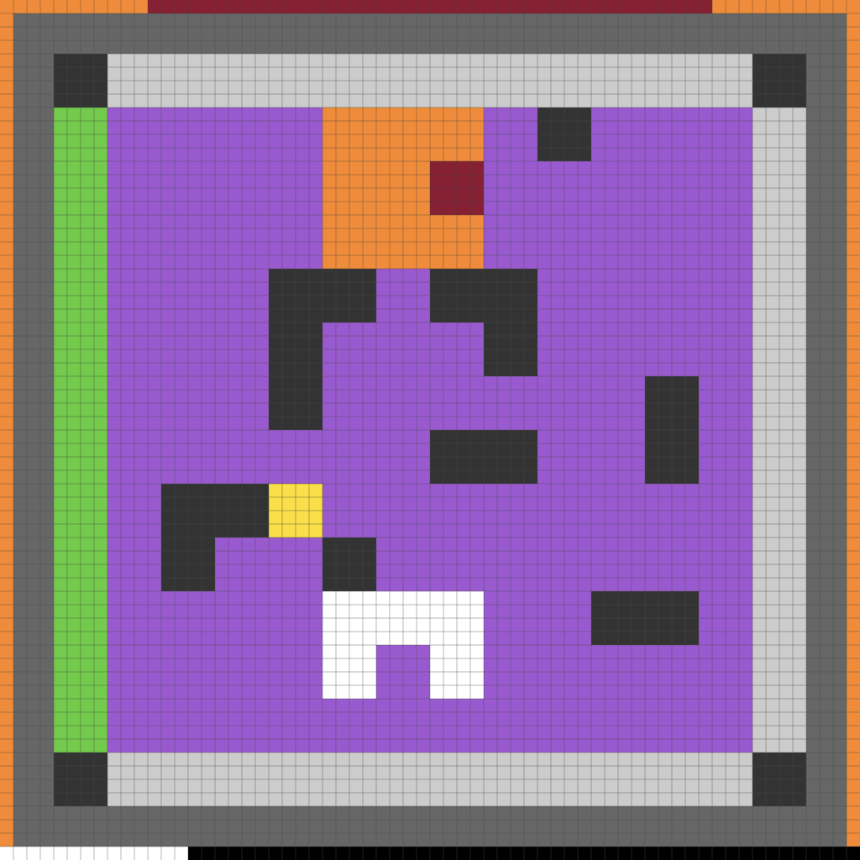
The image displays a square, pixel-art style grid diagram, likely representing a level layout, puzzle, or schematic for a game or simulation. It consists of a central purple field populated with various colored blocks and shapes, enclosed by a multi-layered border. There is no textual information (labels, titles, legends) present in the image. The entire composition is built from a fine grid of small squares (pixels).
### Components/Axes
* **Grid Structure:** The entire image is a uniform grid of small squares. The central area is a large square field.
* **Borders:**
* **Outermost Border:** A thin, solid orange frame.
* **Second Border:** A thick, dark grey frame inside the orange one.
* **Inner Border:** A light grey frame inside the dark grey one, forming the immediate boundary of the main playfield.
* **Corner Blocks:** Four dark grey/black squares are positioned at the four corners where the inner and second borders meet.
* **Main Field:** The central area is filled with a solid light purple color.
* **Colored Regions & Blocks (within the purple field):**
* **Left Green Bar:** A vertical, solid green bar runs the full height of the purple field along its left edge, adjacent to the inner border.
* **Top Orange Region:** A rectangular orange block is located in the top-center of the field. Within this orange block, there is a smaller, dark red square positioned in its top-right quadrant.
* **White Shape:** A white, irregular shape resembling a stylized letter "A" or a simple house (a rectangle with a smaller rectangle cut out from its bottom center) is located in the lower-central part of the field.
* **Yellow Block:** A single, small yellow square is attached to the left side of a black shape in the lower-left quadrant.
* **Black Shapes:** Multiple black shapes of various sizes and forms are scattered across the field:
* An "L" shape in the upper-left quadrant.
* A small square in the upper-right quadrant.
* A horizontal rectangle in the center-right.
* A vertical rectangle on the far right.
* A horizontal rectangle in the lower-right.
* A complex shape in the lower-left, to which the yellow block is attached.
* A small square just above the white shape.
* **Bottom Bar:** A thin, segmented bar runs along the very bottom edge of the image, outside the main border. It is partially white on the left and black on the right.
### Detailed Analysis
* **Spatial Relationships:**
* The **green bar** acts as a left-side boundary or status indicator within the field.
* The **orange region with the red square** is a prominent feature in the upper area, possibly indicating a goal, hazard, or special zone.
* The **white shape** is centrally located in the lower half, suggesting it may be a player character, a key object, or a safe zone.
* The **black shapes** appear as obstacles, walls, or interactive elements distributed asymmetrically across the field, creating pathways and barriers.
* The **yellow block** is uniquely positioned, attached to a black obstacle, possibly indicating a switch, collectible, or point of interest.
* **Color Palette:** The colors are flat and distinct: light purple (background), green, orange, dark red, white, yellow, black, light grey, dark grey, and orange (outer border). This suggests a functional, non-realistic design where color denotes category or function.
### Key Observations
1. **Asymmetrical Design:** The layout is not symmetrical. Obstacles and features are placed irregularly, suggesting a designed path or puzzle rather than a random pattern.
2. **Isolated Elements:** The yellow block and the dark red square within the orange region are the only instances of their colors, making them visually salient and likely important.
3. **Pathways:** The arrangement of black shapes creates implied pathways, particularly around the central white shape and between the orange region and the lower part of the field.
4. **Layered Borders:** The multi-layered border (orange, dark grey, light grey) creates a strong visual frame, separating the "game space" from the external environment.
### Interpretation
This image is a technical diagram of a spatial layout, most likely a level map for a grid-based game or a puzzle schematic. The absence of text means all information is conveyed through color, shape, and position.
* **Function over Form:** The design prioritizes clear visual distinction between element types (background, obstacles, special zones, player) over aesthetic detail. This is characteristic of a prototype, a design document, or a debug view.
* **Implied Narrative or Mechanics:** The layout suggests a scenario where an entity (represented by the white shape) must navigate from a starting point (possibly near the green bar or the white shape's location) through a field of obstacles (black shapes) to interact with key objectives (the yellow block, the orange/red zone). The green bar could represent a health meter, a timer, or a progress indicator.
* **Investigative Reading:** The design invites analysis of possible routes and interactions. For example: Can the white shape move? Is the yellow block a key to open a path? Does the orange region represent a goal or a danger? The isolated nature of the red square within the orange block suggests it is a specific target or trigger within that larger zone.
* **Data Content:** The image does not contain quantitative data, trends, or textual facts. Its "information" is purely relational and spatial, defining a set of rules and positions within a bounded system. To understand it fully, one would need the accompanying ruleset or context for what the colors and shapes represent (e.g., "white = player, black = wall, yellow = key, orange = exit").