## System Architecture Diagram: Federated Learning Workflow
### Overview
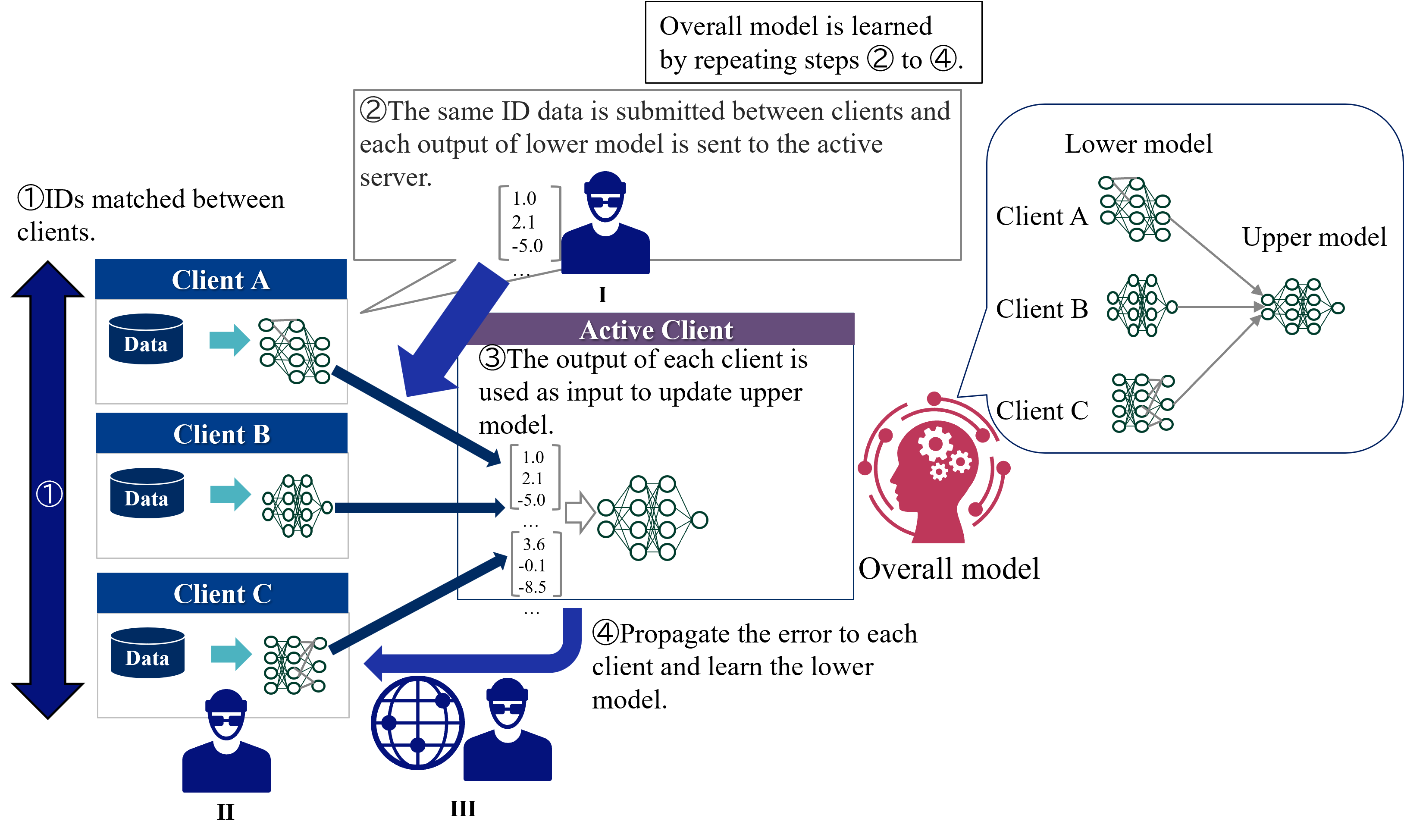
This diagram illustrates a federated learning system where multiple clients (A, B, C) collaboratively train a shared "overall model" while maintaining data privacy. The workflow involves iterative steps of model training, error propagation, and synchronization between clients and a central server.
### Components/Axes
1. **Clients (A, B, C)**:
- Each client has:
- **Data**: Represented by blue database icons.
- **Lower Model**: Neural network diagrams (green nodes) processing client-specific data.
- Positioned on the left side of the diagram.
2. **Active Client (Client A)**:
- Highlighted with a purple banner.
- Sends its lower model's output (numerical values: `1.0`, `2.1`, `-5.0`, `3.6`, `-0.1`, `-8.5`) to the server.
3. **Server**:
- Central node receiving inputs from clients.
- Updates the **Upper Model** (global model) using the active client's output.
4. **Upper Model**:
- Aggregates contributions from all clients' lower models.
- Positioned on the right side, connected to clients via gray arrows.
5. **Error Propagation**:
- Red arrows indicate error feedback from the server to all clients.
- Clients update their lower models using propagated errors.
### Detailed Analysis
- **Step ①**: Client IDs are matched between clients (blue vertical arrow).
- **Step ②**: Active client (A) sends its lower model's output to the server.
- **Step ③**: Server uses the active client's output to update the upper model.
- **Step ④**: Error from the upper model is propagated back to all clients to refine their lower models.
- **Overall Model**: Learned iteratively by repeating steps ②–④.
### Key Observations
- **Hierarchical Structure**: Clients train local models (lower) that contribute to a global model (upper).
- **Data Flow**:
- Client data → Lower model → Active client output → Server → Upper model → Error → Clients.
- **Numerical Values**:
- Active client's output includes values like `1.0`, `2.1`, `-5.0`, `3.6`, `-0.1`, `-8.5`.
- **Color Coding**:
- Blue: Clients and data.
- Purple: Active client.
- Red: Error propagation.
- Green: Neural network nodes.
### Interpretation
This system demonstrates a **decentralized machine learning framework** where:
1. **Privacy Preservation**: Raw data remains on clients; only model updates are shared.
2. **Collaborative Learning**: The upper model aggregates knowledge from all clients' local models.
3. **Iterative Refinement**: Error feedback ensures continuous improvement of both local and global models.
4. **Scalability**: The workflow can accommodate additional clients (e.g., Client D, E) without structural changes.
The diagram emphasizes **federated averaging** principles, where local model updates are combined to form a robust global model while minimizing data exposure. The error propagation step ensures that discrepancies between local and global models are addressed, enhancing overall accuracy.