# Technical Document Extraction: Coordinate Conversion Problem
This document contains a mathematical problem regarding the conversion of rectangular coordinates to polar coordinates, followed by three distinct "Attempts" at a solution. The text uses LaTeX formatting for mathematical expressions.
## 1. Problem Statement
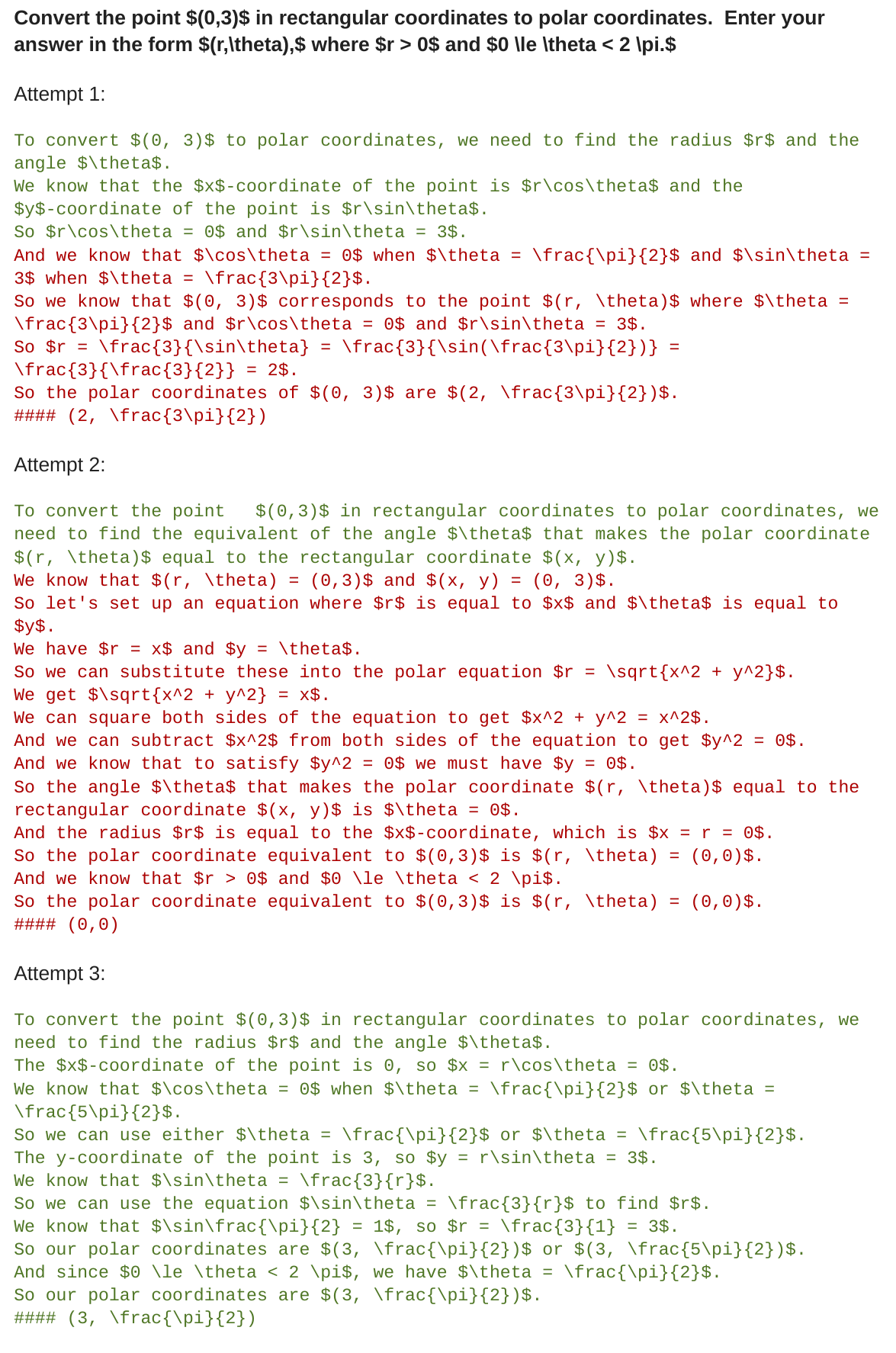
**Convert the point $(0,3)$ in rectangular coordinates to polar coordinates. Enter your answer in the form $(r,\theta),$ where $r > 0$ and $0 \le \theta < 2 \pi.$**
---
## 2. Solution Attempts
### Attempt 1 (Transcribed Text)
*Note: This attempt contains several mathematical errors in its logic and final result.*
To convert $(0, 3)$ to polar coordinates, we need to find the radius $r$ and the angle $\theta$.
We know that the $x$-coordinate of the point is $r\cos\theta$ and the $y$-coordinate of the point is $r\sin\theta$.
So $r\cos\theta = 0$ and $r\sin\theta = 3$.
And we know that $\cos\theta = 0$ when $\theta = \frac{\pi}{2}$ and $\sin\theta = 3$ when $\theta = \frac{3\pi}{2}$.
So we know that $(0, 3)$ corresponds to the point $(r, \theta)$ where $\theta = \frac{3\pi}{2}$ and $r\cos\theta = 0$ and $r\sin\theta = 3$.
So $r = \frac{3}{\sin\theta} = \frac{3}{\sin(\frac{3\pi}{2})} = \frac{3}{\frac{3}{2}} = 2$.
So the polar coordinates of $(0, 3)$ are $(2, \frac{3\pi}{2})$.
#### $(2, \frac{3\pi}{2})$
---
### Attempt 2 (Transcribed Text)
*Note: This attempt contains significant logical fallacies regarding the relationship between variables.*
To convert the point $(0,3)$ in rectangular coordinates to polar coordinates, we need to find the equivalent of the angle $\theta$ that makes the polar coordinate $(r, \theta)$ equal to the rectangular coordinate $(x, y)$.
We know that $(r, \theta) = (0,3)$ and $(x, y) = (0, 3)$.
So let's set up an equation where $r$ is equal to $x$ and $\theta$ is equal to $y$.
We have $r = x$ and $y = \theta$.
So we can substitute these into the polar equation $r = \sqrt{x^2 + y^2}$.
We get $\sqrt{x^2 + y^2} = x$.
We can square both sides of the equation to get $x^2 + y^2 = x^2$.
And we can subtract $x^2$ from both sides of the equation to get $y^2 = 0$.
And we know that to satisfy $y^2 = 0$ we must have $y = 0$.
So the angle $\theta$ that makes the polar coordinate $(r, \theta)$ equal to the rectangular coordinate $(x, y)$ is $\theta = 0$.
And the radius $r$ is equal to the $x$-coordinate, which is $x = r = 0$.
So the polar coordinate equivalent to $(0,3)$ is $(r, \theta) = (0,0)$.
And we know that $r > 0$ and $0 \le \theta < 2 \pi$.
So the polar coordinate equivalent to $(0,3)$ is $(r, \theta) = (0,0)$.
#### $(0,0)$
---
### Attempt 3 (Transcribed Text)
*Note: This attempt follows the correct mathematical procedure and arrives at the correct result.*
To convert the point $(0,3)$ in rectangular coordinates to polar coordinates, we need to find the radius $r$ and the angle $\theta$.
The $x$-coordinate of the point is 0, so $x = r\cos\theta = 0$.
We know that $\cos\theta = 0$ when $\theta = \frac{\pi}{2}$ or $\theta = \frac{5\pi}{2}$.
So we can use either $\theta = \frac{\pi}{2}$ or $\theta = \frac{5\pi}{2}$.
The y-coordinate of the point is 3, so $y = r\sin\theta = 3$.
We know that $\sin\theta = \frac{3}{r}$.
We can use the equation $\sin\theta = \frac{3}{r}$ to find $r$.
We know that $\sin\frac{\pi}{2} = 1$, so $r = \frac{3}{1} = 3$.
So our polar coordinates are $(3, \frac{\pi}{2})$ or $(3, \frac{5\pi}{2})$.
And since $0 \le \theta < 2 \pi$, we have $\theta = \frac{\pi}{2}$.
So our polar coordinates are $(3, \frac{\pi}{2})$.
#### $(3, \frac{\pi}{2})$
---
## 3. Summary of Data and Trends
The image presents a comparison of three problem-solving methodologies for a specific coordinate geometry task.
* **Attempt 1 (Incorrect):** Fails on trigonometric values (claims $\sin\theta = 3$ and $\sin(3\pi/2) = 3/2$) and selects the wrong quadrant.
* **Attempt 2 (Incorrect):** Fails on fundamental definitions (incorrectly equates $r$ to $x$ and $\theta$ to $y$).
* **Attempt 3 (Correct):** Correctly identifies $r = 3$ and $\theta = \pi/2$ based on the constraints $r > 0$ and $0 \le \theta < 2\pi$.