## Diagram: Relative Size Comparison of Three Circles
### Overview
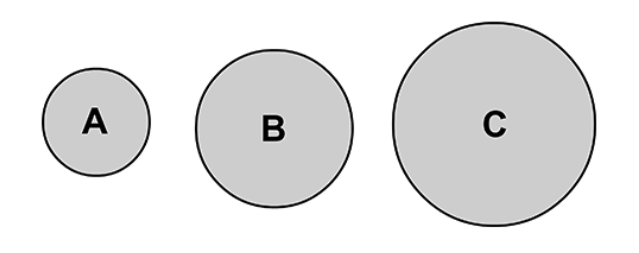
The image displays a simple, non-quantitative diagram consisting of three circles arranged horizontally on a plain white background. The circles are labeled sequentially and increase in size from left to right, illustrating a clear progression or comparison of scale.
### Components/Axes
* **Elements:** Three circles.
* **Labels:** Each circle contains a single, bold, black capital letter centered within it.
* Left circle: **A**
* Center circle: **B**
* Right circle: **C**
* **Visual Properties:**
* **Fill Color:** All circles are filled with a uniform light gray.
* **Outline:** Each circle has a thin, solid black border.
* **Arrangement:** The circles are aligned along a horizontal axis. Circle A is positioned on the far left, Circle B in the center, and Circle C on the far right. There is consistent, moderate spacing between them.
### Detailed Analysis
* **Size Progression:** The primary data conveyed is relative size.
* **Circle A:** The smallest circle.
* **Circle B:** Visibly larger than Circle A.
* **Circle C:** The largest circle, significantly bigger than both A and B.
* **Trend Verification:** The visual trend is a monotonic increase in diameter from left to right (A < B < C). There are no decreases or fluctuations in the progression.
* **Spatial Grounding:** The legend (the labels A, B, C) is embedded directly within each corresponding data point (circle). The positioning is unambiguous: the label is always at the geometric center of its circle.
### Key Observations
1. **Uniform Styling:** All circles share identical color, fill, and outline style, ensuring the only variable being compared is size.
2. **Clear Hierarchy:** The arrangement and size difference create an immediate visual hierarchy, suggesting a sequence (e.g., small, medium, large) or a ranked order.
3. **Lack of Quantification:** The diagram contains no numerical scales, axes, or measurement indicators. The comparison is purely qualitative and relative.
### Interpretation
This diagram is a fundamental visual tool for demonstrating **relative scale, growth, or hierarchy** without specifying exact metrics. The progression from A to B to C suggests a logical sequence, such as stages of development, levels of importance, or categories of magnitude. The use of identical styling isolates size as the sole differentiating factor, making the comparison direct and unambiguous. In a technical context, this could represent concepts like:
* **System Components:** Where C is the core module, B a secondary service, and A a peripheral utility.
* **Data Volumes:** Illustrating orders of magnitude difference between datasets.
* **Process Steps:** Showing the expanding scope or impact from an initial step (A) to a final outcome (C).
The absence of specific data indicates the diagram's purpose is conceptual illustration rather than precise data presentation. Its power lies in its simplicity and immediate comprehensibility.