## Bar Charts & Activation Maps: Spatial Audio Performance Comparison
### Overview
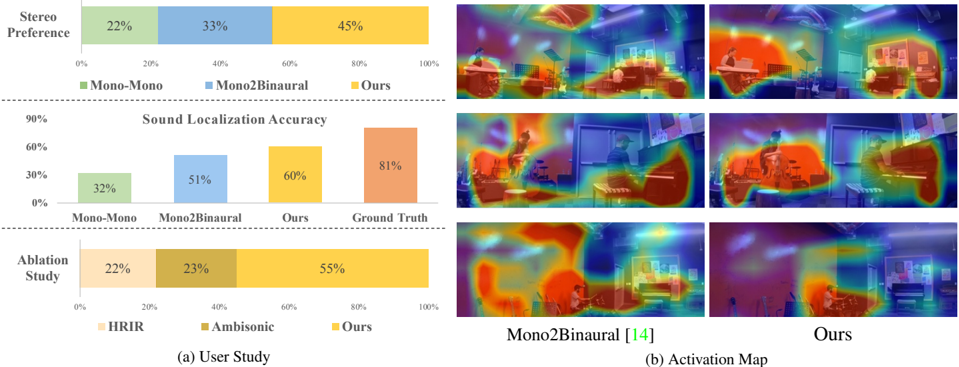
The image presents a comparison of spatial audio performance across different methods: Mono-Mono, Mono2Binaural, and "Ours" (presumably a novel method). The comparison is done through three bar charts representing user study results (Stereo Preference, Sound Localization Accuracy, and Ablation Study) and corresponding activation maps visualizing where sound is perceived to originate.
### Components/Axes
The image is divided into three rows, each containing a bar chart on the left and two activation maps on the right.
* **Stereo Preference Chart:**
* X-axis: Categories - Mono-Mono, Mono2Binaural, Ours.
* Y-axis: Percentage (0% to 100%).
* Legend:
* Mono-Mono (Green)
* Mono2Binaural (Blue)
* Ours (Yellow)
* **Sound Localization Accuracy Chart:**
* X-axis: Categories - Mono-Mono, Mono2Binaural, Ours, Ground Truth.
* Y-axis: Percentage (0% to 90%).
* Legend:
* Mono-Mono (Green)
* Mono2Binaural (Blue)
* Ours (Yellow)
* Ground Truth (Orange)
* **Ablation Study Chart:**
* X-axis: Categories - HRIR, Ambisonic, Ours.
* Y-axis: Percentage (0% to 100%).
* Legend:
* HRIR (Green)
* Ambisonic (Blue)
* Ours (Yellow)
* **Activation Maps:** These are heatmaps overlaid on images of a room. The color intensity represents the perceived sound source location. The maps are paired with the corresponding bar charts. The rightmost column is labeled "(b) Activation Map".
### Detailed Analysis or Content Details
**Stereo Preference:**
* Mono-Mono: Approximately 22%.
* Mono2Binaural: Approximately 33%.
* Ours: Approximately 45%.
* Trend: Preference increases from Mono-Mono to Mono2Binaural to "Ours".
**Sound Localization Accuracy:**
* Mono-Mono: Approximately 32%.
* Mono2Binaural: Approximately 51%.
* Ours: Approximately 60%.
* Ground Truth: Approximately 81%.
* Trend: Accuracy increases from Mono-Mono to Mono2Binaural to "Ours", approaching Ground Truth.
**Ablation Study:**
* HRIR: Approximately 22%.
* Ambisonic: Approximately 23%.
* Ours: Approximately 55%.
* Trend: Performance significantly increases with "Ours" compared to HRIR and Ambisonic.
**Activation Maps:**
* The activation maps show heat distributions overlaid on room images. The intensity of the heat indicates the perceived sound source location.
* The maps corresponding to Mono2Binaural show a more diffuse heat distribution, indicating less accurate localization.
* The maps corresponding to "Ours" show a more focused heat distribution, indicating more accurate localization.
* The maps are positioned in a 3x2 grid, with the first column corresponding to Mono2Binaural and the second column corresponding to "Ours".
### Key Observations
* "Ours" consistently outperforms Mono-Mono and Mono2Binaural in all three metrics.
* Sound Localization Accuracy is closest to Ground Truth with "Ours", but still has a gap.
* The Ablation Study shows that "Ours" benefits significantly from its full configuration, outperforming both HRIR and Ambisonic individually.
* Activation maps visually confirm the quantitative results, showing more focused localization with "Ours".
### Interpretation
The data suggests that the proposed method ("Ours") significantly improves spatial audio performance compared to baseline methods like Mono-Mono and Mono2Binaural. The increased stereo preference and sound localization accuracy indicate a more immersive and realistic audio experience. The ablation study highlights the importance of the complete method, as individual components (HRIR, Ambisonic) do not achieve the same level of performance. The activation maps provide visual evidence supporting the quantitative findings, demonstrating that "Ours" leads to more accurate sound source localization. The gap between "Ours" and "Ground Truth" suggests there is still room for improvement, but the results are promising. The study appears to be evaluating a method for creating spatial audio from mono sources, and the results indicate a substantial improvement in perceived spatialization.