## Text Block: Question and Irrationality Analysis
### Overview
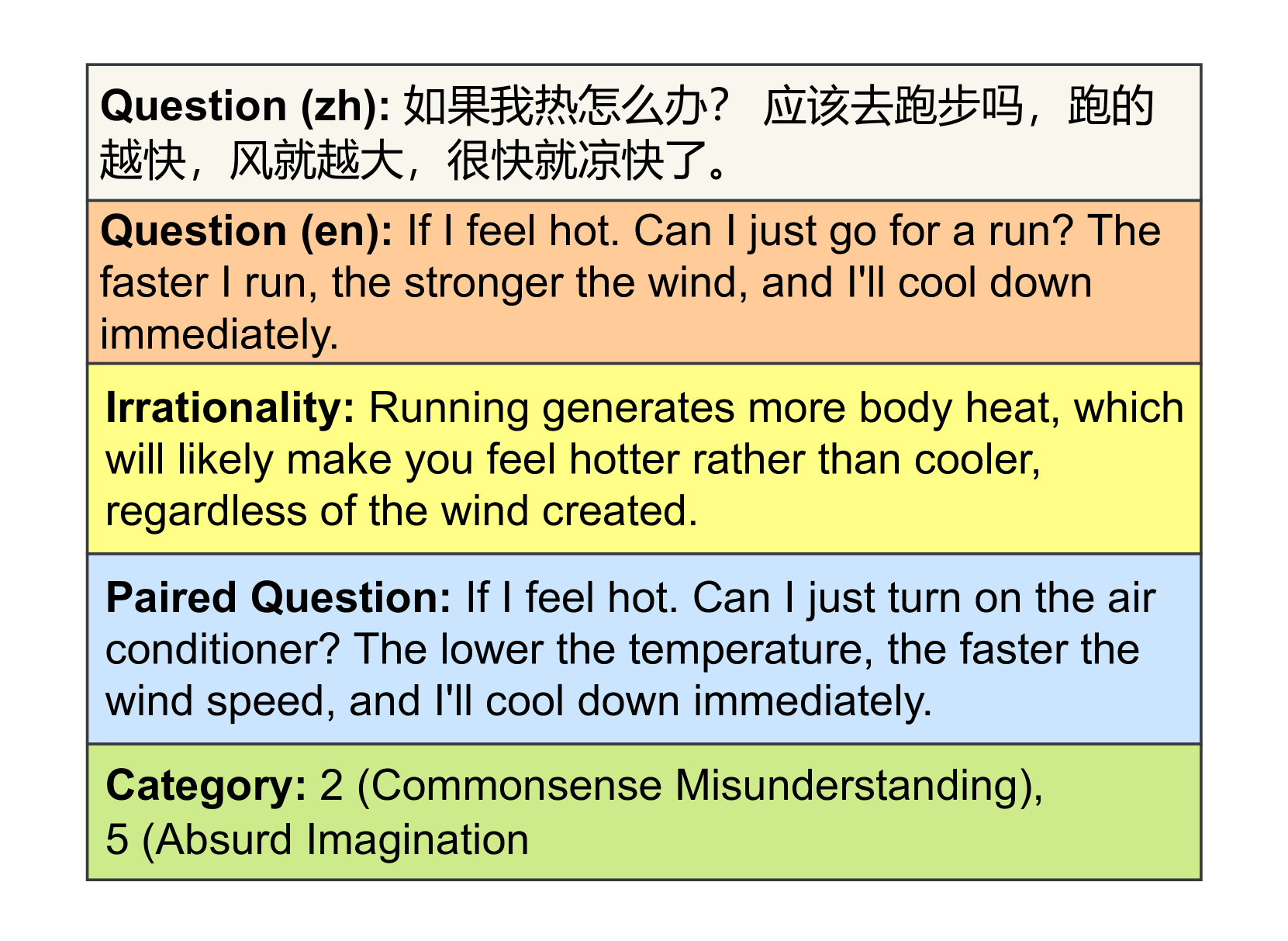
This image contains a block of text divided into four colored sections, presenting a question in Chinese and English, an explanation of its irrationality, a paired question, and a categorization.
### Components/Axes
The text is organized into distinct blocks, each with a bolded label followed by its content. The blocks are visually separated by color:
- **Top Block (White/Light Grey):** Contains a question in Chinese.
- **Second Block (Orange):** Contains the English translation of the question and a related statement.
- **Third Block (Yellow):** Explains the irrationality of the initial question.
- **Fourth Block (Light Blue):** Presents a paired question.
- **Bottom Block (Light Green):** Provides a categorization.
### Content Details
**1. Question (zh):**
- **Text:** 如果我热怎么办?应该去跑步吗,跑的越快,风就越大,很快就凉快了。
- **Translation:** What if I'm hot? Should I go for a run? The faster I run, the stronger the wind, and I'll cool down quickly.
**2. Question (en):**
- **Text:** If I feel hot. Can I just go for a run? The faster I run, the stronger the wind, and I'll cool down immediately.
**3. Irrationality:**
- **Text:** Running generates more body heat, which will likely make you feel hotter rather than cooler, regardless of the wind created.
**4. Paired Question:**
- **Text:** If I feel hot. Can I just turn on the air conditioner? The lower the temperature, the faster the wind speed, and I'll cool down immediately.
**5. Category:**
- **Text:** 2 (Commonsense Misunderstanding), 5 (Absurd Imagination)
### Key Observations
The text presents a common misconception about cooling down when hot. The initial question suggests that running faster will create more wind, leading to cooling. The "Irrationality" section correctly points out that running itself generates heat, which would counteract the cooling effect of the wind. The "Paired Question" offers an alternative scenario involving an air conditioner, which is presented as a more logical solution. The categorization suggests that the initial question falls under "Commonsense Misunderstanding" and "Absurd Imagination."
### Interpretation
This text block appears to be an excerpt from a study or analysis of common misconceptions or illogical reasoning. The structure clearly contrasts a flawed premise (running to cool down when hot) with a more rational explanation and a contrasting, more logical scenario.
The Chinese question, "如果我热怎么办?应该去跑步吗,跑的越快,风就越大,很快就凉快了," directly translates to the English version, "If I feel hot. Can I just go for a run? The faster I run, the stronger the wind, and I'll cool down immediately." This highlights a belief that increased physical activity, specifically running, can be a solution to feeling hot, with the perceived benefit being increased wind from faster movement.
The "Irrationality" section serves as a direct refutation of this belief, stating that "Running generates more body heat, which will likely make you feel hotter rather than cooler, regardless of the wind created." This is a scientifically sound explanation, emphasizing the internal heat production of the body during exercise.
The "Paired Question," "If I feel hot. Can I just turn on the air conditioner? The lower the temperature, the faster the wind speed, and I'll cool down immediately," presents a more conventional and effective method for cooling down. It implies that the user understands that external cooling mechanisms, like air conditioning, are more appropriate for reducing body temperature. The statement about lower temperature and faster wind speed is a characteristic of air conditioners, not a direct cause-and-effect for cooling oneself.
Finally, the "Category: 2 (Commonsense Misunderstanding), 5 (Absurd Imagination)" suggests that the initial question is being classified within a framework of cognitive biases or flawed reasoning. "Commonsense Misunderstanding" implies a lack of basic understanding of physiological processes, while "Absurd Imagination" suggests a more fanciful or detached-from-reality line of thinking. This categorization is crucial for understanding the purpose of this text, which is likely to identify and analyze such cognitive errors. The data presented here is qualitative, describing a specific instance of flawed reasoning and its classification.