## Diagram: Conditional Probabilities of Night, Sleep, and Light
### Overview
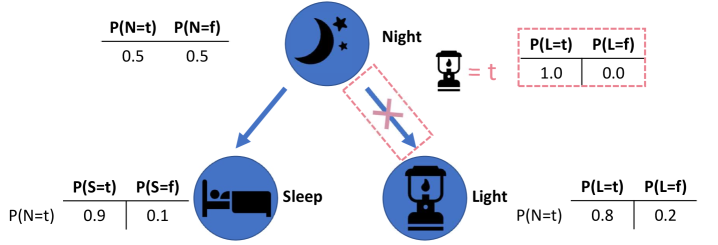
The diagram illustrates a probabilistic model with three interconnected nodes: **Night**, **Sleep**, and **Light**. Arrows indicate causal or conditional relationships, with probabilities assigned to binary states (true/false) for each node. A red dashed box highlights a deterministic relationship between **Night** and **Light**.
### Components/Axes
- **Nodes**:
- **Night**: Represented by a crescent moon icon.
- **Sleep**: Represented by a bed icon.
- **Light**: Represented by a lantern icon.
- **Probabilities**:
- **Night**:
- P(N=t) = 0.5
- P(N=f) = 0.5
- **Sleep**:
- P(S=t) = 0.9
- P(S=f) = 0.1
- **Light**:
- P(L=t) = 0.8
- P(L=f) = 0.2
- **Conditional**:
- When **Night** is true (N=t), **Light** is deterministic:
- P(L=t | N=t) = 1.0
- P(L=f | N=t) = 0.0
### Detailed Analysis
1. **Night Node**:
- Equal probability (0.5) of being true or false.
- Branches to both **Sleep** and **Light** nodes.
2. **Sleep Node**:
- High probability (0.9) of being true when **Night** is true.
- Low probability (0.1) of being false.
3. **Light Node**:
- Default probabilities: 0.8 (true) and 0.2 (false).
- Overridden by the red dashed box: When **Night** is true, **Light** is certain (P(L=t) = 1.0).
4. **Relationships**:
- **Night → Sleep**: Strong association (0.9 probability).
- **Night → Light**: Deterministic when **Night** is true (1.0 probability).
### Key Observations
- **Deterministic Override**: The red dashed box explicitly enforces P(L=t) = 1.0 when **Night** is true, overriding the default 0.8 probability.
- **High Correlation**: **Sleep** is highly likely (0.9) when **Night** is true, suggesting a strong but non-deterministic link.
- **Symmetry in Night**: Equal prior probabilities (0.5) for **Night** being true or false.
### Interpretation
The diagram models a scenario where **Night** acts as a conditional trigger:
- When **Night** is true, **Light** is guaranteed (e.g., a nightlight activating automatically).
- **Sleep** is strongly associated with **Night** but not absolute (0.9 probability), allowing for exceptions (e.g., insomnia).
- The default probabilities for **Light** (0.8 true) suggest it is generally active but not tied to **Night** in all cases.
The red dashed box emphasizes a rule-based exception: **Light**’s state is fully determined by **Night**’s truth value, highlighting a critical dependency in the system. This could represent a safety mechanism (e.g., ensuring light is on during nighttime) or a logical constraint in a probabilistic model.