\n
## Scatter Plot: Decoding Steps vs. Output Token Position Index
### Overview
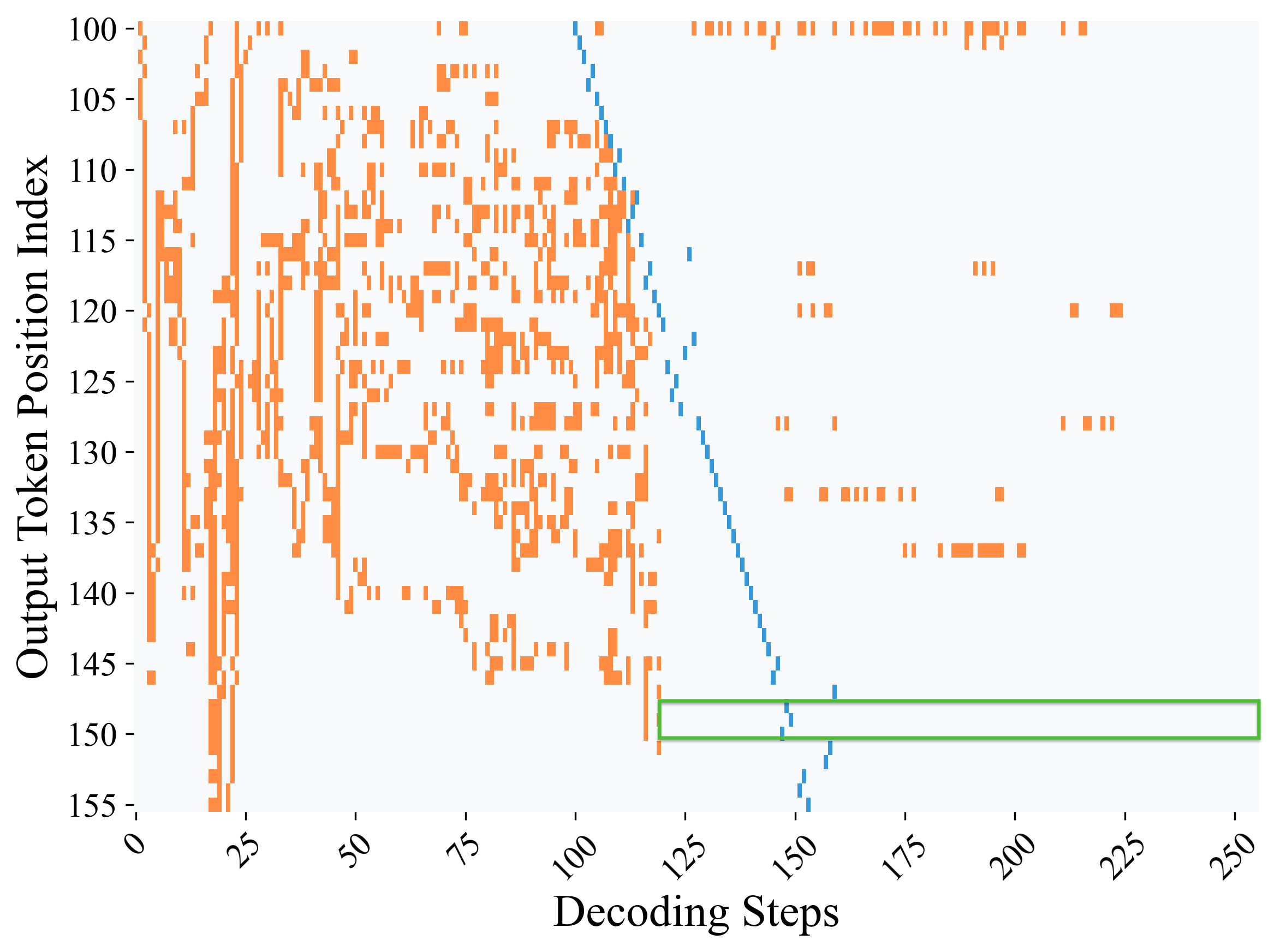
The image is a scatter plot visualizing the relationship between "Decoding Steps" (x-axis) and "Output Token Position Index" (y-axis). It displays two distinct data series represented by orange and blue points, along with a green rectangular highlight. The plot appears to track the progression or activation of tokens during a decoding process, likely from a sequence generation model (e.g., a language model).
### Components/Axes
- **X-axis**: Labeled "Decoding Steps". Scale ranges from 0 to 250, with major tick marks at intervals of 25 (0, 25, 50, 75, 100, 125, 150, 175, 200, 225, 250). The axis label is centered below the axis.
- **Y-axis**: Labeled "Output Token Position Index". Scale ranges from 100 to 155, with major tick marks at intervals of 5 (100, 105, 110, 115, 120, 125, 130, 135, 140, 145, 150, 155). The axis label is rotated 90 degrees and placed to the left of the axis.
- **Data Series**:
1. **Orange Points**: A dense, scattered series of points.
2. **Blue Points**: A series forming a clear, diagonal line.
- **Highlight**: A green rectangular box outlines a specific region of the plot.
- **Legend**: No explicit legend is present in the image. The meaning of the orange and blue colors must be inferred from context.
### Detailed Analysis
**1. Orange Data Series (Scatter):**
* **Spatial Distribution**: The orange points are heavily concentrated in the left portion of the plot, primarily between decoding steps 0 and 125. Their density is highest in vertical bands, particularly around steps 0-25 and 50-100.
* **Y-axis Range**: The points span nearly the entire y-axis range, from approximately index 100 to 155.
* **Trend**: There is no single linear trend. Instead, the data shows high variability and clustering. Notable dense vertical clusters appear at:
* Steps ~0-25: Points span from index ~100 to ~155.
* Steps ~50-100: Points are concentrated between indices ~105 and ~145.
* **Sparse Regions**: Beyond step 125, orange points become very sparse and are mostly located in the upper region (indices 100-120).
**2. Blue Data Series (Line):**
* **Spatial Distribution**: The blue points form a distinct, nearly perfect diagonal line.
* **Trend & Key Points**: The line shows a strong, positive linear correlation. It starts at approximately **(Decoding Step: 100, Token Index: 100)** and ends at approximately **(Decoding Step: 150, Token Index: 155)**.
* **Slope Calculation**: The approximate slope is (155 - 100) / (150 - 100) = 55 / 50 = **1.1**. This indicates that for each additional decoding step in this range, the output token position index increases by about 1.1 units.
**3. Green Highlight Box:**
* **Position & Dimensions**: The box is located in the bottom-right quadrant. Its approximate coordinates are:
* Left edge: Decoding Step ~125
* Right edge: Decoding Step ~250 (extends to the plot boundary)
* Bottom edge: Output Token Position Index ~145
* Top edge: Output Token Position Index ~150
* **Content**: The box specifically encloses the segment of the blue diagonal line that passes through this region, from roughly step 125 to step 150. It also contains a few sparse orange points near its left edge.
### Key Observations
1. **Two Distinct Behaviors**: The plot reveals two fundamentally different patterns: a noisy, scattered process (orange) and a clean, deterministic linear progression (blue).
2. **Phase Transition**: The blue line emerges clearly around step 100, suggesting a shift in the decoding process from a scattered, exploratory phase (orange) to a focused, sequential phase (blue).
3. **Region of Interest**: The green box highlights the final segment of the blue linear progression, possibly indicating a critical or terminal phase of the decoding sequence where token positions stabilize or follow a strict order.
4. **Asymmetry**: The orange activity is almost entirely confined to the first half of the decoding steps (0-125), while the blue line dominates the transition and later steps (100-150).
### Interpretation
This visualization likely depicts the internal dynamics of an autoregressive or sequential decoding process, such as in a transformer-based language model.
* **Orange Series Interpretation**: The scattered orange points may represent **attention patterns**, **hidden state activations**, or **parallel token computations** occurring during the initial, more exploratory phase of generation. The vertical clustering suggests that at certain decoding steps, the model is simultaneously considering or updating a wide range of output token positions.
* **Blue Series Interpretation**: The clean diagonal line strongly suggests the **primary decoding trajectory**. It represents the sequential, step-by-step generation of output tokens, where each decoding step corresponds to advancing to the next token position in the sequence. The linearity indicates a stable, one-to-one (or near one-to-one) mapping between steps and positions in this phase.
* **Green Box Significance**: The highlighted region likely marks the **finalization stage** of the sequence. The model has locked onto a specific path (the blue line) and is sequentially producing the last tokens (positions 145-150) in a deterministic manner. The absence of orange scatter here implies reduced parallelism or exploration.
* **Overall Narrative**: The data suggests a two-stage decoding process: an initial **parallel/exploratory phase** (steps 0-125, orange scatter) where the model processes context and considers multiple possibilities, followed by a **sequential/execution phase** (steps 100-150, blue line) where it commits to and generates the output tokens in order. The overlap between steps 100-125 shows the transition between these modes.