## Geometry Problem and Solution: Circle Angle Calculation
### Overview
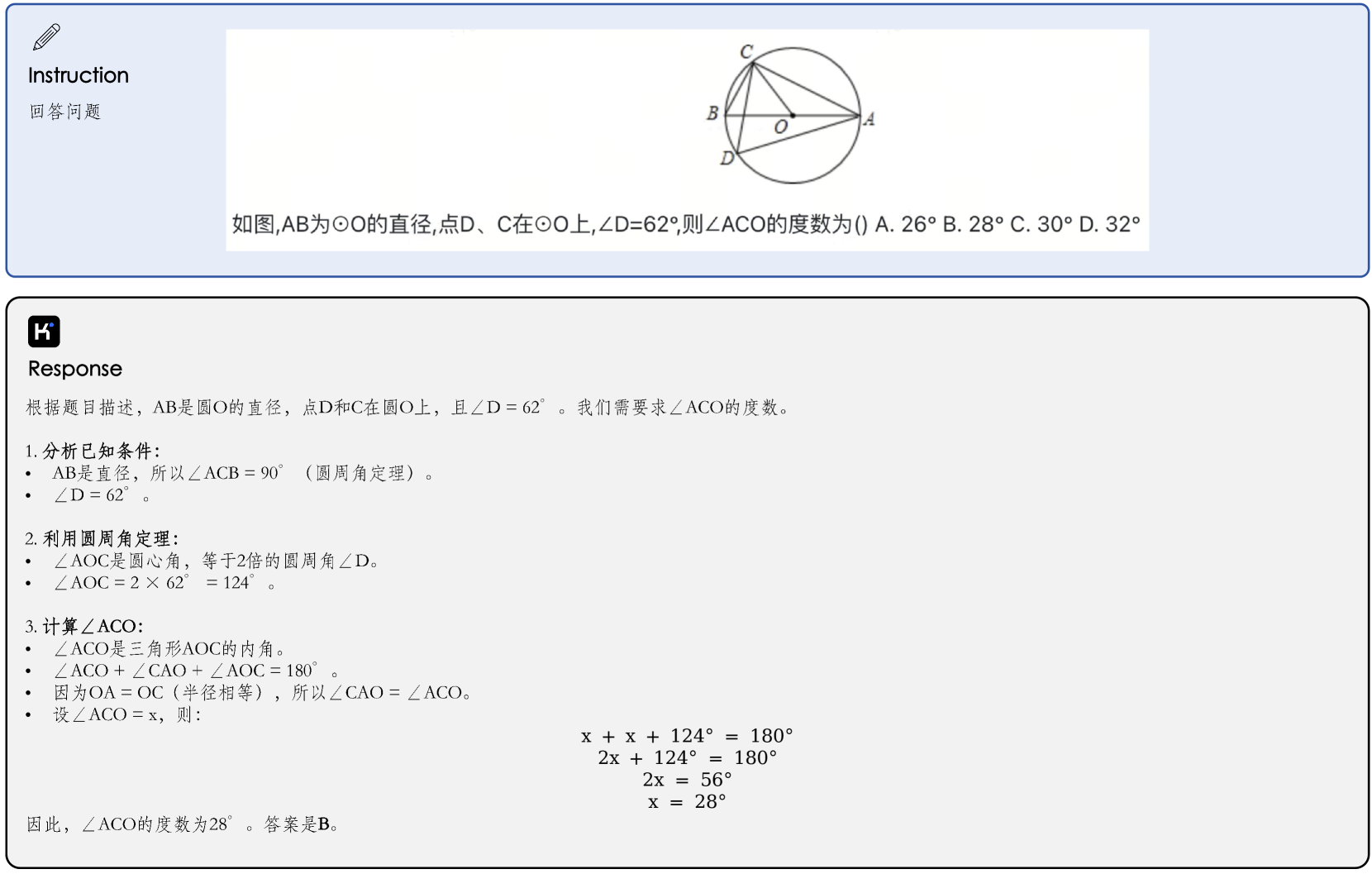
The image displays a two-part educational interface. The top section presents a geometry problem with a diagram and a multiple-choice question in Chinese. The bottom section provides a detailed, step-by-step solution to the problem, also in Chinese. The content is presented within a clean, digital learning platform layout.
### Components/Axes
The image is divided into two main rectangular containers:
1. **Top Container (Instruction):**
* **Header:** Contains a pencil icon and the English word "Instruction".
* **Sub-header:** Contains the Chinese text "回答问题" (Answer the question).
* **Diagram:** A circle with center `O`. A horizontal line segment `AB` passes through `O`, making it the diameter. Points `C` and `D` are on the circle's circumference. Lines connect `A` to `C`, `C` to `B`, `C` to `D`, and `D` to `B`. The angle at point `D` (∠CDB) is labeled.
* **Problem Statement (Chinese):** "如图,AB为⊙O的直径,点D、C在⊙O上,∠D=62°,则∠ACO的度数为() A. 26° B. 28° C. 30° D. 32°"
* **English Translation of Problem:** "As shown in the figure, AB is the diameter of circle O, points D and C are on circle O, ∠D = 62°. Then the degree measure of ∠ACO is (). A. 26° B. 28° C. 30° D. 32°"
2. **Bottom Container (Response):**
* **Header:** Contains an "H+" icon and the English word "Response".
* **Solution Text:** A complete, logically structured solution written in Chinese, using mathematical notation and equations.
### Detailed Analysis / Content Details
**Problem Statement (Transcribed from Image):**
* **Given:** AB is the diameter of circle O. Points C and D lie on the circumference of circle O. The measure of angle D (∠CDB) is 62°.
* **To Find:** The measure of angle ACO (∠ACO).
* **Options:** A. 26°, B. 28°, C. 30°, D. 32°.
**Solution Steps (Transcribed and Translated from Image):**
The solution proceeds in three main steps:
1. **Analyze Known Conditions:**
* "AB是直径, 所以∠ACB = 90° (圆周角定理)。" -> "AB is the diameter, so ∠ACB = 90° (Inscribed Angle Theorem)."
* "∠D = 62°。" -> "∠D = 62°."
2. **Apply the Inscribed Angle Theorem:**
* "∠AOC是圆心角, 等于2倍的圆周角∠D。" -> "∠AOC is a central angle, equal to 2 times the inscribed angle ∠D."
* "∠AOC = 2 × 62° = 124°。" -> "∠AOC = 2 × 62° = 124°."
3. **Calculate ∠ACO:**
* "∠ACO是三角形AOC的内角。" -> "∠ACO is an interior angle of triangle AOC."
* "∠ACO + ∠CAO + ∠AOC = 180°。" -> "∠ACO + ∠CAO + ∠AOC = 180°."
* "因为OA = OC (半径相等), 所以∠CAO = ∠ACO。" -> "Because OA = OC (radii are equal), therefore ∠CAO = ∠ACO."
* "设∠ACO = x, 则:" -> "Let ∠ACO = x, then:"
* `x + x + 124° = 180°`
* `2x + 124° = 180°`
* `2x = 56°`
* `x = 28°`
* "因此, ∠ACO的度数为28°。答案是B。" -> "Therefore, the degree measure of ∠ACO is 28°. The answer is B."
### Key Observations
* The solution correctly identifies and applies two fundamental circle theorems: the **Inscribed Angle Theorem** (angle at the center is twice the angle at the circumference subtended by the same arc) and the property that **angles subtended by the same arc are equal**.
* The problem cleverly uses the given inscribed angle ∠D (62°) to find the central angle ∠AOC (124°), which is then used in the isosceles triangle ΔAOC (OA=OC=radius) to find the unknown base angle ∠ACO.
* The multiple-choice options are closely spaced (26°, 28°, 30°, 32°), requiring precise calculation.
### Interpretation
This image is a snapshot of a digital math tutoring or assessment system. It demonstrates a classic geometry problem designed to test a student's understanding of circle theorems and their ability to chain logical steps.
The **Peircean investigative reading** reveals:
* **Sign (Diagram & Text):** The diagram is an iconic sign representing the geometric configuration. The text is a symbolic sign stating the problem.
* **Object (Mathematical Relationship):** The underlying object is the set of immutable geometric relationships within a circle (diameter, inscribed angles, central angles, isosceles triangles).
* **Interpretant (Solution Process):** The solution is the interpretant, a rule or habit of reasoning that connects the sign to the object. It shows how to transform the given information (∠D=62°) into the desired information (∠ACO=28°) using established mathematical laws.
The solution's structure is pedagogical, breaking the problem into "Analyze," "Apply Theorem," and "Calculate" phases. This not only provides the answer but also reinforces the underlying concepts and problem-solving methodology. The final answer, **28° (Option B)**, is derived through necessary and deductive reasoning, leaving no room for ambiguity given the initial conditions.