## System Architecture Diagram: Reinforcement Learning Workflow with Experience Buffer
### Overview
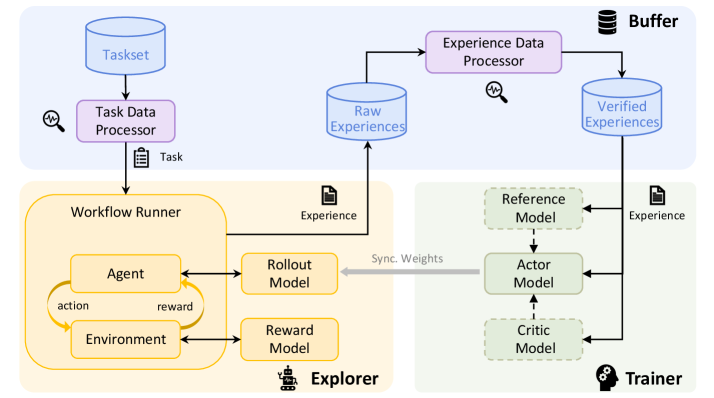
The image displays a technical system architecture diagram illustrating a reinforcement learning (RL) workflow. The diagram is segmented into three primary colored regions representing distinct functional modules: a **Data Processing Layer** (light blue, top), an **Explorer Module** (yellow, left), and a **Trainer Module** (light green, right). The flow depicts how tasks are processed, experiences are generated and stored, and models are trained and synchronized.
### Components/Regions
The diagram is organized into three main spatial regions:
1. **Top Region (Light Blue Background): Data Processing & Buffer**
* **Components:**
* `Taskset` (Cylinder/Database icon, top-left)
* `Task Data Processor` (Purple rectangle, below Taskset)
* `Experience Data Processor` (Purple rectangle, top-center)
* `Raw Experiences` (Cylinder/Database icon, center)
* `Verified Experiences` (Cylinder/Database icon, top-right)
* `Buffer` (Database icon with label, top-right corner)
* **Flow & Labels:** An arrow from `Taskset` to `Task Data Processor` is labeled with a document icon and the word `Task`. An arrow from `Raw Experiences` to `Experience Data Processor` has a magnifying glass icon. An arrow from `Experience Data Processor` to `Verified Experiences` also has a magnifying glass icon. An arrow from `Verified Experiences` points to the `Buffer` icon.
2. **Left Region (Yellow Background): Explorer**
* **Components:**
* `Workflow Runner` (Large yellow rounded rectangle)
* `Agent` (Yellow rectangle inside Workflow Runner)
* `Environment` (Yellow rectangle inside Workflow Runner, below Agent)
* `Rollout Model` (Yellow rectangle, right of Workflow Runner)
* `Reward Model` (Yellow rectangle, below Rollout Model)
* **Flow & Labels:** Inside the `Workflow Runner`, a circular flow is shown: an arrow from `Agent` to `Environment` is labeled `action`, and an arrow from `Environment` back to `Agent` is labeled `reward`. A double-headed arrow connects `Agent` and `Rollout Model`. A double-headed arrow connects `Environment` and `Reward Model`. An arrow from `Rollout Model` points to the `Raw Experiences` database in the top region, labeled with a document icon and the word `Experience`. A robot icon is placed near the `Reward Model`.
3. **Right Region (Light Green Background): Trainer**
* **Components:**
* `Reference Model` (Green dashed rectangle, top)
* `Actor Model` (Green dashed rectangle, center)
* `Critic Model` (Green dashed rectangle, bottom)
* **Flow & Labels:** All three models (`Reference Model`, `Actor Model`, `Critic Model`) receive input via arrows originating from the `Verified Experiences` database. These arrows are each labeled with a document icon and the word `Experience`. A thick, gray, double-headed arrow labeled `Sync. Weights` connects the `Actor Model` (in the Trainer region) to the `Rollout Model` (in the Explorer region). A head-with-gears icon is placed in the bottom-right corner of this region.
### Detailed Analysis: Component Relationships and Data Flow
The diagram defines a closed-loop system for training RL agents using stored experiences.
1. **Task Initiation:** The process begins with a `Taskset` (a collection of tasks). The `Task Data Processor` extracts a specific `Task` and sends it to the `Workflow Runner` within the Explorer.
2. **Experience Generation (Explorer):** Inside the `Workflow Runner`, an `Agent` interacts with an `Environment` by taking `action`s and receiving `reward`s. This interaction loop generates experience data. The `Rollout Model` (likely responsible for generating trajectories) and the `Reward Model` (for evaluating states/actions) are part of this process. The `Rollout Model` sends generated `Experience` data to the `Raw Experiences` database.
3. **Experience Processing (Buffer):** The `Experience Data Processor` retrieves data from `Raw Experiences`, processes or filters it (indicated by the magnifying glass icons), and outputs cleaned `Verified Experiences` into a `Buffer` for later use.
4. **Model Training (Trainer):** The `Verified Experiences` from the buffer are used as training data for three models in the Trainer module: the `Reference Model`, the `Actor Model`, and the `Critic Model`. This suggests a model-based or actor-critic RL training paradigm.
5. **Synchronization:** A critical feedback loop is shown by the `Sync. Weights` arrow. The trained `Actor Model`'s parameters are synchronized back to the `Rollout Model` in the Explorer, updating it for future experience generation. This creates an iterative cycle of experience collection and model improvement.
### Key Observations
* **Modular Design:** The system is cleanly separated into data handling, exploration (data generation), and training (model improvement) modules.
* **Central Role of Experience Buffer:** The `Buffer` containing `Verified Experiences` acts as the central hub, decoupling the Explorer and Trainer. This allows for asynchronous data generation and training.
* **Model Synchronization:** The explicit `Sync. Weights` connection highlights that the policy being executed in the environment (`Rollout Model`) is periodically updated with the improved policy learned by the `Actor Model`.
* **Iconography:** Icons are used consistently to denote data types: a document icon for `Task` and `Experience`, a magnifying glass for processing/inspection, a robot for the Explorer module, and a head with gears for the Trainer module.
### Interpretation
This diagram represents a sophisticated reinforcement learning system designed for stability and efficiency. The architecture addresses several key challenges in RL:
1. **Experience Replay & Stability:** By storing experiences in a `Buffer` and using a `Verified Experiences` database, the system can break temporal correlations in data and reuse past experiences for training, which stabilizes learning.
2. **Parallelization Potential:** The separation of Explorer and Trainer suggests these processes could run in parallel or on different resources. The Explorer can continuously generate new data while the Trainer improves models using stored data.
3. **Policy Iteration:** The core learning loop is clearly depicted: the current policy (in the `Rollout Model`) generates experiences, which are used to train an improved policy (in the `Actor Model`), which is then synced back to become the new data-generating policy. This is a classic policy iteration scheme.
4. **Model-Based Elements:** The presence of a `Reward Model` and `Reference Model` alongside the standard `Actor` and `Critic` suggests this might be a model-based RL setup or one that uses auxiliary tasks and reward shaping to improve learning efficiency and performance.
In essence, the diagram illustrates a production-oriented RL pipeline that emphasizes data management, modular component design, and a continuous cycle of experience collection and policy refinement.