\n
## Venn Diagram: Multi-agent Reinforcement Learning Tasks
### Overview
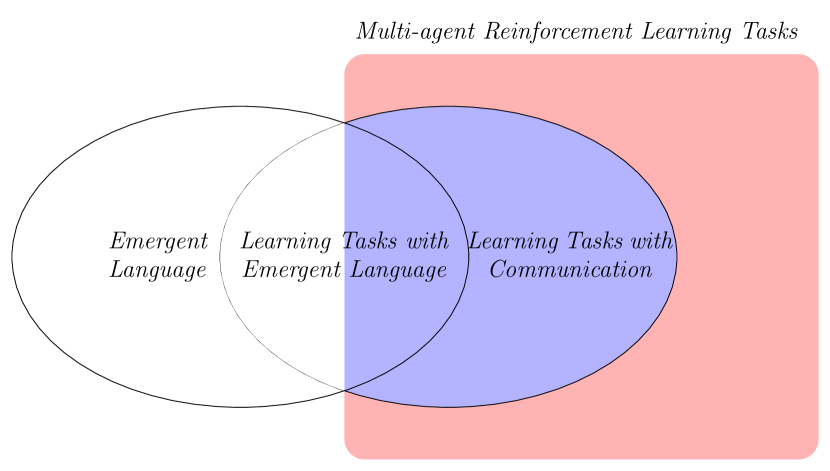
The image is a conceptual Venn diagram illustrating the relationships between different categories of tasks in the field of multi-agent reinforcement learning. It uses overlapping shapes and color coding to show set relationships and intersections.
### Components/Axes
The diagram consists of three primary geometric shapes, each with a distinct color and label:
1. **Gray Circle (Left):** Positioned on the left side of the diagram. It is labeled **"Emergent Language"**.
2. **Blue Circle (Right):** Positioned on the right side, overlapping with the gray circle. It is labeled **"Learning Tasks with Communication"**.
3. **Pink Rectangle (Background):** A large, rounded rectangle that encompasses the entire blue circle and the overlapping region between the two circles. It is labeled at the top-right as **"Multi-agent Reinforcement Learning Tasks"**.
The overlapping region between the gray and blue circles is labeled **"Learning Tasks with Emergent Language"**.
### Detailed Analysis
The diagram defines three distinct but related conceptual sets:
* **Set A (Gray Circle):** Represents the domain of "Emergent Language." This is a standalone concept.
* **Set B (Blue Circle):** Represents "Learning Tasks with Communication." This is a broader category that includes tasks where communication is a designed or given component.
* **Intersection (A ∩ B):** The area where the gray and blue circles overlap is explicitly labeled "Learning Tasks with Emergent Language." This signifies that tasks in this intersection are a subset of both Emergent Language and Learning Tasks with Communication. They are tasks where communication protocols are not pre-defined but emerge during the learning process.
* **Superset (Pink Rectangle):** The "Multi-agent Reinforcement Learning Tasks" rectangle acts as a superset. It fully contains the blue circle ("Learning Tasks with Communication") and the intersection ("Learning Tasks with Emergent Language"). It does *not* fully contain the gray circle ("Emergent Language"), indicating that not all emergent language research falls under the specific umbrella of multi-agent RL tasks as defined by this diagram.
### Key Observations
1. **Hierarchical Containment:** The diagram establishes a clear hierarchy. "Learning Tasks with Communication" is a subset of "Multi-agent Reinforcement Learning Tasks." "Learning Tasks with Emergent Language" is a further subset of both.
2. **Partial Overlap of "Emergent Language":** A significant portion of the "Emergent Language" circle lies outside the pink rectangle. This visually argues that the study of emergent language is a broader field that extends beyond the specific context of multi-agent reinforcement learning tasks.
3. **Color-Coded Regions:** The blue circle is filled with a semi-transparent blue, the overlapping region is a blend of blue and gray, and the pink rectangle provides a background context. This color coding helps distinguish the sets and their intersections.
### Interpretation
This diagram serves as a conceptual map to clarify terminology and scope within a research area. It makes several key arguments:
* **Communication vs. Emergent Language:** It distinguishes between tasks where communication is an engineered component ("Learning Tasks with Communication") and the more specific phenomenon where language-like protocols arise spontaneously from agent interactions ("Emergent Language").
* **Scope of Multi-agent RL:** It posits that the field of multi-agent reinforcement learning explicitly includes the study of communication and, by extension, the study of emergent language within that communication framework.
* **Broader Context of Emergent Language:** By placing part of the "Emergent Language" circle outside the multi-agent RL rectangle, the diagram acknowledges that emergent language is a topic studied in other disciplines (e.g., linguistics, complex systems, evolutionary biology) and is not solely the domain of RL.
The diagram is likely used to frame a research paper or presentation, helping the audience understand where the authors' work on "Learning Tasks with Emergent Language" fits within the larger landscape of related concepts. It emphasizes that this work is at the intersection of two fields and is a specific instance of multi-agent RL.