\n
## Diagram: Iterative Process with Robots
### Overview
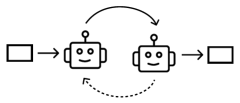
The image depicts a diagram illustrating an iterative process involving two robotic entities. Input enters the first robot, which processes it and passes it to the second robot. The second robot outputs a result, and there is feedback between the two robots, suggesting a loop or iterative refinement.
### Components/Axes
The diagram consists of the following components:
* **Input:** A square on the left side, representing the initial input.
* **Robot 1:** A robotic figure with a smiling face and a circular head. It has an input arrow pointing towards it and an output arrow pointing to Robot 2.
* **Robot 2:** A robotic figure identical to Robot 1, receiving input from Robot 1 and producing an output.
* **Output:** A square on the right side, representing the final output.
* **Feedback Loop (Solid Arrow):** A curved arrow originating from the output of Robot 2 and pointing back to Robot 1.
* **Feedback Loop (Dotted Arrow):** A curved dotted arrow originating from the output of Robot 2 and pointing back to Robot 1.
### Detailed Analysis or Content Details
The diagram shows a sequential process:
1. An unspecified input enters Robot 1.
2. Robot 1 processes the input and passes it to Robot 2.
3. Robot 2 processes the input from Robot 1 and generates an output.
4. The output of Robot 2 is fed back to Robot 1 via a solid curved arrow.
5. The output of Robot 2 is also fed back to Robot 1 via a dotted curved arrow.
The presence of both a solid and dotted feedback loop suggests different types of feedback or levels of influence. The dotted line may represent a weaker or less direct feedback mechanism.
### Key Observations
The diagram emphasizes an iterative process where the output is continuously refined through feedback. The use of robots suggests automation or a system where the process is carried out by machines. The two robots could represent different stages or aspects of the process.
### Interpretation
This diagram likely represents a machine learning or control system. Robot 1 could be a feature extractor, and Robot 2 could be a classifier. The feedback loop represents the error signal used to adjust the parameters of the system. The solid line could represent the primary feedback signal, while the dotted line could represent a secondary or less important feedback signal. The iterative nature of the process suggests that the system is learning or adapting over time. The diagram highlights the importance of feedback in achieving desired outcomes in automated systems. The simplicity of the diagram suggests a high-level conceptual overview rather than a detailed technical specification.