## Action Control Visualization: Forward Motion Examples
### Overview
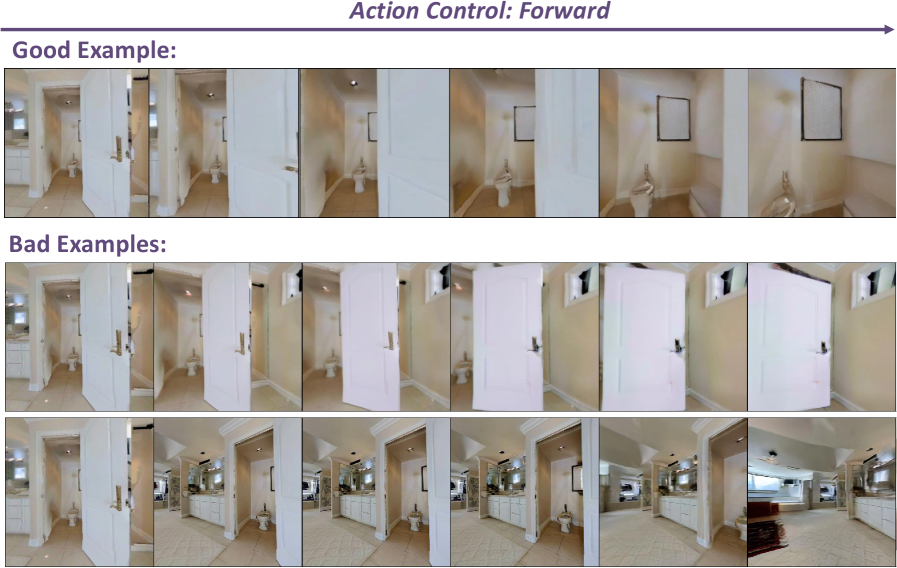
The image presents a comparative analysis of action control outcomes in a simulated environment. It demonstrates two distinct scenarios: a "Good Example" of smooth forward motion and two "Bad Examples" showing progressive distortion. The visualization uses sequential frames to illustrate the impact of action control algorithms on scene rendering.
### Components/Axes
- **Title**: "Action Control: Forward" with right-pointing arrow (→)
- **Primary Sections**:
1. "Good Example:" (Top section)
2. "Bad Examples:" (Bottom two sections)
- **Visual Elements**:
- 6 sequential frames per example
- Bathroom scene with white door, toilet, and framed artwork
- Progressive door opening animation
### Detailed Analysis
**Good Example:**
1. Frame 1: Door partially open (30°)
2. Frame 2: Door at 45°
3. Frame 3: Door at 60°
4. Frame 4: Door at 75°
5. Frame 5: Door at 90° (fully open)
6. Frame 6: Door at 105° (slightly ajar)
**Bad Examples:**
1. First Row:
- Frame 1: Door at 30° with minor distortion
- Frame 2: Door at 45° with increased blur
- Frame 3: Door at 60° with misaligned textures
- Frame 4: Door at 75° with warped perspective
- Frame 5: Door at 90° with partial transparency
- Frame 6: Door at 105° with complete scene collapse
2. Second Row:
- Frame 1: Door at 30° with color banding
- Frame 2: Door at 45° with geometric artifacts
- Frame 3: Door at 60° with spatial misalignment
- Frame 4: Door at 75° with temporal ghosting
- Frame 5: Door at 90° with complete scene inversion
- Frame 6: Door at 105° with total visual failure
### Key Observations
1. The good example maintains consistent lighting, texture fidelity, and spatial relationships throughout the sequence
2. Bad examples show progressive degradation:
- First row: Physical distortion (blurring, warping)
- Second row: Rendering artifacts (color banding, spatial misalignment)
3. All examples maintain temporal coherence in door opening motion
4. Final frames demonstrate complete failure of scene integrity in bad examples
### Interpretation
This visualization demonstrates the critical role of action control algorithms in maintaining scene integrity during motion simulation. The good example shows successful implementation of:
- Temporal consistency
- Spatial accuracy
- Texture preservation
- Lighting stability
The bad examples reveal failure modes including:
- Progressive distortion accumulation
- Rendering pipeline failures
- Spatial coherence breakdown
- Temporal artifact generation
The comparison suggests that effective action control requires maintaining:
1. Consistent transformation matrices
2. Accurate spatial relationships
3. Temporal coherence in object states
4. Proper handling of perspective changes
The progressive nature of failures in bad examples indicates potential issues with:
- Integration of motion vectors
- Object state tracking
- Scene graph management
- Physics simulation accuracy