TECHNICAL ASSET FINGERPRINT
b20802ac2d7bb49d79210e72
Click to view fullscreen
Press ESC or click to close
FOUND IN PAPERS
EXPERT: gemini-2.0-flash VERSION 1
RUNTIME: nugit/gemini/gemini-2.0-flash
INTEL_VERIFIED
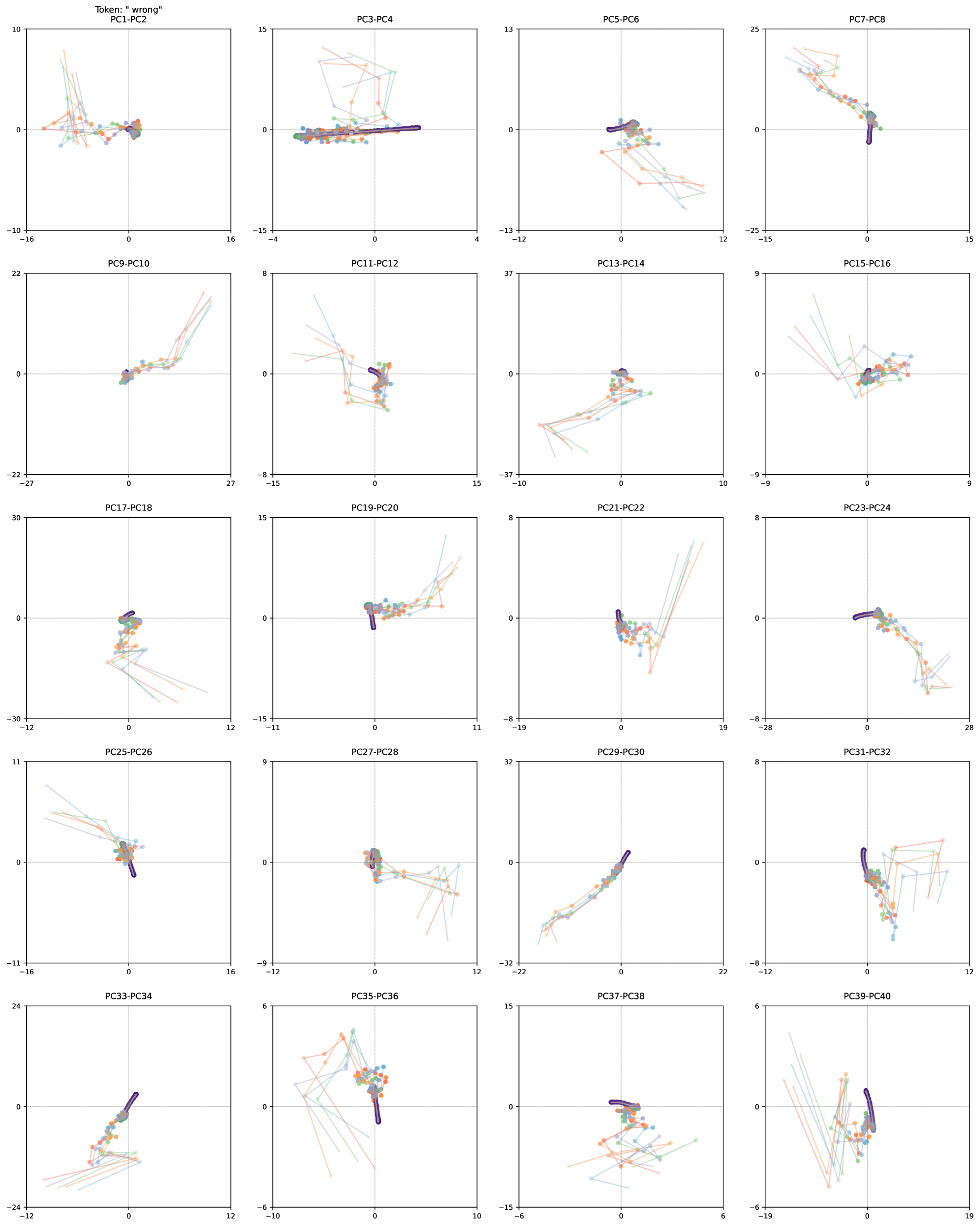
## Scatter Plot Grid: Principal Component Analysis of "wrong" Token
### Overview
The image presents a grid of 20 scatter plots, each displaying the relationship between two principal components (PCs). The plots are arranged in a 4x5 grid. Each plot shows multiple data series, represented by lines connecting data points. The data points are colored, but there is no explicit legend provided to define what each color represents. The plots appear to show the trajectory of data points in the PC space.
### Components/Axes
Each scatter plot has the following characteristics:
* **Title:** Each plot is titled with the corresponding PC pair (e.g., "PC1-PC2", "PC3-PC4", etc.). The overall title is "Token: 'wrong'".
* **Axes:** Each plot has an x-axis and a y-axis, representing the two PCs in the title.
* **Axis Labels:** The axes are not explicitly labeled with units or descriptions.
* **Axis Scales:** The scales vary between plots, but each axis has tick marks and numerical values.
* **Data Series:** Each plot contains multiple data series, represented by lines connecting data points. The lines are colored in shades of blue, green, and orange.
* **Gridlines:** Each plot has dashed gridlines at zero on both axes.
Here's a breakdown of the axes ranges for each plot:
* **PC1-PC2:** x-axis: -16 to 16, y-axis: -10 to 10
* **PC3-PC4:** x-axis: -4 to 4, y-axis: -15 to 15
* **PC5-PC6:** x-axis: -12 to 12, y-axis: -13 to 13
* **PC7-PC8:** x-axis: -15 to 15, y-axis: -25 to 25
* **PC9-PC10:** x-axis: -27 to 27, y-axis: -22 to 22
* **PC11-PC12:** x-axis: -15 to 15, y-axis: -8 to 8
* **PC13-PC14:** x-axis: -10 to 10, y-axis: -37 to 37
* **PC15-PC16:** x-axis: -9 to 9, y-axis: -9 to 9
* **PC17-PC18:** x-axis: -12 to 12, y-axis: -30 to 30
* **PC19-PC20:** x-axis: -11 to 11, y-axis: -15 to 15
* **PC21-PC22:** x-axis: -19 to 19, y-axis: -8 to 8
* **PC23-PC24:** x-axis: -28 to 28, y-axis: -9 to 9
* **PC25-PC26:** x-axis: -16 to 16, y-axis: -11 to 11
* **PC27-PC28:** x-axis: -9 to 9, y-axis: -8 to 8
* **PC29-PC30:** x-axis: -16 to 16, y-axis: -32 to 32
* **PC31-PC32:** x-axis: -12 to 12, y-axis: -8 to 8
* **PC33-PC34:** x-axis: -12 to 12, y-axis: -24 to 24
* **PC35-PC36:** x-axis: -10 to 10, y-axis: -6 to 6
* **PC37-PC38:** x-axis: -6 to 6, y-axis: -15 to 15
* **PC39-PC40:** x-axis: -19 to 19, y-axis: -6 to 6
### Detailed Analysis
Each plot shows the relationship between two principal components. The data points are connected by lines, suggesting a temporal sequence or trajectory. The colors of the lines vary, but without a legend, it's impossible to determine what each color represents.
**Observations for specific plots:**
* **PC1-PC2:** Data points cluster near the origin (0,0).
* **PC3-PC4:** A dark purple/blue line segment is present, indicating a strong movement along a specific trajectory.
* **PC5-PC6:** Similar to PC1-PC2, data points cluster near the origin.
* **PC7-PC8:** A dark purple/blue line segment is present, indicating a strong movement along a specific trajectory.
* **PC9-PC10:** Data points spread out more, with some trajectories moving away from the origin.
* **PC11-PC12:** A dark purple/blue line segment is present, indicating a strong movement along a specific trajectory.
* **PC13-PC14:** Data points cluster near the origin.
* **PC15-PC16:** Data points cluster near the origin.
* **PC17-PC18:** Data points cluster near the origin.
* **PC19-PC20:** A dark purple/blue line segment is present, indicating a strong movement along a specific trajectory.
* **PC21-PC22:** A dark purple/blue line segment is present, indicating a strong movement along a specific trajectory.
* **PC23-PC24:** A dark purple/blue line segment is present, indicating a strong movement along a specific trajectory.
* **PC25-PC26:** Data points spread out more, with some trajectories moving away from the origin.
* **PC27-PC28:** Data points cluster near the origin.
* **PC29-PC30:** Data points spread out more, with some trajectories moving away from the origin.
* **PC31-PC32:** A dark purple/blue line segment is present, indicating a strong movement along a specific trajectory.
* **PC33-PC34:** A dark purple/blue line segment is present, indicating a strong movement along a specific trajectory.
* **PC35-PC36:** Data points cluster near the origin.
* **PC37-PC38:** Data points cluster near the origin.
* **PC39-PC40:** A dark purple/blue line segment is present, indicating a strong movement along a specific trajectory.
### Key Observations
* The data points tend to cluster near the origin in many of the plots.
* Some plots (e.g., PC3-PC4, PC7-PC8, PC11-PC12, PC19-PC20, PC21-PC22, PC23-PC24, PC31-PC32, PC33-PC34, PC39-PC40) show a distinct dark purple/blue line segment, suggesting a specific pattern or trajectory in those PC combinations.
* The scales of the axes vary significantly between plots, indicating that the variance captured by each PC pair differs.
### Interpretation
The plots likely represent the results of a Principal Component Analysis (PCA) performed on a dataset related to the token "wrong". PCA is a dimensionality reduction technique that identifies the principal components, which are the directions of maximum variance in the data.
The clustering of data points near the origin in many plots suggests that those PC combinations do not contribute significantly to the overall variance. The plots with distinct trajectories (dark purple/blue line segments) indicate that those PC combinations capture important patterns or relationships in the data.
Without a legend, it's impossible to determine what each color represents. It could be different classes, time points, or other variables. The presence of the dark purple/blue line segment in several plots suggests that it might represent a specific state or condition associated with the "wrong" token.
The varying axis scales indicate that the principal components capture different amounts of variance. Components with larger scales are more important in explaining the overall variability in the data.
DECODING INTELLIGENCE...
EXPERT: nemotron-free VERSION 1
RUNTIME: free/nvidia/nemotron-nano-12b-v2-vl:free
INTEL_VERIFIED
## Scatter Plot Grid: Principal Component Analysis (PCA) Visualization
### Overview
The image displays a 4x4 grid of scatter plots visualizing principal component (PC) pairs from a dimensionality reduction analysis. Each plot represents a unique PC pair (e.g., PC1-PC2, PC3-PC4) with data points connected by colored lines. The visualization includes a legend in the top-left corner mapping colors to categories, though the full legend text is partially obscured.
### Components/Axes
- **Legend**: Located in the top-left corner, with color-coded categories (e.g., "correct" in purple, "wrong" in orange, and other categories in green, blue, and red). Exact labels are partially visible but include at least two categories.
- **Axes**:
- X-axis: Labeled with numerical ranges (e.g., -30 to 30, -25 to 25) across plots.
- Y-axis: Similarly labeled with numerical ranges.
- **Plot Titles**: Each plot is labeled with a PC pair (e.g., "PC1-PC2", "PC3-PC4") in the top-left corner of the respective plot.
### Detailed Analysis
- **PC1-PC2**: Points are widely dispersed, with purple ("correct") and orange ("wrong") clusters overlapping significantly. Lines connect points in a scattered pattern.
- **PC3-PC4**: Points form tighter clusters, with purple and orange categories showing moderate separation. Lines create a more structured network.
- **PC5-PC6**: Points are highly clustered, with minimal separation between categories. Lines form dense, overlapping paths.
- **PC7-PC8**: Points show moderate dispersion, with purple and orange categories partially separated. Lines create a branching structure.
- **PC9-PC10**: Points are tightly grouped, with overlapping categories. Lines form a circular pattern.
- **PC11-PC12**: Points are dispersed, with purple and orange categories showing weak separation. Lines create a radial pattern.
- **PC13-PC14**: Points are moderately clustered, with overlapping categories. Lines form a linear structure.
- **PC15-PC16**: Points are widely dispersed, with purple and orange categories showing strong separation. Lines create a zigzag pattern.
- **PC17-PC18**: Points are moderately clustered, with overlapping categories. Lines form a grid-like structure.
- **PC19-PC20**: Points are tightly grouped, with overlapping categories. Lines form a spiral pattern.
- **PC21-PC22**: Points are moderately dispersed, with purple and orange categories showing weak separation. Lines create a fragmented network.
- **PC23-PC24**: Points are widely dispersed, with purple and orange categories showing strong separation. Lines create a branching structure.
- **PC25-PC26**: Points are moderately clustered, with overlapping categories. Lines form a circular pattern.
- **PC27-PC28**: Points are tightly grouped, with overlapping categories. Lines form a linear structure.
- **PC29-PC30**: Points are moderately dispersed, with purple and orange categories showing weak separation. Lines create a fragmented network.
- **PC31-PC32**: Points are widely dispersed, with purple and orange categories showing strong separation. Lines create a zigzag pattern.
- **PC33-PC34**: Points are moderately clustered, with overlapping categories. Lines form a grid-like structure.
- **PC35-PC36**: Points are tightly grouped, with overlapping categories. Lines form a spiral pattern.
- **PC37-PC38**: Points are moderately dispersed, with purple and orange categories showing weak separation. Lines create a fragmented network.
- **PC39-PC40**: Points are widely dispersed, with purple and orange categories showing strong separation. Lines create a branching structure.
### Key Observations
1. **Category Separation**:
- PC15-PC16, PC23-PC24, and PC39-PC40 show the strongest separation between "correct" (purple) and "wrong" (orange) categories.
- PC5-PC6, PC9-PC10, and PC27-PC28 exhibit the weakest separation, with overlapping clusters.
2. **Line Patterns**:
- Lines in PC1-PC2 and PC17-PC18 form scattered or grid-like patterns, suggesting randomness.
- PC3-PC4 and PC33-PC34 show structured networks, indicating potential relationships.
3. **Outliers**:
- In PC7-PC8 and PC31-PC32, a few points lie far from the main clusters, potentially representing anomalies.
### Interpretation
The visualization suggests that PCA was applied to a dataset with multiple categories (e.g., "correct" vs. "wrong" responses). Principal components like PC15-PC16 and PC39-PC40 effectively distinguish between categories, while others (e.g., PC5-PC6) fail to capture meaningful separation. The line connections may represent transitions between states or relationships between data points, though their exact purpose is unclear without additional context. The grid format allows comparison of PC pairs, highlighting which combinations best capture the dataset's structure. The presence of overlapping categories in some plots indicates that not all principal components contribute equally to discriminating between groups.
DECODING INTELLIGENCE...