## Image Sequence: Day/Night and Warm/Cold Color Grading
### Overview
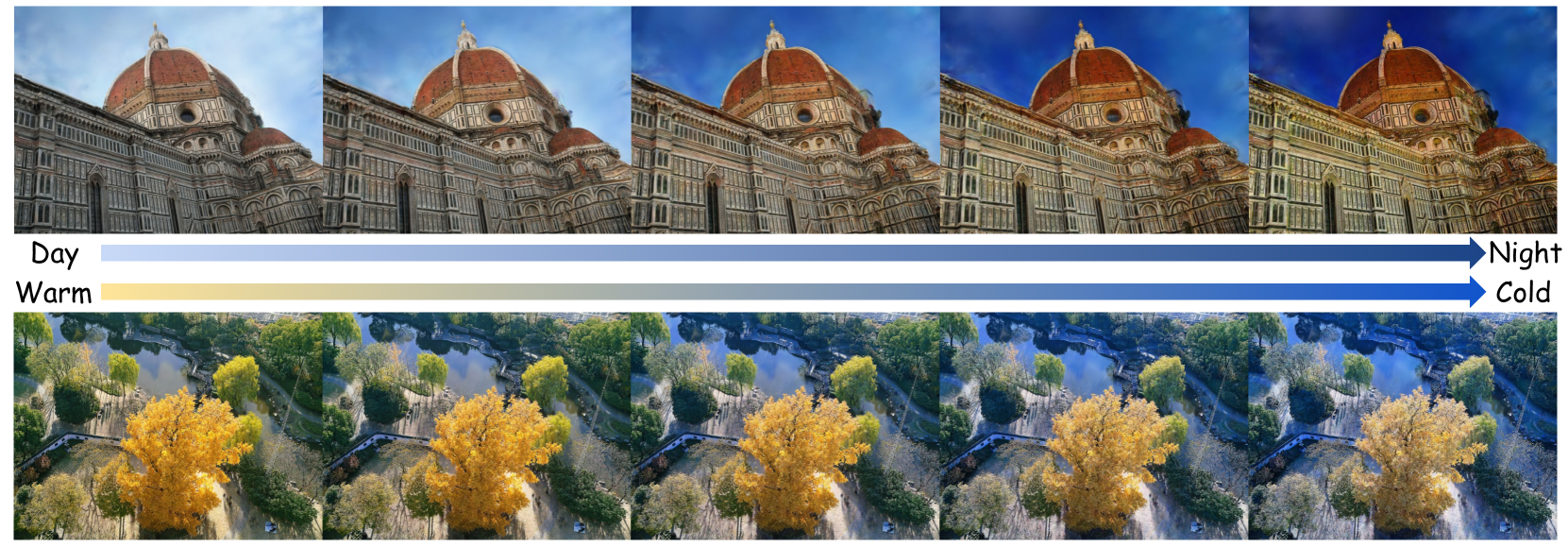
The image presents a sequence of photographs depicting two different scenes (a cathedral and a park) under varying color grading conditions. The sequence progresses from left to right, transitioning from daytime/warm tones to nighttime/cold tones. The color grading is indicated by two color gradients with labels "Day" to "Night" and "Warm" to "Cold".
### Components/Axes
* **Scenes:**
* Top Row: Cathedral (likely the Florence Cathedral)
* Bottom Row: Park scene with a pond and trees
* **Color Gradients:**
* Top Gradient: Light blue transitioning to dark blue, labeled "Day" (left) and "Night" (right) with an arrow indicating the direction of change.
* Bottom Gradient: Light yellow transitioning to dark blue, labeled "Warm" (left) and "Cold" (right) with an arrow indicating the direction of change.
### Detailed Analysis or ### Content Details
The image is divided into three horizontal sections: the cathedral images, the color gradients, and the park images.
**Cathedral Images:**
* There are five images of the cathedral, each with a different color grading.
* From left to right, the images transition from a bright, warm tone to a darker, cooler tone.
* The first image has a light blue sky and warm lighting on the cathedral.
* The last image has a dark blue sky and cooler lighting on the cathedral.
**Color Gradients:**
* The color gradients visually represent the transition from day to night and warm to cold.
* The gradients are positioned between the cathedral and park images, providing a visual key for the color grading applied to each scene.
**Park Images:**
* There are five images of the park, each with a different color grading corresponding to the cathedral images above.
* From left to right, the images transition from a bright, warm tone to a darker, cooler tone.
* The first image has warm, yellow tones in the trees and a light blue sky.
* The last image has cooler, blue tones in the trees and a darker blue sky.
### Key Observations
* The color grading is consistent across both the cathedral and park scenes.
* The transition from warm to cold tones is gradual and visually apparent.
* The color gradients provide a clear visual representation of the color grading applied to each image.
### Interpretation
The image demonstrates the effect of different color grading techniques on two distinct scenes. The transition from daytime/warm tones to nighttime/cold tones is visually striking and effectively conveys the impact of color grading on the overall mood and atmosphere of the images. The color gradients serve as a key to understanding the color grading applied to each image, making it easy to compare and contrast the different effects. The image is likely intended to showcase the capabilities of color grading software or techniques.