## Heatmap: Radial Snowflake Distribution
### Overview
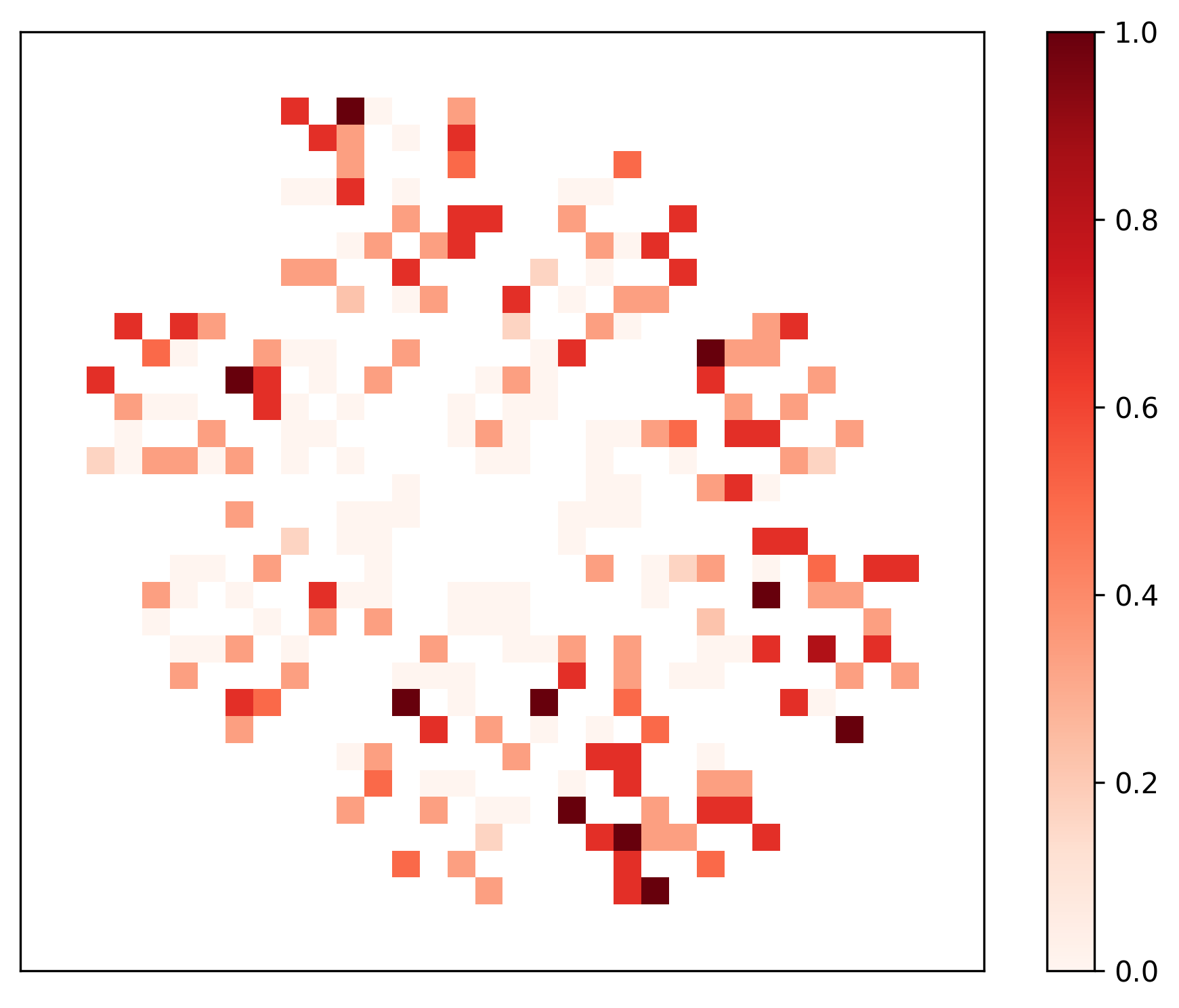
The image is a heatmap visualization arranged in a radial, snowflake-like pattern. It lacks explicit axis labels, titles, or textual annotations. The visualization uses a color gradient to represent data intensity, ranging from white (0.0) to dark red (1.0). The structure exhibits 6-fold rotational symmetry, characteristic of hexagonal crystal lattices or snowflake growth simulations.
### Components/Axes
* **Main Chart:** A grid-based radial plot. The data points are discrete squares arranged in a pattern that radiates from a central, empty origin.
* **Color Bar (Legend):** Located on the right side of the image.
* **Scale:** Linear, ranging from 0.0 (bottom, white) to 1.0 (top, dark red).
* **Gradient:** Transitions from white to light orange, to medium red, and finally to dark maroon/red.
* **Axes:** No numerical or categorical axes are provided.
### Detailed Analysis
The data distribution is non-uniform and sparse, characterized by the following trends:
* **Radial Gradient:** There is a clear trend of increasing intensity (color value) as the distance from the center increases.
* **Center (Origin):** The central region is almost entirely white, indicating values near 0.0.
* **Mid-Radius:** Contains sparse, low-to-medium intensity values (approx. 0.2–0.5), represented by light orange to light red squares.
* **Outer-Radius:** Contains the highest concentration of high-intensity values (approx. 0.6–1.0), represented by medium-to-dark red squares.
* **Symmetry:** The plot exhibits 6-fold rotational symmetry. The "arms" of the snowflake-like structure are composed of clusters of squares.
* **Hotspots:** There are distinct, high-intensity clusters (dark red, ~0.9–1.0) located primarily in the outer regions of the arms.
* *Example:* A prominent dark red cluster is visible in the lower-right quadrant.
* *Example:* Another significant cluster is located in the upper-left quadrant.
* **Density:** The density of the data points (the number of colored squares) is higher in the outer regions compared to the inner regions, suggesting a "growth" or "diffusion" pattern.
### Key Observations
* **Data Sparsity:** The plot is not a filled grid; it is a sparse matrix where most cells are empty (white).
* **Symmetry:** The 6-fold symmetry is highly precise, suggesting this is likely the output of a mathematical model, a physical simulation (e.g., crystal growth), or a specific type of polar coordinate data mapping.
* **Outliers:** There are no obvious isolated outliers; the high-intensity values are generally grouped within the arms of the structure, rather than appearing randomly in the empty spaces.
### Interpretation
* **What the data demonstrates:** This visualization likely represents a simulation of a physical process, such as dendritic crystal growth, snowflake formation, or a diffusion-limited aggregation (DLA) model. The radial symmetry and the outward increase in intensity suggest a process that originates at a central point and expands outward over time or space.
* **How elements relate:** The color bar acts as a magnitude scale. The relationship between the spatial position (distance from center) and the color intensity suggests that the variable being measured (e.g., density, probability, or concentration) is positively correlated with the distance from the nucleation point.
* **Peircean/Reading between the lines:** The absence of labels and the highly stylized, symmetric nature of the data strongly imply this is a figure from a scientific or computational paper. The "empty" center represents the initial state (time zero or origin), and the "arms" represent the progression of the phenomenon. The dark red "hotspots" likely represent the most recent or most active areas of the simulation/process.