## Network Diagram: Gender-Related Term Associations
### Overview
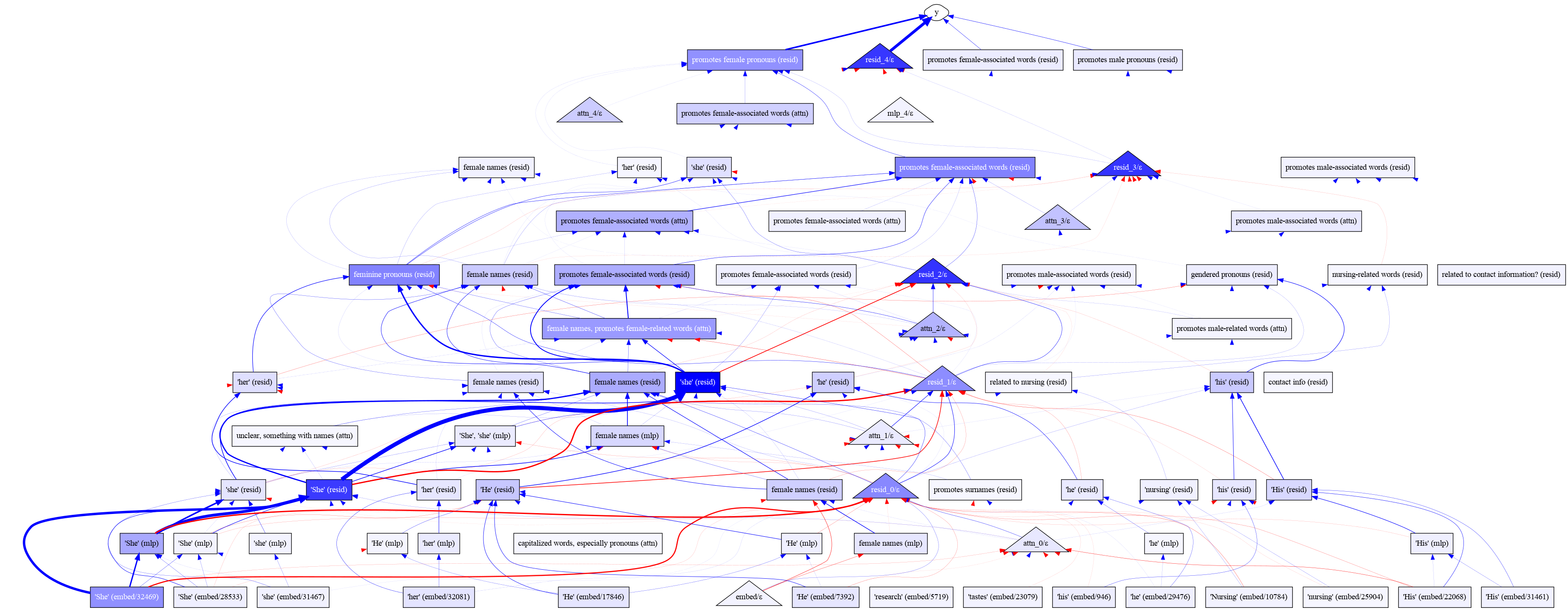
The diagram depicts a complex network of nodes and edges representing relationships between gender-related terms, pronouns, and associated concepts. Nodes are color-coded (blue, red, gray) and labeled with terms like "promotes female pronouns (resid)", "female names (resid)", and "nursing-related words (resid)". Edges indicate directional relationships between concepts, with some nodes containing numerical embeddings (e.g., "She' (embed32469)").
### Components/Axes
1. **Nodes**:
- **Blue Nodes**: Represent core gender-related concepts (e.g., "promotes female pronouns (resid)", "female names (resid)", "She' (resid)").
- **Red Nodes**: Indicate associations with male-related terms (e.g., "promotes male pronouns (resid)", "his' (resid)", "contact info (resid)").
- **Gray Nodes**: Denote ambiguous or neutral terms (e.g., "unclear, something with names (attn)", "related to contact information? (resid)").
- **Embedded Nodes**: Include numerical embeddings (e.g., "She' (embed32469)", "He' (embed32081)").
2. **Edges**:
- **Blue Arrows**: Represent "promotes" relationships (e.g., "promotes female-associated words (resid)" → "female names (resid)").
- **Red Arrows**: Indicate "related to" or "associated with" connections (e.g., "nursing-related words (resid)" → "contact info (resid)").
- **Gray Arrows**: Suggest weaker or uncertain relationships (e.g., "unclear, something with names (attn)" → "female names (resid)").
3. **Legend**:
- Located at the bottom, mapping colors to relationship types:
- **Blue**: "promotes" (e.g., "promotes female-associated words (resid)").
- **Red**: "related to" (e.g., "nursing-related words (resid)").
- **Gray**: "unclear" or neutral (e.g., "unclear, something with names (attn)").
### Detailed Analysis
- **Gender Pronouns**:
- "She' (resid)" and "He' (resid)" are central nodes with bidirectional connections to "promotes female-associated words (resid)" and "promotes male-associated words (resid)".
- Embeddings (e.g., "She' (embed32469)") suggest quantitative representations of these terms.
- **Occupational Associations**:
- "nursing-related words (resid)" connects to "contact info (resid)" and "his' (resid)", implying gendered occupational stereotypes.
- **Ambiguity Nodes**:
- Nodes like "unclear, something with names (attn)" and "related to contact information? (resid)" highlight unresolved or context-dependent relationships.
- **Embedding Patterns**:
- Numerical embeddings (e.g., "She' (embed32469)", "He' (embed32081)") vary significantly, suggesting distinct semantic representations for gendered terms.
### Key Observations
1. **Gendered Occupational Bias**: Nursing-related terms are linked to male-associated concepts ("his' (resid)"), reflecting societal stereotypes.
2. **Pronoun Prominence**: "She'" and "He'" nodes are highly connected, indicating their centrality in gender-related discourse.
3. **Ambiguity in Relationships**: Gray nodes and edges suggest uncertainty in some associations (e.g., "unclear, something with names (attn)").
4. **Embedding Diversity**: Numerical embeddings for similar terms (e.g., "She' (embed32469)" vs. "She' (embed28533)") imply nuanced semantic distinctions.
### Interpretation
The diagram reveals a network where gendered terms and pronouns are tightly interconnected with occupational and social concepts. The prominence of "She'" and "He'" nodes, along with their associations with nursing and contact information, highlights potential biases in language models or datasets. Ambiguity nodes suggest areas requiring further clarification, while embedding variations indicate complex semantic representations. This structure could reflect training data biases or societal gender norms encoded in language models.