\n
## Diagram: Communication Protocols in Multi-Agent Systems
### Overview
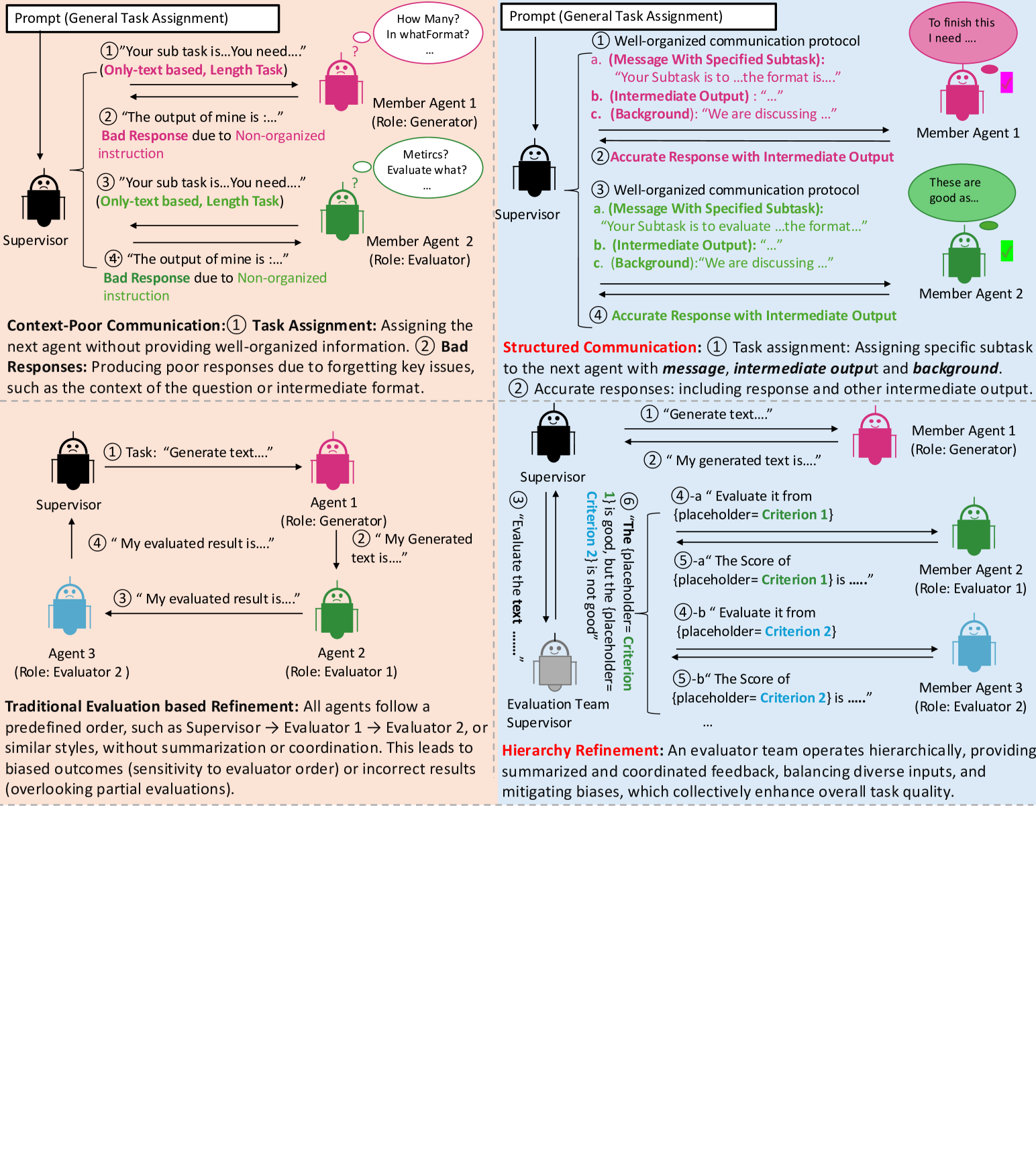
The image presents a comparative diagram illustrating two communication protocols in multi-agent systems: "Context-Poor Communication" and "Structured Communication." Each protocol is depicted with a Supervisor agent and two Member agents (Agent 1 and Agent 2). The diagram highlights the differences in task assignment and response quality between the two approaches. The diagram also includes a scoring rubric for evaluating responses.
### Components/Axes
The diagram is divided into two main sections, one for each communication protocol. Each section contains:
* **Supervisor:** Represented by a head icon, initiating tasks.
* **Member Agent 1 (Generator):** Represented by a head icon, generating responses. Labeled with "(Role: Generator)".
* **Member Agent 2 (Evaluator):** Represented by a head icon, evaluating responses. Labeled with "(Role: Evaluator)".
* **Communication Arrows:** Illustrating the flow of prompts, outputs, and evaluations.
* **Text Boxes:** Containing example prompts, responses, and evaluation criteria.
* **Scoring Rubric:** A table at the bottom detailing evaluation criteria (a-b) and scores.
### Detailed Analysis or Content Details
**Context-Poor Communication (Left Side):**
1. **Prompt (Supervisor to Agent 1):** "Your sub task is…You need…" (Only-text based, Length Task).
2. **Agent 1 Response:** "The output of mine is…" Bad Response due to Non-organized instruction.
3. **Prompt (Supervisor to Agent 2):** "Your sub task is…You need…" (Only-text based, Length Task).
4. **Agent 2 Response:** "The output of mine is…" Bad Response due to Non-organized instruction.
5. **Annotation:** "Context-Poor Communication: Assigning the next agent without providing well-organized information. ② Bad Responses: Producing poor responses due to forgetting key issues, such as the context of the question or intermediate format."
**Structured Communication (Right Side):**
1. **Prompt (Supervisor to Agent 1):** "Generate text…"
2. **Agent 1 Response:** "My generated text is…"
3. **Prompt (Supervisor to Agent 2):** "Evaluate it from…"
4. **Agent 2 Response:** "My evaluated result is…" These are good as…
5. **Annotation:** "Structured Communication: Assigning specific subtask to the next agent with message, intermediate output and background. ② Accurate responses: including response and other intermediate output."
**Scoring Rubric (Bottom):**
The rubric is presented as a table with two rows and two columns.
| | a. (Placeholder-Criterion 1) | b. (Placeholder-Criterion 2) |
|--------------|------------------------------|------------------------------|
| **A** | "The [placeholder-Criterion 1] is good but the [placeholder-Criterion 2] is not good" | "The Score of [placeholder-Criterion 1] is…" |
| **B** | "Evaluate it from [placeholder-Criterion 2]" | "The Score of [placeholder-Criterion 2] is…" |
**Additional Text:**
* "How Many?"
* "In what Format?"
* "Metrics? Evaluate what?"
* "To finish this I need…"
### Key Observations
* The "Structured Communication" protocol consistently yields "good" responses, while the "Context-Poor Communication" protocol results in "bad" responses.
* The scoring rubric uses placeholder criteria, suggesting it's a template for evaluation.
* The diagram emphasizes the importance of providing context and intermediate outputs in multi-agent communication.
* The diagram uses a consistent visual style with head icons representing agents and arrows indicating communication flow.
### Interpretation
The diagram demonstrates the critical role of well-defined communication protocols in multi-agent systems. The "Structured Communication" approach, which includes clear task assignments, intermediate outputs, and background information, leads to more accurate and useful responses. Conversely, the "Context-Poor Communication" approach, lacking these elements, results in poor-quality responses. The scoring rubric suggests a framework for evaluating the quality of responses based on specific criteria.
The diagram highlights a fundamental principle in AI and distributed systems: effective communication is essential for collaboration and achieving desired outcomes. The use of placeholders in the scoring rubric indicates that the specific evaluation criteria will vary depending on the task and the agents involved. The diagram serves as a visual guide for designing and implementing robust communication protocols in multi-agent systems. The diagram is a conceptual illustration, and the specific details of the prompts and responses are examples to demonstrate the difference in outcomes. The diagram is not presenting factual data, but rather a conceptual comparison.