## Flowchart: User Feedback and Model Alignment System
### Overview
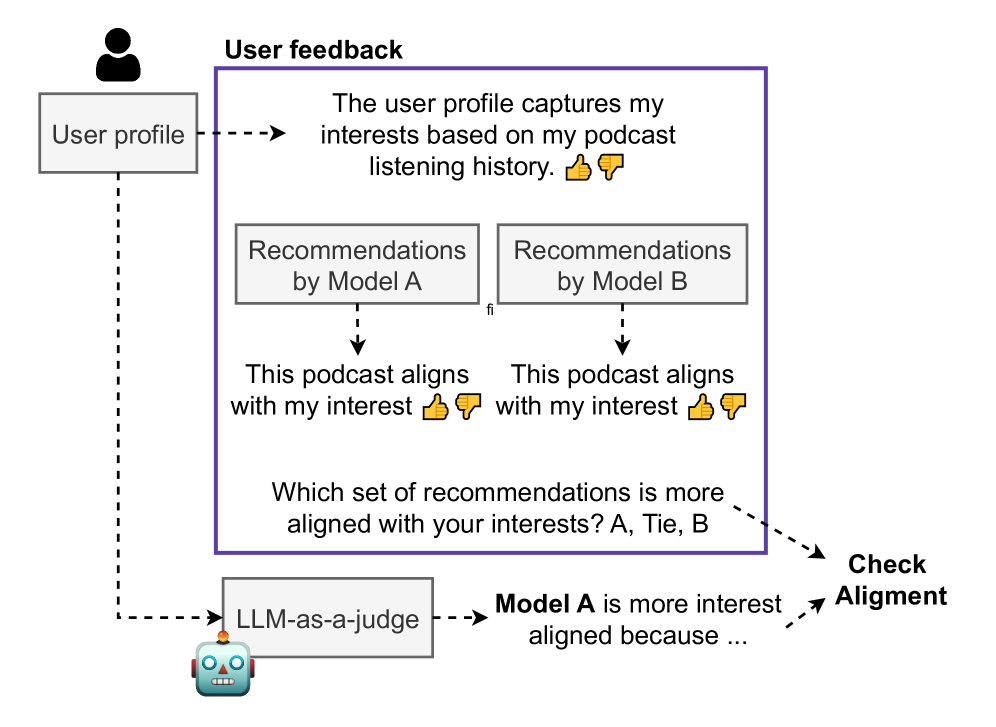
The diagram illustrates a recommendation system workflow that evaluates podcast alignment with user interests through two models (A and B), user feedback, and an LLM-as-a-judge. The system captures user preferences via podcast listening history and uses thumbs-up/thumbs-down feedback to assess model performance.
### Components/Axes
1. **User Profile** (top-left)
- Captures interests based on podcast listening history
- Includes thumbs-up/thumbs-down emojis for feedback
2. **Recommendations by Model A** (left-center)
- Output: "This podcast aligns with my interest" with thumbs-up/thumbs-down
3. **Recommendations by Model B** (right-center)
- Output: "This podcast aligns with my interest" with thumbs-up/thumbs-down
4. **LLM-as-a-judge** (bottom-left)
- Evaluates which model's recommendations are more aligned with user interests
- Output: "Model A is more interest aligned because..."
5. **Check Alignment** (right-center)
- Decision point: "Which set of recommendations is more aligned with your interests? A, Tie, B"
### Detailed Analysis
- **User Profile** → **Recommendations by Model A/B**: Dotted arrows indicate parallel processing of recommendations
- **Feedback Loop**: Thumbs-up/thumbs-down emojis appear in both recommendation paths
- **LLM-as-a-judge** receives input from both models and outputs a comparative analysis
- **Check Alignment** box contains a decision question with three possible outcomes (A, Tie, B)
### Key Observations
1. **Parallel Processing**: Both models generate recommendations simultaneously
2. **Feedback Integration**: User feedback is embedded in both recommendation paths
3. **LLM Evaluation**: The LLM-as-a-judge acts as a meta-evaluator comparing model performance
4. **Decision Tree**: The system includes a structured decision point for alignment verification
### Interpretation
This system demonstrates a hybrid approach to recommendation validation:
1. **Model Diversity**: Using two distinct models (A and B) prevents over-reliance on a single algorithm
2. **User-Centric Feedback**: Direct user input (thumbs-up/down) grounds model performance in real-world relevance
3. **LLM Reasoning**: The LLM-as-a-judge adds explainability by providing rationale for its alignment judgment
4. **Decision Transparency**: The explicit "Check Alignment" step creates an audit trail for recommendation quality
The architecture suggests a focus on explainable AI in recommendation systems, where model outputs are not just evaluated for accuracy but also for their alignment with user intent through multiple validation layers.