## Screenshot: Rust Code Implementation for String Concatenation
### Overview
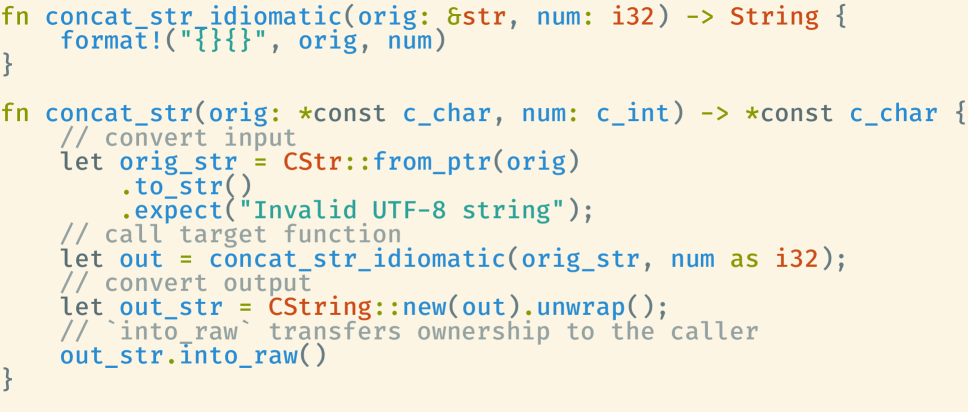
The image shows a Rust code snippet implementing two functions for string concatenation: `concat_str_idiomatic` and `concat_str`. The code includes syntax highlighting with color-coded elements (blue for keywords, orange for types, green for identifiers) and comments explaining the logic.
### Components/Axes
- **Function Definitions**:
- `fn concat_str_idiomatic(orig: &str, num: i32) -> String`
- `fn concat_str(orig: *const c_char, num: c_int) -> *const c_char`
- **Syntax Highlighting**:
- Keywords (e.g., `fn`, `let`, `expect`) in blue
- Types (e.g., `String`, `CString`, `CStr`) in orange
- Identifiers (e.g., `orig`, `num`, `out_str`) in green
- Comments in gray
- **Error Handling**:
- `expect("Invalid UTF-8 string")` for UTF-8 validation
- `unwrap()` for optional value conversion
### Detailed Analysis
1. **`concat_str_idiomatic` Function**:
- Parameters: `orig` (string slice), `num` (32-bit integer)
- Returns: `String` (heap-allocated string)
- Logic:
- Uses `format!` macro to concatenate `orig` and `num` into a formatted string.
- Example: `format!("{{}}", orig, num)` creates a string like `"hello123"` if `orig="hello"` and `num=123`.
2. **`concat_str` Function**:
- Parameters: `orig` (pointer to constant C string), `num` (C integer)
- Returns: Pointer to constant C string (`*const c_char`)
- Logic:
- Converts `orig` to a Rust `CString` via `CStr::from_ptr(orig).to_str().expect("Invalid UTF-8 string")`.
- Calls `concat_str_idiomatic` with the converted string and `num` (cast to `i32`).
- Wraps the result in a new `CString` and returns its raw pointer via `unwrap()` and `into_raw()`.
3. **Ownership Transfer**:
- `out_str.into_raw()` transfers ownership of the `CString` to the caller, requiring manual deallocation.
### Key Observations
- **Idiomatic vs. Low-Level**: `concat_str_idiomatic` uses Rust's high-level string formatting, while `concat_str` bridges Rust and C via raw pointers.
- **Error Propagation**: The `expect` macro enforces UTF-8 validity, crashing on invalid input.
- **Memory Management**: The `unwrap()` and `into_raw()` combination assumes valid input, risking panics or memory leaks if misused.
### Interpretation
- **Purpose**: The code demonstrates safe interoperability between Rust and C strings, with `concat_str_idiomatic` providing a safe abstraction and `concat_str` enabling low-level C compatibility.
- **Trade-offs**: The `concat_str` function sacrifices Rust's safety guarantees (e.g., raw pointers, `unwrap()`) for C compatibility, requiring careful error handling.
- **Design Insight**: The separation of concerns—`concat_str_idiomatic` for Rust-centric use and `concat_str` for FFI (Foreign Function Interface)—highlights Rust's emphasis on safety without sacrificing performance.
## Additional Notes
- **Language**: Rust (no other languages detected).
- **Color Significance**: Syntax highlighting aids readability but does not affect code semantics.
- **Missing Context**: The code lacks error recovery mechanisms (e.g., `?` operator) for the `expect` call, which could improve robustness.