## Diagram: Secure Computation Protocol Architecture
### Overview
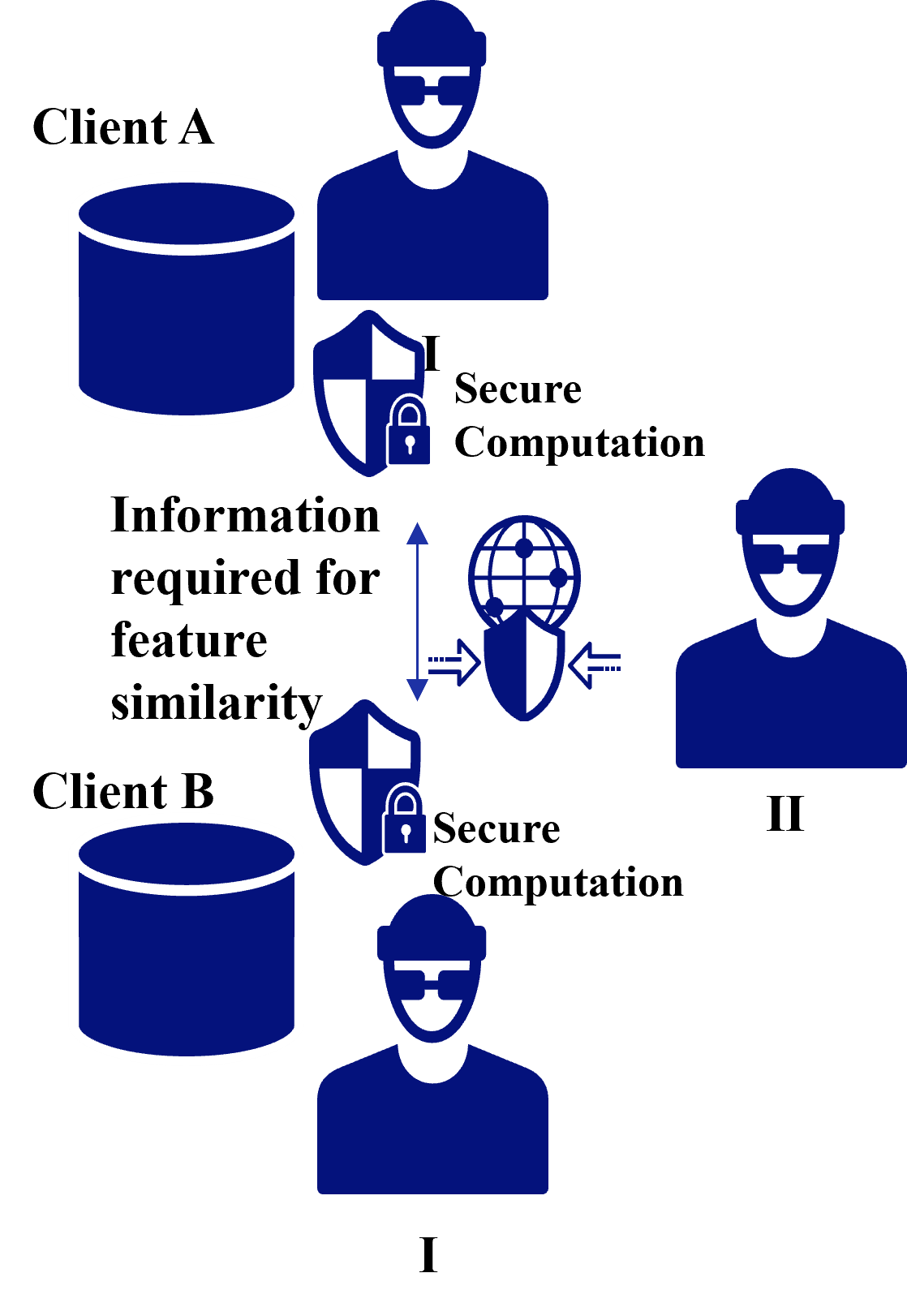
The image is a conceptual diagram illustrating a secure computation architecture involving two clients (Client A and Client B) and two external entities (labeled I and II). The diagram depicts a process where information is exchanged for "feature similarity" while utilizing "Secure Computation" mechanisms to protect data integrity and privacy.
### Components/Axes
* **Entities:**
* **Client A:** Located at the top-left, represented by a database icon and a person icon.
* **Client B:** Located at the bottom-left, represented by a database icon and a person icon.
* **Entity I:** Located at the bottom-center, represented by a person icon.
* **Entity II:** Located at the right-center, represented by a person icon.
* **Central Hub:**
* **Globe with Shield:** Located in the center, representing the central computation or aggregation point.
* **Security Mechanisms:**
* **Secure Computation Shields:** Two shield icons with padlocks, positioned between the clients and the central globe.
* **Textual Labels:**
* "Client A" (Top-left)
* "Client B" (Bottom-left)
* "Secure Computation" (Appears twice, next to the shield icons)
* "Information required for feature similarity" (Left-center)
* "I" (Below the bottom-center person icon)
* "II" (Below the right-center person icon)
### Detailed Analysis
* **Spatial Layout:**
* The diagram is organized with the data sources (Clients A and B) on the left.
* The central processing hub (Globe/Shield) is in the middle.
* The external entities (I and II) are positioned at the bottom and right, respectively.
* **Flow and Interaction:**
* **Data Protection:** The "Secure Computation" shields are placed directly between the client databases and the central globe. This implies that data leaving the clients is encrypted or processed via secure computation protocols before reaching the central hub.
* **Information Exchange:** The text "Information required for feature similarity" is positioned to the left of the central globe. A vertical double-headed arrow indicates that this specific information is the subject of the exchange between the clients and the central hub.
* **Directionality:** Horizontal arrows point toward the central globe from the left (representing the clients) and from the right (representing Entity II), suggesting a multi-directional data flow into the central computation hub.
### Key Observations
* **Color Scheme:** The diagram uses a consistent dark blue color for all icons and text against a light gray background, creating a unified visual identity.
* **Iconography:** The use of a shield with a padlock is a standard industry symbol for encryption or secure computation. The globe icon typically represents a network or a global server.
* **Role Differentiation:** The labeling of entities as "I" and "II" suggests distinct roles in the protocol, though the diagram does not explicitly define the functional difference between these two entities.
### Interpretation
This diagram illustrates a **Secure Multi-Party Computation (SMPC)** or **Federated Learning** environment.
* **Purpose:** The primary goal is to calculate "feature similarity" between Client A and Client B. This is a common requirement in privacy-preserving machine learning or data analysis, where two parties want to know how similar their datasets are without revealing the raw data itself.
* **Mechanism:** The "Secure Computation" shields indicate that the raw data remains at the client side (in the databases). Only the necessary, computed, or encrypted information required for the similarity calculation is transmitted to the central globe.
* **Architecture:** The layout suggests a hub-and-spoke model. The central globe acts as the aggregator or the "honest broker" that performs the computation on the received secure inputs. The presence of entities "I" and "II" suggests that the protocol involves more than just the two data-holding clients; these entities likely represent the orchestrator, the computation server, or other participants necessary to facilitate the secure exchange.