TECHNICAL ASSET FINGERPRINT
b55e8642fdf886326a954ac1
Click to view fullscreen
Press ESC or click to close
FOUND IN PAPERS
EXPERT: healer-alpha-free VERSION 1
RUNTIME: free/openrouter/healer-alpha
INTEL_VERIFIED
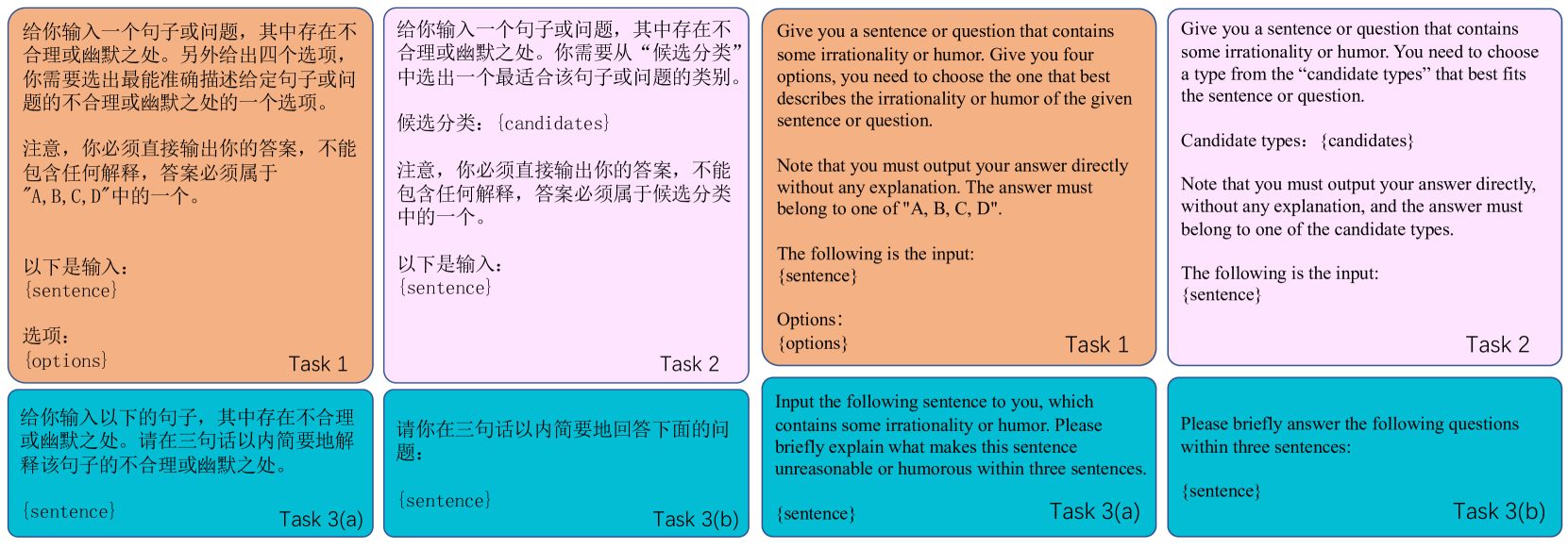
## Diagram: Task Template Grid for Evaluating Irrationality/Humor in Language
### Overview
The image displays a 4x2 grid of colored rectangular boxes, each containing a task template for processing sentences or questions that contain "irrationality or humor." The grid is organized into two rows. The top row contains four distinct task templates, and the bottom row contains two task templates, each split into two sub-variants (a and b). The templates are presented in both Chinese and English, with a clear color-coding scheme: orange for Task 1, purple for Task 2, and blue for Task 3. The purpose appears to be defining standardized prompts for an AI or human evaluator to analyze linguistic irrationality or humor.
### Components/Axes
The image is a diagram, not a chart, so it has no axes. The components are the eight task template boxes, arranged in a grid.
**Spatial Layout & Color Coding:**
* **Top Row (Left to Right):**
1. **Top-Left (Orange):** Task 1 (Chinese version)
2. **Top-Center-Left (Purple):** Task 2 (Chinese version)
3. **Top-Center-Right (Orange):** Task 1 (English version)
4. **Top-Right (Purple):** Task 2 (English version)
* **Bottom Row (Left to Right):**
1. **Bottom-Left (Blue):** Task 3(a) (Chinese version)
2. **Bottom-Center-Left (Blue):** Task 3(b) (Chinese version)
3. **Bottom-Center-Right (Blue):** Task 3(a) (English version)
4. **Bottom-Right (Blue):** Task 3(b) (English version)
### Detailed Analysis / Content Details
Below is the precise transcription of all text within each box, followed by its English translation where applicable.
**1. Top-Left Box (Orange, Task 1 - Chinese)**
* **Text (Chinese):**
> 给你输入一个句子或问题,其中存在不合理或幽默之处。另外给出四个选项,你需要选出最能准确描述给定句子或问题的不合理或幽默之处的一个选项。
>
> 注意,你必须直接输出你的答案,不能包含任何解释,答案必须属于"A, B, C, D"中的一个。
>
> 以下是输入:
> {sentence}
>
> 选项:
> {options}
>
> Task 1
* **English Translation:**
> We input a sentence or question to you, which contains some irrationality or humor. Additionally, four options are given. You need to select the one option that most accurately describes the irrationality or humor of the given sentence or question.
>
> Note that you must directly output your answer, without any explanation. The answer must belong to one of "A, B, C, D".
>
> The following is the input:
> {sentence}
>
> Options:
> {options}
>
> Task 1
**2. Top-Center-Left Box (Purple, Task 2 - Chinese)**
* **Text (Chinese):**
> 给你输入一个句子或问题,其中存在不合理或幽默之处。你需要从“候选分类”中选出一个最适合该句子或问题的类别。
>
> 候选分类:{candidates}
>
> 注意,你必须直接输出你的答案,不能包含任何解释,答案必须属于候选分类中的一个。
>
> 以下是输入:
> {sentence}
>
> Task 2
* **English Translation:**
> We input a sentence or question to you, which contains some irrationality or humor. You need to choose a category from the "candidate types" that best fits the sentence or question.
>
> Candidate types: {candidates}
>
> Note that you must directly output your answer, without any explanation. The answer must belong to one of the candidate types.
>
> The following is the input:
> {sentence}
>
> Task 2
**3. Top-Center-Right Box (Orange, Task 1 - English)**
* **Text (English):**
> Give you a sentence or question that contains some irrationality or humor. Give you four options, you need to choose the one that best describes the irrationality or humor of the given sentence or question.
>
> Note that you must output your answer directly without any explanation. The answer must belong to one of "A, B, C, D".
>
> The following is the input:
> {sentence}
>
> Options:
> {options}
>
> Task 1
**4. Top-Right Box (Purple, Task 2 - English)**
* **Text (English):**
> Give you a sentence or question that contains some irrationality or humor. You need to choose a type from the “candidate types” that best fits the sentence or question.
>
> Candidate types: {candidates}
>
> Note that you must output your answer directly, without any explanation, and the answer must belong to one of the candidate types.
>
> The following is the input:
> {sentence}
>
> Task 2
**5. Bottom-Left Box (Blue, Task 3(a) - Chinese)**
* **Text (Chinese):**
> 给你输入以下的句子,其中存在不合理或幽默之处。请在三句话以内简要地解释该句子的不合理或幽默之处。
>
> {sentence}
>
> Task 3(a)
* **English Translation:**
> Input the following sentence to you, which contains some irrationality or humor. Please briefly explain what makes this sentence unreasonable or humorous within three sentences.
>
> {sentence}
>
> Task 3(a)
**6. Bottom-Center-Left Box (Blue, Task 3(b) - Chinese)**
* **Text (Chinese):**
> 请你在三句话以内简要地回答下面的问题:
>
> {sentence}
>
> Task 3(b)
* **English Translation:**
> Please briefly answer the following questions within three sentences:
>
> {sentence}
>
> Task 3(b)
**7. Bottom-Center-Right Box (Blue, Task 3(a) - English)**
* **Text (English):**
> Input the following sentence to you, which contains some irrationality or humor. Please briefly explain what makes this sentence unreasonable or humorous within three sentences.
>
> {sentence}
>
> Task 3(a)
**8. Bottom-Right Box (Blue, Task 3(b) - English)**
* **Text (English):**
> Please briefly answer the following questions within three sentences:
>
> {sentence}
>
> Task 3(b)
### Key Observations
1. **Parallel Structure:** The grid presents a direct parallel between Chinese and English versions of the same tasks. Task 1 (orange) and Task 2 (purple) are mirrored in the top row. Task 3 (blue) is split into two sub-tasks (a and b) in the bottom row, also mirrored.
2. **Task Differentiation:**
* **Task 1:** A multiple-choice task with fixed options (A, B, C, D).
* **Task 2:** A classification task with a dynamic set of candidate types (`{candidates}`).
* **Task 3(a):** A generative/explanatory task requiring a brief explanation (max 3 sentences) of the irrationality/humor.
* **Task 3(b):** A generative/answering task requiring a brief answer (max 3 sentences) to a question posed within the `{sentence}`.
3. **Placeholders:** All tasks use curly-brace placeholders (`{sentence}`, `{options}`, `{candidates}`) indicating where dynamic input content would be inserted.
4. **Constraint Emphasis:** Tasks 1 and 2 strongly emphasize output constraints: "directly output," "without any explanation," and strict adherence to the answer format (specific letters or candidate types). Task 3 emphasizes a length constraint ("within three sentences").
5. **Color as Identifier:** Color is used consistently to group task types across languages (Orange=Task1, Purple=Task2, Blue=Task3).
### Interpretation
This diagram serves as a **specification sheet for a benchmark or evaluation suite** designed to test an AI system's (or human's) ability to understand and categorize non-literal, humorous, or illogical language.
* **Purpose:** The structured tasks suggest a methodology for quantitatively and qualitatively assessing language model performance on pragmatic understanding, specifically targeting the nuanced domains of humor and logical inconsistency.
* **Relationships:** The tasks form a progression or complementary set. Tasks 1 and 2 are **classification/selection** tasks, suitable for automated scoring. Task 3 is a **generation/explanation** task, requiring more complex language production and likely needing human or advanced model evaluation. The split between 3(a) and 3(b) distinguishes between *explaining* the humor/irrationality and *answering* a question that may be inherently humorous or irrational.
* **Underlying Need:** The existence of both Chinese and English versions indicates an intent for **cross-lingual evaluation**, ensuring the assessment isn't biased towards a single language's cultural or linguistic nuances of humor.
* **Notable Design Choice:** The strict output constraints in Tasks 1 and 2 are typical for creating clean, machine-readable evaluation data, minimizing the noise from explanatory text. This contrasts with the open-ended but length-constrained nature of Task 3, which captures a different dimension of understanding.
In essence, this image outlines a framework for probing how well an intelligence can navigate the gap between literal meaning and intended, often playful or absurd, meaning in human communication.
DECODING INTELLIGENCE...