## Diagram: Modular Space Partitioning
### Overview
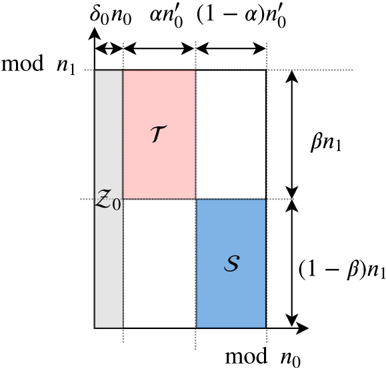
The image is a diagram illustrating the partitioning of a modular space. It shows a rectangular area divided into sections, labeled with mathematical expressions related to modular arithmetic. The diagram includes axes labeled "mod n₀" and "mod n₁", and regions marked as "T" and "S".
### Components/Axes
* **X-axis:** Labeled "mod n₀" at the bottom. The axis is divided into three segments with lengths δ₀n₀, αn'₀, and (1-α)n'₀.
* **Y-axis:** Labeled "mod n₁" on the left. The axis is divided into two segments with lengths βn₁ and (1-β)n₁.
* **Regions:**
* A gray region on the left, spanning the entire height of the rectangle and having a width of δ₀n₀.
* A pink region labeled "T" in the top-center. Its width is αn'₀ and its height is βn₁.
* A blue region labeled "S" in the bottom-center. Its width is αn'₀ and its height is (1-β)n₁.
* **Point:** A point labeled "Z₀" is located at the intersection of the gray region and the horizontal line dividing the pink and blue regions.
### Detailed Analysis or ### Content Details
* **X-axis segments:**
* Segment 1 (left): δ₀n₀
* Segment 2 (center): αn'₀
* Segment 3 (right): (1-α)n'₀
* **Y-axis segments:**
* Segment 1 (top): βn₁
* Segment 2 (bottom): (1-β)n₁
* **Region T:**
* Color: Pink
* Width: αn'₀
* Height: βn₁
* Position: Top-center
* **Region S:**
* Color: Blue
* Width: αn'₀
* Height: (1-β)n₁
* Position: Bottom-center
* **Gray Region:**
* Color: Gray
* Width: δ₀n₀
* Height: βn₁ + (1-β)n₁ = n₁
* Position: Left
* **Point Z₀:**
* Position: At the intersection of the top of the "S" region and the right edge of the gray region.
### Key Observations
* The diagram represents a modular space divided into regions based on parameters α, β, δ₀, n₀, and n₁.
* The regions T and S have the same width but different heights.
* The gray region's width is determined by δ₀n₀.
* The point Z₀ seems to be a reference point within this modular space.
### Interpretation
The diagram likely illustrates a concept in number theory or cryptography, possibly related to modular arithmetic or lattice-based cryptography. The partitioning of the space into regions T and S, along with the parameters α, β, δ₀, n₀, and n₁, likely represent different sets or conditions within the modular space. The point Z₀ could be a specific element or a reference point used in some algorithm or proof. The diagram visualizes how the modular space "mod n₀ x mod n₁" is partitioned based on the given parameters.