## Diagram: Proof Tree and State Transition
### Overview
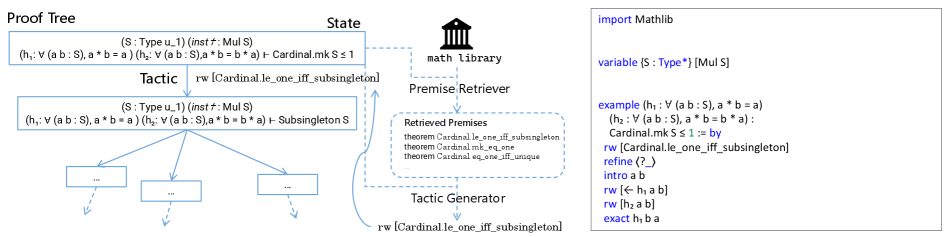
The image depicts a diagram illustrating a proof tree and state transition process, likely within a formal verification or automated theorem proving context. It shows the flow from a proof tree to a state, involving tactic application, premise retrieval from a math library, and tactic generation. A code snippet on the right provides a concrete example.
### Components/Axes
* **Proof Tree:** Located on the left side of the diagram. It represents the hierarchical structure of the proof.
* Node 1: (S: Type u\_1) (inst +: Mul S) (h₁: ∀ (a b: S), a\*b=a) (h₂: ∀ (a b: S), a\*b=b\*a)
* Node 2: (S: Type u\_1) (inst +: Mul S) (h₁: ∀ (a b: S), a\*b=a) (h₂: ∀ (a b: S), a\*b=b\*a)
* **State:** Located on the top-right side of the diagram. It represents the current state of the proof.
* Node: (S: Type u\_1) (inst +: Mul S) (h₁: ∀ (a b: S), a\*b=a) (h₂: ∀ (a b: S), a\*b=b\*a) |- Cardinal.mk S ≤ 1
* **Tactic:** Labels the action applied to the proof tree.
* `rw [Cardinal.le_one_iff_subsingleton]`
* **Math Library:** Represented by a building icon, located in the upper-right quadrant.
* **Premise Retriever:** A process that retrieves relevant premises from the math library.
* **Retrieved Premises:** A list of theorems retrieved from the math library.
* theorem `Cardinal.le_one_iff_subsingleton`
* theorem `Cardinal.mk_eq_one`
* theorem `Cardinal.eq_one_iff_unique`
* **Tactic Generator:** A process that generates tactics based on the retrieved premises.
* **Code Snippet:** Located on the right side of the diagram. It provides a code example.
* `import Mathlib`
* `variable {S: Type*} [Mul S]`
* `example (h₁: ∀ (a b: S), a * b = a) (h₂: ∀ (a b: S), a * b = b * a): Cardinal.mk S ≤ 1 := by`
* `rw [Cardinal.le_one_iff_subsingleton]`
* `refine (?_)`
* `intro a b`
* `rw [← h₁ a b]`
* `rw [h₂ a b]`
* `exact h₁ b a`
### Detailed Analysis
* The proof tree starts with an initial state and branches out as tactics are applied.
* The tactic `rw [Cardinal.le_one_iff_subsingleton]` is applied to the initial state in the proof tree.
* The state transitions from the initial state to a state where `Cardinal.mk S ≤ 1` needs to be proven.
* The premise retriever retrieves relevant theorems from the math library.
* The tactic generator generates tactics based on the retrieved premises.
* The code snippet provides a concrete example of how the tactic `Cardinal.le_one_iff_subsingleton` is used in a proof.
### Key Observations
* The diagram illustrates the process of automated theorem proving, where tactics are applied to a proof tree to reach a desired state.
* The math library provides a source of relevant theorems that can be used to generate tactics.
* The code snippet provides a concrete example of how the process works in practice.
### Interpretation
The diagram demonstrates a simplified model of automated theorem proving. The proof tree represents the exploration of different proof paths, guided by tactics. The state represents the current goal or assertion to be proven. The math library and premise retriever provide the necessary knowledge to guide the proof search. The code snippet provides a practical example, showing how these components interact in a real-world scenario. The diagram highlights the interplay between symbolic reasoning (proof tree), knowledge retrieval (math library), and tactic application in the context of formal verification.